Hoa Lo, Hanoi · Museum
Hoa Lo Prison
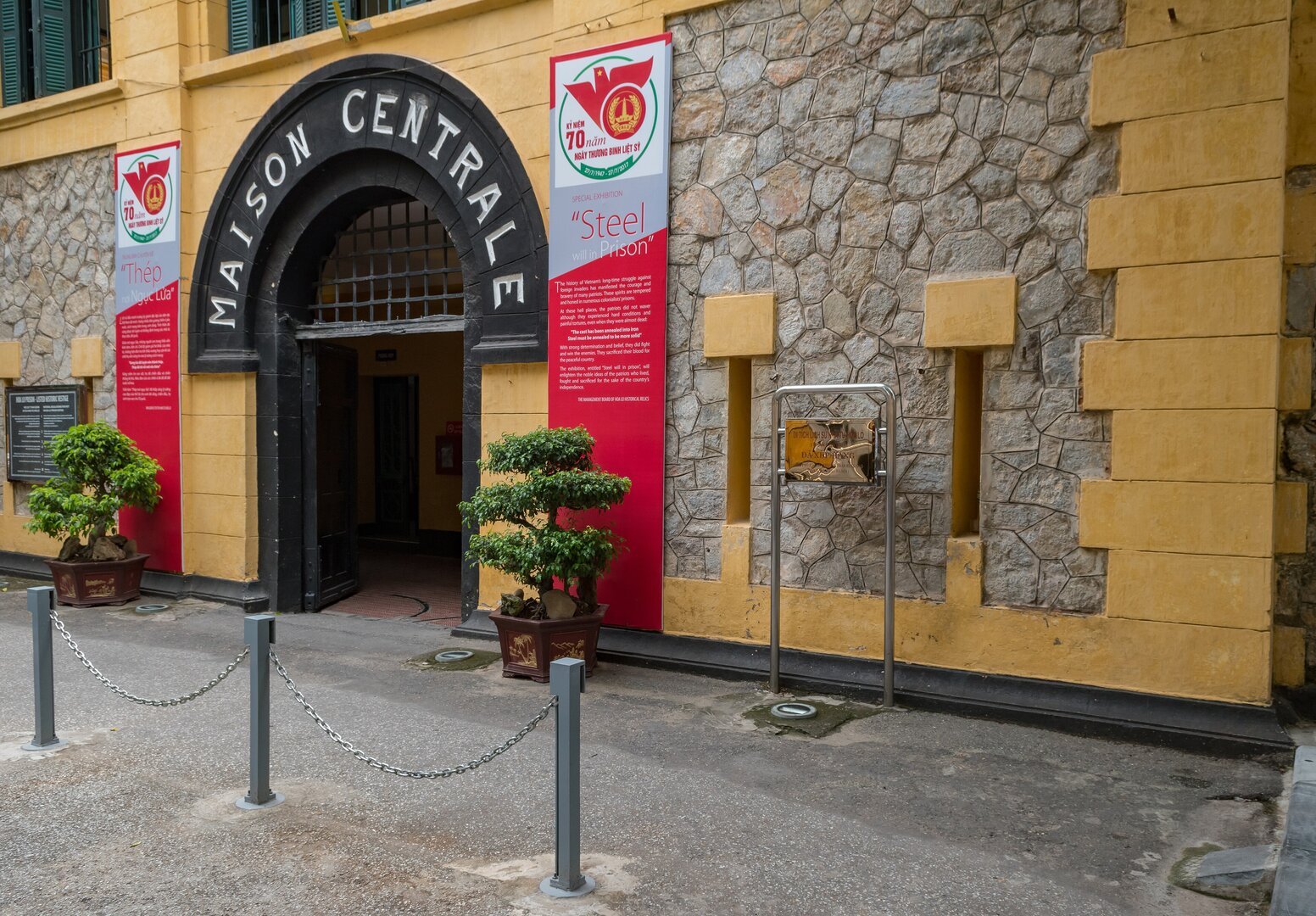
Picture a gate on a Hanoi street still bearing the words Maison Centrale, two tall towers right beside it, and the nickname American POWs gave this place: the "Hanoi Hilton".
That gate stands on Hỏa Lò Street, and the French words above it mean "Central Prison". The "Hanoi Hilton" was never a hotel. It was the mocking nickname that American pilots held here between 1964 and 1973 gave the prison. The pilot Bob Shumaker says he was the first to write the name down, in 1965. It later became the title of a 1987 Hollywood film, The Hanoi Hilton.
Hỏa Lò: The Part of a Prison Kept for Remembering
Local people called the place by an older name. This land was once Phụ Khánh village, which made kettles, pots and stoves from fired clay; its kilns burned day and night, so the village's everyday Vietnamese (Nôm) name was Hỏa Lò. The French colonial authorities began building the prison in 1896, moved the whole village away, and people called the prison after the village rather than by its official name. Before it was even finished it was already taking prisoners, from 1899, and at one point it held nearly 2,000 people. After 1954 it became Hanoi's detention centre, and kept doing that job until 1993. Today it holds no one: the site is open to visitors during the day, sells admission tickets, and has an audio guide and on-site guides in Vietnamese and English.
In 1993 roughly four-fifths of the land was converted to build Hanoi Towers, one building of serviced apartments and one of offices. Roughly one-fifth, at the southeast corner along Hỏa Lò Street, was kept and restored as a memorial site, and ranked a National Historic Site in 1997. What you walk through today is the part of the memory that was chosen to stay: the men's prison, the dungeon (cachot) that the site calls "the hell of hell", the cells for women with small children, four death-row cells, and two sewer openings from two prison escapes. And one very small object: a pen that political prisoners made themselves, its barrel a dry branch of the bàng (Indian almond) tree, its nib a coral-vine bud, its ink methylene blue asked for at the infirmary. Are you curious what people learned, and what they learned with, in a place where even bowls and chopsticks were banned? From around late 1931 to early 1932, communist prisoners set up a Party cell (chi bộ, the Party's smallest unit), put out a handwritten newspaper, "Lao tù đỏ" ("Red Prison"), and studied in small classes inside their cells. The site calls this turning the prison into a school.
The site describes itself as evidence of the sacrifice and struggle of patriotic and revolutionary fighters, and as an indictment of the French colonial prison system. It still does the work of a memorial: at the Memorial, in black and red stone carved with eight golden words, "Kiên trung bất khuất - vinh quang đời đời" ("Steadfast and unyielding – eternal glory"), schools and agencies come to offer incense, report their achievements, and admit new members of the Communist Party and the Communist Youth Union. But memory here speaks with more than one voice. About the years American pilots were held here, among them John McCain and Douglas "Pete" Peterson, who later became the first US Ambassador to Vietnam, the site's exhibition says they were given the best possible living conditions, while the accounts of former American POWs describe mistreatment. The prison has also, at times, opened at night for a programme called "Đêm thiêng liêng" ("Sacred Night"), in which visitors played political prisoners and walked through cells, death-row cells and sewers. About four-fifths of the old prison has become buildings. What will you go to hear the rest of it say?
Timeline
- 1896A French colonial prison built from 1896
- 1899from 1899
- 1954After 1954 it became Hanoi's detention centre
- 1987It later became the title of a 1987 Hollywood film
- 1993and kept doing that job until 1993
- 1997ranked a National Historic Site in 1997
Photographs
14 of 14 on filedronepicr· CC BY 2.0 · source
Richard Mortel from Riyadh, Saudi Arabia· CC BY 2.0 · source
dronepicr· CC BY 2.0 · source
Zack Knowles· CC BY-SA 3.0 · source
Richard Mortel from Riyadh, Saudi Arabia· CC BY 2.0 · source
Gary Todd from Xinzheng, China· CC0 · source
xiquinhosilva· CC BY 2.0 · source
dronepicr· CC BY 2.0 · source
Gary Todd from Xinzheng, China· CC0 · source
dronepicr· CC BY 2.0 · source
flowcomm· CC BY 2.0 · source
Gary Todd from Xinzheng, China· CC0 · source
Gary Todd from Xinzheng, China· CC0 · source
Gary Todd from Xinzheng, China· CC0 · source
Enough to decide whether to go
- What it is
- A French colonial prison built from 1896; ranked a National Historic Site in 1997
- Other names
- Maison Centrale ("Central Prison"); "Hanoi Hilton", a nickname given by American POWs, not a hotel
- What remains
- About one-fifth of the old prison, at its southeast corner; the rest is now Hanoi Towers
- Don't miss
- The bàng-branch pen, the dungeon (cachot), the death-row cells, two escape sewers, the room of 1,651 names
- Visiting
- Open during the day, tickets sold; guides in Vietnamese and English (verified 11/09/2026)
- Address
- 1 Hỏa Lò Street, Cửa Nam Ward, Hanoi (a ward, phường, is the administrative unit below the city)
From someone who has been
Suits anyone who would rather understand Vietnam's 20th century through objects than through books, and anyone who knows the name "Hanoi Hilton" and wants to hear both ways of telling it. If you only have time to stop in one place, go upstairs to the room that lists the names of 1,651 patriotic and revolutionary fighters held here between 1899 and 1954. Incense and flowers go only in the memorial area; bags are left where the site designates.
Vibe
Tags
Source
Identity and location were cross-checked independently against Wikidata (Q1359941, coordinates matching the displayed point) and OpenStreetMap (way 340128580, 'Nhà tù Hỏa Lò', 1 phố Hỏa Lò, centre about 11 m from the displayed point). The address under the new ward structure (1 phố Hỏa Lò, Cửa Nam ward) comes from the heritage record of the Department of Cultural Heritage; that page gives both the old address and the new ward, and it matches the footer of the Hỏa Lò Prison Relic Management Board; read on 11 Sep 2026. The dating (construction began in 1896, and the prison had to be put into use before it was finished), the perimeter wall and four watchtowers of the original design, the raising of the wall in 1945, the 1993 conversion that kept about one fifth of the prison grounds, and the 1997 listing as a National Historic Site all come from the Department of Cultural Heritage record and an article in Tạp chí Văn hóa Nghệ thuật (15 Apr 2013), cross-checked against the Management Board's page. The dungeon area, the death-row cells, the guillotine, the bàng tree, the two underground sewer exits, the items made by prisoners, the room recording the names of 1,651 fighters and the Memorial come from the relic's own articles on hoalo.vn. The stories of the individuals (Đỗ Mười, Nguyễn Thị Quang Thái, Đỗ Nhuận, Nguyễn Thái Học) were cross-checked against Vietnamese Wikipedia. The period of American pilots held as prisoners of war and the nickname 'Hanoi Hilton' were cross-checked against English Wikipedia and the account of pilot Bob Shumaker himself, published by the Maine Military Museum in 2016. The night tour programme was cross-checked against VnExpress (2020) and VietnamPlus (15 Feb 2023). Opening hours of 8:00–17:00 every day including public holidays and Tết, the daytime ticket price of 50,000 VND per person (applied from 1 Jan 2024), the rules and the Vietnamese–English guide service come from hoalo.vn, verified on 11 Sep 2026. The basis for saying the site is open is the relic's news item about receiving visiting groups on 23 Jul 2026. The following were rejected and are not included here. The name 'Ministry of Culture, Sports and Tourism' attached to the 1997 listing decision is wrong, because that ministry was only created in 2007; the 1997 decision was issued by the Ministry of Culture and Information, even though both the relic's own page and the Department of Cultural Heritage record write the new ministry's name. The story that Shumaker 'scratched a message on a bucket handle' was rejected, because his own account says he wrote on a scrap of paper. The statement 'Mrs Nguyễn Thị Quang Thái died in prison' was rejected: she fell ill while caring for fellow prisoners and died in 1944 in a hospital. The claim that the guillotine now on display beheaded Nguyễn Thái Học or Nguyễn Đức Cảnh was also rejected, because they were executed at Yên Bái and Hải Phòng. Figures on which the sources, including the relic's own pages, contradict one another are not given: the height and material of the wall, the date the design was approved, the design capacity, the year of completion, the total number of people who escaped on Christmas night 1951, and the area in square metres of the remaining part. Only what the sources agree on is kept. The schedule, price and age limit of the night tour are also not given, because the sources disagree and no source confirms that the programme is still running in 2026.
Place data is compiled from many sources across the internet by a team of automated AI agents that collect, enrich, check, challenge, score, edit, review and verify it.

Ratings & comments
Anyone can read. Sign in to rate, comment and like.