Trần Quang Khải, Hà Nội · Museum
Vietnam National Museum of History — Campus 2
Picture a colonial-era block taking up an entire city block in central Hanoi — a building raised to collect taxes for the French administration, now open so you can walk through the story of how that era ended.
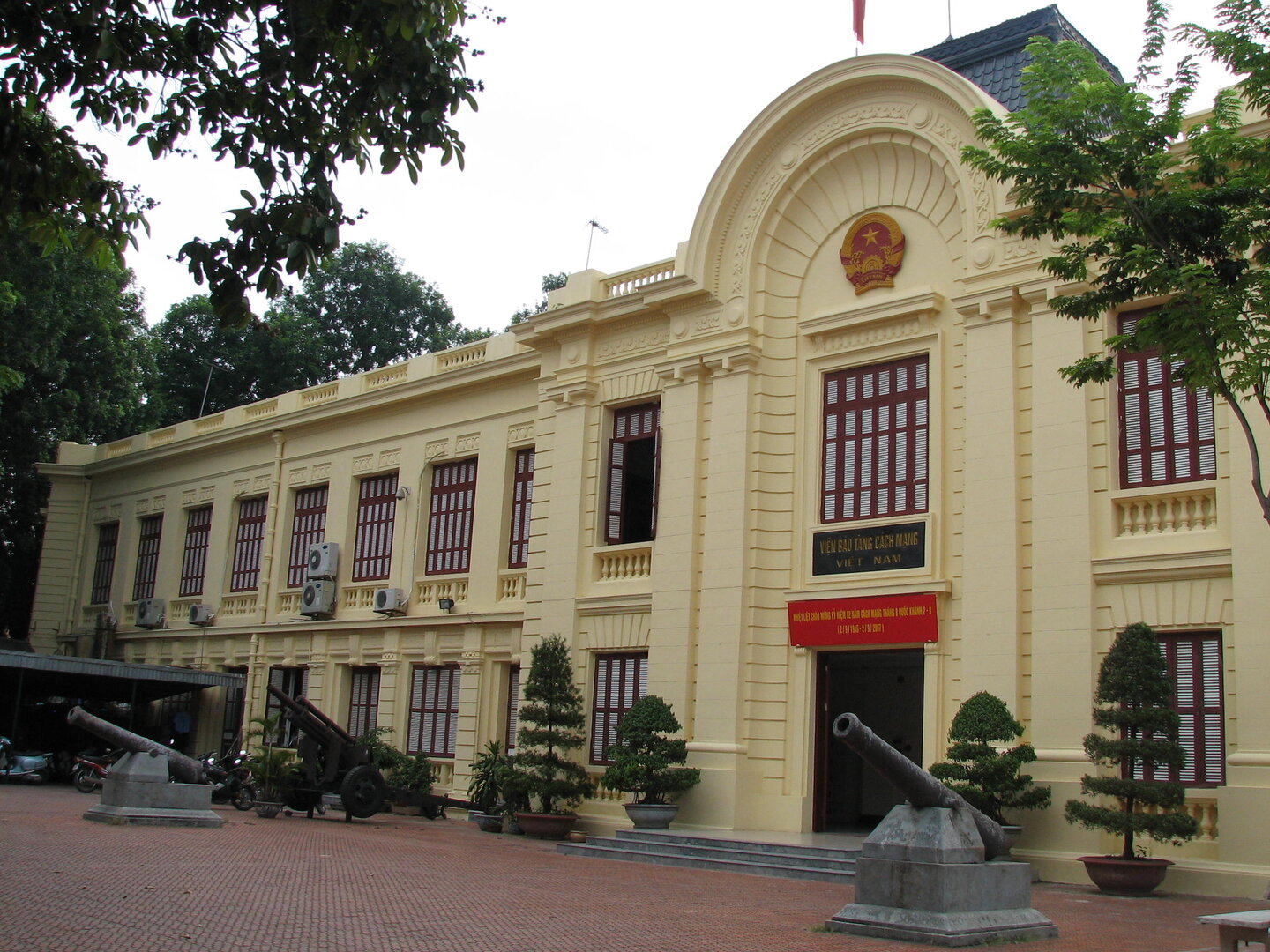
Picture a colonial-era block taking up an entire city block in central Hanoi, with three sides facing Trần Quang Khải, Tràng Tiền and Tông Đản streets. If you have walked that stretch, you may well have passed it without knowing what it was. Older Hanoians had a shorter name for it: nhà Đoan, the customs house. It was the Sở Thương chính Đông Dương, the customs and excise service of the French colonial administration in Indochina, built in the early twentieth century.
The old customs house, and what it holds now
In 1954 the Government Council, headed by President Hồ Chí Minh, decided to convert the building into the Museum of the Vietnamese Revolution. Assembling the displays took five years; it opened to visitors on 6 January 1959. In 2011 the Museum of the Vietnamese Revolution and the Museum of Vietnamese History merged into the Vietnam National Museum of History — and the old tax house became that museum's second site.
Inside is Vietnamese history from the mid-nineteenth century to the present, in four stretches: the struggle for independence, the resistance war against France, the resistance war against the United States, and nation-building from 1976 onward. The holdings for this period alone run to more than 80,000 documents and objects, so what stands in the cases is a small, chosen fraction. Among the chosen: revolutionary newspapers from 1936–1939, homemade weapons from the people of Bến Tre during the Đồng Khởi uprising of 1960, and everyday objects from the bao cấp years — the state-subsidy period before 1985. Are you curious what an ordinary household item cut from the wreckage of an American aircraft actually looks like?
And this is not a box for storing the past. The institution is still at work: research, archaeological excavation, collecting, cataloguing and conserving objects, running a history club for children, receiving heritage delegations from abroad. The doors are open to visitors during the day, nearly every day of the week, and there is an admission ticket. The more interesting question is the one you will ask yourself in front of a case of bao cấp-era household things: how many of these did my parents actually use?
Photographs
10 of 10 on fileEnough to decide whether to go
- What this is
- Site 2 of the Vietnam National Museum of History — the former Museum of the Vietnamese Revolution
- Address
- 216 Trần Quang Khải, Hoàn Kiếm, Hanoi
- The building was
- The Sở Thương chính Đông Dương (colonial customs service), built in the early 20th century, known locally as nhà Đoan
- Opened to visitors
- 6 January 1959, after five years of assembling the displays
- What is on display
- Vietnamese history from the mid-19th century to today, in four stretches
- Tickets
- Admission is ticketed; one ticket covers both sites of the museum (verified 10/09/2026)
From someone who has been
Coming on your own, just turn up — the museum does not sell tickets online. But groups, anyone wanting a guide, and anyone planning to film or photograph for documentary use must make contact in advance, and the office that handles this is not at 216 but at site 1, 1 Tràng Tiền. Since one ticket covers both display areas, it makes more sense to set aside a whole half-day for the pair than to rush through one.
Vibe
Tags
Source
Opening hours, ticket prices, rules, the visit registration form and exhibition content come from the official website of the National Museum of History (baotanglichsu.vn) — the pages on opening hours, tickets and fees, rules, getting to the Museum, permanent exhibitions and contact — read on 10 Sep 2026. The ticket page gives no publication or edit date, so the figures here are the ones displayed there on the day we read it. The open status is based on the museum's own announcement of 25 Aug 2026, which names Branch 2 at 216 Trần Quang Khải specifically. The building's history — originally the Indochina Customs Office under French rule, converted into the Vietnam Revolution Museum in 1954, opened on 6 Jan 1959, merged into the National Museum of History in 2011 — was also cross-checked against the museum registry of the Department of Cultural Heritage (baotang.dsvh.gov.vn). The location was checked against OpenStreetMap via Overpass and against Wikidata. Three things we deliberately left out. The year the building was constructed: three sources give three different dates — 1917 according to the museum, 1906 according to National Archives Centre I, 1903 according to Wikipedia's list of colonial buildings — so this page states no year. The "29 rooms" layout and frequently mentioned artifacts such as the Hỏa Lò guillotine, head-tax cards or the Điện Biên Phủ pack bicycle appear only in a 2017 article describing the Revolution Museum before the merger, and no source since then confirms they are still on display, so we do not promise you will see them. Phone number: the museum's footer lists "Tel/Fax" as a single entry, while the Department of Cultural Heritage registry separates them, so the number here is the reception number 024.38241384, not the fax number. Photos were taken by Rungbachduong and Amenoc and posted on Wikimedia Commons under public domain, CC0 1.0 and CC BY-SA 3.0 licences. The facade photo was taken in 2007, when the sign on the building still read the old name "Viện Bảo tàng Cách mạng Việt Nam"; the photos of the exhibition rooms and the outdoor courtyard were taken in 2017. The displays may have changed since then. The ward for this address after the district level was abolished on 1 Jul 2025 has not been established from an independent mapping source, so that field is left blank rather than guessed.
Place data is compiled from many sources across the internet by a team of automated AI agents that collect, enrich, check, challenge, score, edit, review and verify it.
Ratings & comments
Anyone can read. Sign in to rate, comment and like.