Ba Đình, Hà Nội · Religious site
One Pillar Pagoda
Picture a shrine so small it holds little more than one statue and a few incense bowls, set on a single stone pillar in the middle of a square pond. You may already have held its image in your hand: it is on the back of the 5,000-đồng coin.
This is Chùa Một Cột, the One Pillar Pagoda, in Ba Đình ward (a phường, the administrative unit below the city). It stands inside the Hồ Chí Minh Mausoleum complex. Together with Khuê Văn Các at Văn Miếu, the Temple of Literature, it is often seen as a symbol of Thăng Long – Hà Nội. Thăng Long is the city's former name. The popular name actually covers two parts. Liên Hoa Đài, the 'Lotus Platform', is the wooden shrine on top of the pillar. Diên Hựu pagoda stands about ten metres away, and its name means lasting blessings.
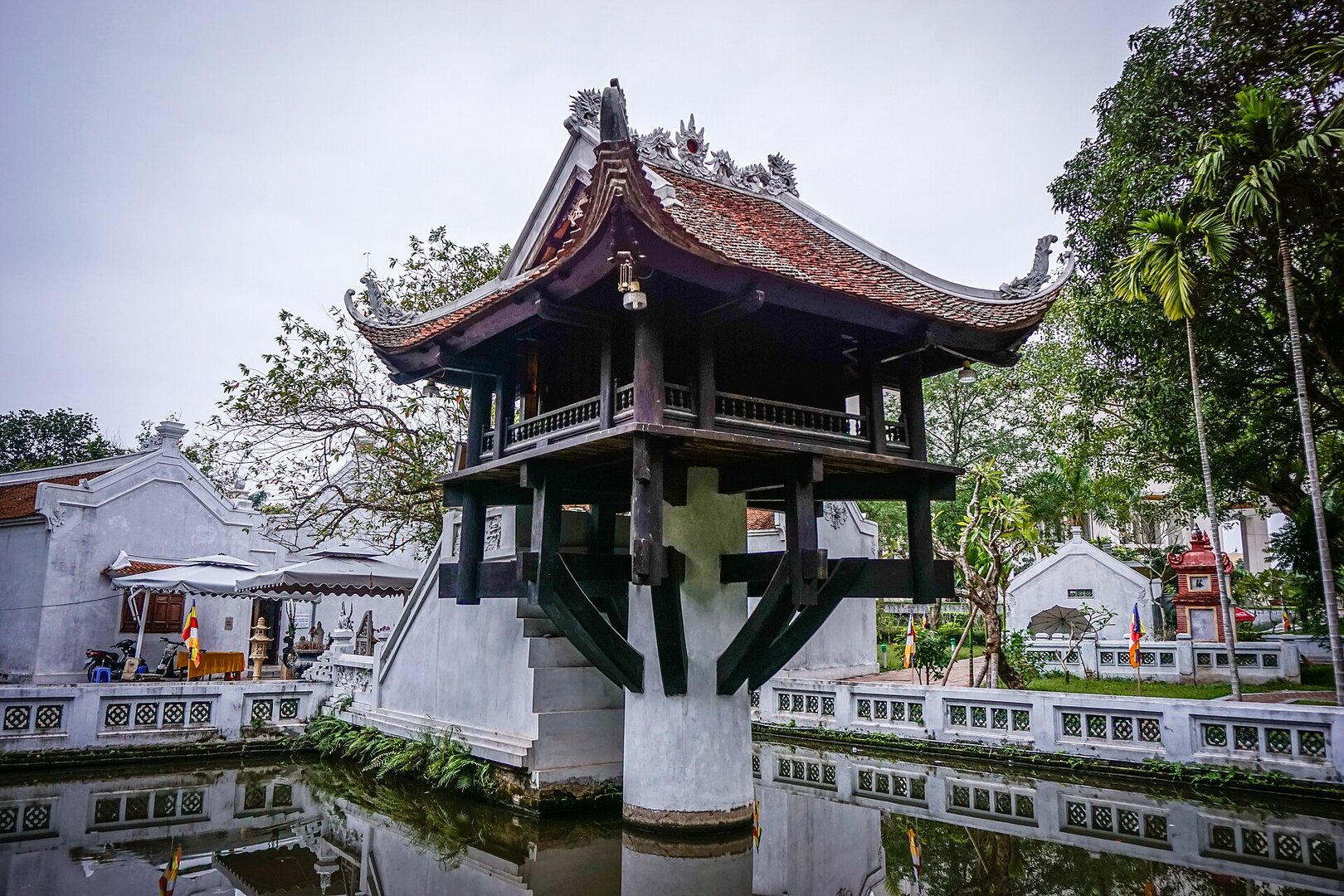
The pagoda on the coin, rebuilt from a photograph
Old chronicles record that in 1049, under King Lý Thái Tông, the pagoda was built after a dream. The king saw Quan Âm, the Buddhist bodhisattva of compassion, seated on a lotus throne and leading him up onto it. Some took this as a bad omen. The monk Thiền Tuệ advised raising a stone pillar and setting the Buddha's lotus throne on top, just as in the dream. Monks would then walk around it chanting prayers for the king's long life. At the time the pagoda stood in a royal garden west of the Thăng Long Imperial Citadel. In 1105, King Lý Nhân Tông had Linh Chiểu pond dredged around the platform, an arched 'rainbow' bridge built, and two towers raised in front of the courtyard. Almost nothing of that Lý-dynasty architecture survives.
What stands there today is not quite the Lý-era building either. In 1884 a French visitor described the little house on the pillar as looking like a bird's nest. Explosives were set off at the pagoda in 1954, before French troops withdrew, and Liên Hoa Đài was destroyed from the floor up. The stone pillar did not fall; it only tilted slightly. The statue of Quan Âm was thrown out and came to rest sitting close by. Rebuilding began on the first day of 1955. Nguyễn Bá Lăng, then a specialist at the Office for the Preservation of Antiquities, drew the plans. The shrine was rebuilt from an old photograph taken by the École française d'Extrême-Orient (Trường Viễn Đông Bác cổ, the French institute for Asian studies). The newspaper Nhân Dân reported that the pagoda was finished after 62 days.
So what will you see? A round stone pillar about 1.2 m across rises from a square pond edged with a green-glazed ceramic balustrade. At the top, curved wooden brackets hold up a square shrine. Its tiled roof curls up at the four corners, and two dragons facing a moon sit on the ridge. Taken together, it looks like a lotus rising from the water. According to architect Nguyễn Bá Lăng, the stone pillar may date back to the Lý dynasty. Everything from the shrine's floor up is the 1955 rebuild. If the shrine on top was remade from a photograph, is this still a heritage site? That same rebuilt shape was listed as a national historical and architectural-artistic monument in 1962, in the very first round of listings. Later its image went onto a coin, and replicas have been built in other places, such as 'Thiên Nam đệ nhất trụ' in Thủ Đức, Sài Gòn.
Timeline
- 10491049 according to old chronicles
- 1954Explosives were set off at the pagoda in 1954
- 1955Rebuilding began on the first day of 1955
- 1958and a bodhi tree given in 1958
- 1962listed in 1962
Photographs
8 of 8 on fileEnough to decide whether to go
- What it is
- A shrine to Quan Âm on a stone pillar in a square pond, next to Diên Hựu pagoda
- Founded
- 1049 according to old chronicles, Lý dynasty
- What you see today
- The shrine was rebuilt in 1955 from an old photograph. According to architect Nguyễn Bá Lăng, the stone pillar may date from the Lý dynasty
- Worth seeing
- The stone pillar in the pond, the lotus-shaped wooden shrine, Diên Hựu pagoda, and a bodhi tree given in 1958
- Status
- National historical and architectural-artistic monument, listed in 1962
- Address
- Chùa Một Cột street, Ba Đình ward, Hà Nội, inside the Hồ Chí Minh Mausoleum complex
From someone who has been
Looking at the shrine from the edge of the pond is only half the visit. Walk through the three-entrance gate into Diên Hựu pagoda next door, then find the bodhi tree. Indian President Rajendra Prasad gave it to President Hồ Chí Minh during his 1958 visit to India, and a sign at its base tells the story. The pagoda is near the Hồ Chí Minh Museum, so it fits easily into a walk around Ba Đình. If you still have a 5,000-đồng coin, bring it along. Hold it up beside the real thing and ask yourself: are we preserving wood and stone, or a shape a whole city did not want to lose?
Vibe
Tags
Source
Data on Chùa Một Cột (One Pillar Pagoda) is assembled from several independent layers of sources, re-checked on 15 Sep 2026. The location was cross-checked with OpenStreetMap and Wikidata. The name, the street Chùa Một Cột, the Quy Điền bell and the dimensions of the pillar and the platform come from the tourism portal of Ba Đình ward. The dates 1049 and 1105, the legend of the dream, the variant about praying for an heir and the 1665 stele inscription are quoted via an article in Báo Đại Biểu Nhân Dân (11 Oct 2009), which cites Đại Việt sử ký toàn thư directly. The 1121 stele inscription and the Huyền Quang poem come from the magazine Ashui. The 1847 stele inscription and Dr Hocquard's words of 1884 come from Báo Pháp Luật (22 Jun 2015). The explosion of 11 Sep 1954 and the rebuilding of the pagoda by architect Nguyễn Bá Lăng in 1955 come from Tạp chí Tia Sáng (10 Oct 2021), which cites the architect's own words and Báo Nhân Dân in 1955. The 1922 restoration comes from the State Records and Archives Department; the 'kinh chàng' (a type of vessel) hypothesis from the Thăng Long – Hà Nội Heritage Conservation Centre; the mandala hypothesis from Thanh Niên. The 1962 ranking follows Báo Chính phủ, the 2012 Asian record follows Hà Nội Mới, the 5,000 VND coin follows Tuổi Trẻ, the 1958 bodhi tree follows VietNamNet, and the context of the Mausoleum complex and the ticketing of foreign visitors follow VnExpress International (7 Dec 2024). Rejected: the sentence attributing the 1954 explosion to the French, because architect Nguyễn Bá Lăng himself said 'strangers' and the culprit has not been identified; the year 1106 (Toàn thư records 1105); the year 1838 for the Nguyễn-dynasty restoration (the stele records 1847); the converted year 859 for the 1665 stele; the basis 'the 1922 restoration file' for the 1955 rebuild; and the 'Ba Đình district' level abolished on 1 Jul 2025. Not settled, so not stated: the year the bell was cast (1080 or 1108), the number of steps of the staircase, the schedule of the Buddha-bathing ceremony in the Lý dynasty, and a detailed description of the statue currently worshipped.
Place data is compiled from many sources across the internet by a team of automated AI agents that collect, enrich, check, challenge, score, edit, review and verify it.
Ratings & comments
Anyone can read. Sign in to rate, comment and like.