Phường Ba Đình · Attraction
Imperial Citadel of Thang Long
Picture a patch of ground in the middle of Hà Nội, hemmed in by four streets, with a single straight line running through it.
Picture a patch of ground in the middle of Hà Nội, hemmed in by four streets, with a single straight line running through it. The old name for that line is trục thần đạo, the spirit path — the site's central north–south axis. Running south to north it strings together the Cột cờ Hà Nội (the Flag Tower), Đoan Môn (the south gate), the platform of Kính Thiên palace, Hậu Lâu, and Bắc Môn (the north gate). What stops people short, though, is a flat-roofed building put up in 1967, during the American bombing of Hà Nội: D67 sits on exactly the same line.
The Fifteenth Century and the Twentieth, a Few Dozen Metres Apart
You have met this place before, even if you don't recall it. Chiếu dời đô, Lý Công Uẩn's Edict on Moving the Capital — a text Vietnamese students read in grade 8 literature class — argues for a piece of land "at the centre of heaven and earth", and that land is this one. In 1428, Lê Thái Tổ raised Kính Thiên palace here, on top of foundations left by the Lý and Trần dynasties. Late in the nineteenth century the French demolished the palace's timber architecture. So there is no palace to look at today. There is something else.
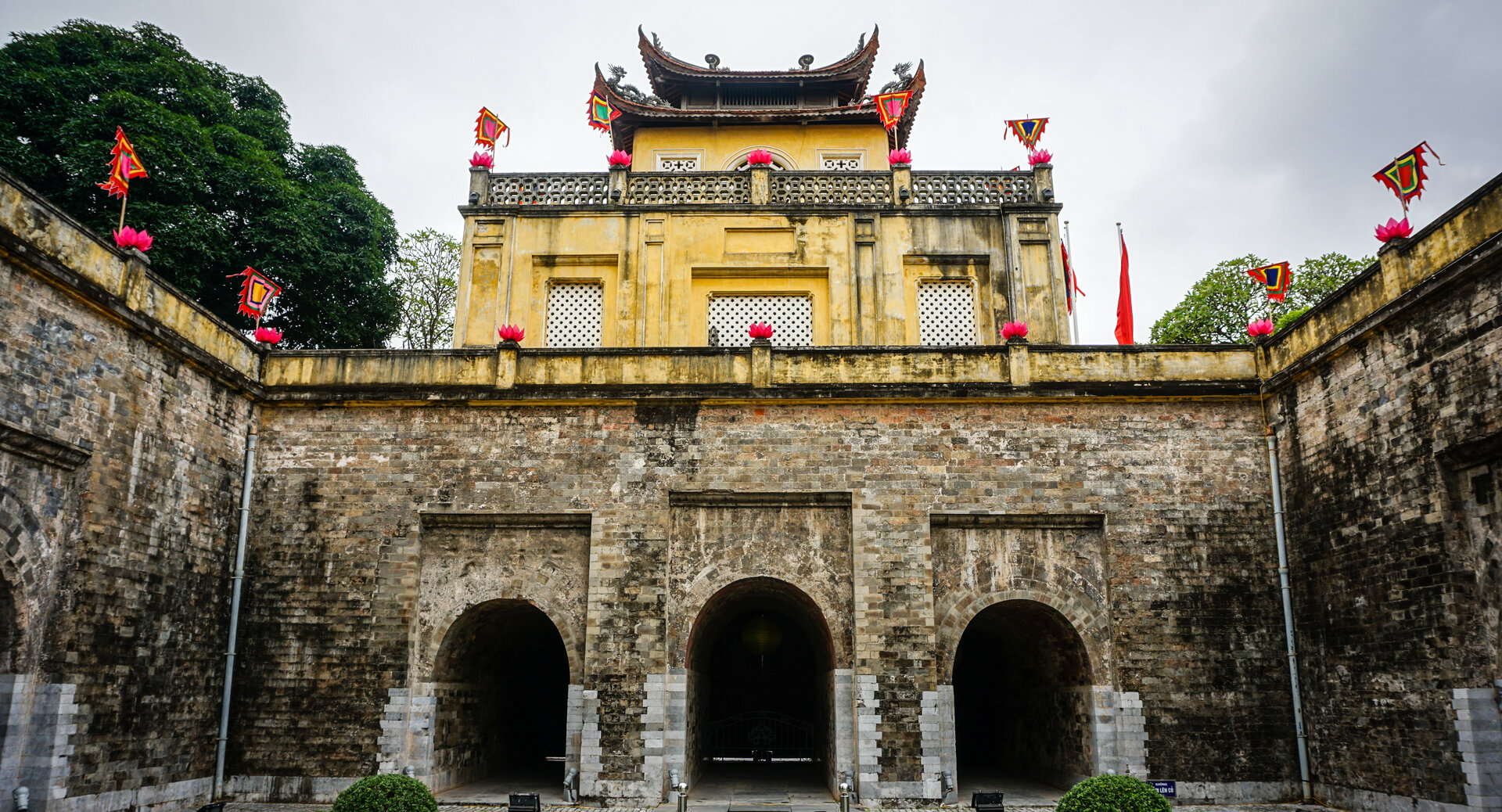
At Đoan Môn — the southern gate into the Cấm thành, the innermost royal enclosure, with five arched passages, the largest in the middle once reserved for the king — look down before you look up. Set into the floor of the gate is an excavation pit opened in 1999: at 1.2 metres, a brick floor from the Lê dynasty; at 1.9 metres, an intact brick-paved road from the Trần dynasty, still carrying its hoa chanh, or lime-blossom, pattern. You are standing less than two metres from that roadway — two metres straight down. Further north stands the stone dragon stair carved in 1467: heads raised, eyes round and protruding, bodies coiling through several curves. The two-storey building the French put up in 1886 directly on the palace platform was carefully dismantled in 2025; archaeologists have found 30 of the palace's 36 column footings. The largest is 81 layers of rammed earth stacked on one another, about four metres deep — to hold up a single column.
At the northern end, Bắc Môn, built in 1805, still carries two cannon scars from French gunboats firing off the Red River in 1882, gouges roughly 20 centimetres deep. The watchtower above the gate honours two governors of Hà Nội, Nguyễn Tri Phương and Hoàng Diệu, both of whom took their own lives when the citadel fell; people still come to burn incense there. A few dozen metres away, behind D67's 0.6-metre walls and double steel-clad doors, are General Võ Nguyên Giáp's working room and the meeting room of the Politburo. And at the 18 Hoàng Diệu archaeological zone, thirteen centuries lie stacked in place — from the Đại La citadel of the 7th to 9th centuries up to the nineteenth-century Hà Nội citadel — with roof tiles bearing five-clawed dragons, a motif reserved for emperors, and ceramics imported from Central Asia, China and Japan: the traces of a capital that traded, not merely a fortress. If one patch of ground was used and reused for thirteen centuries for the same purpose, is the heritage here a few old bricks, or the habit that never stopped? Standing on the central axis, between a Lê king's palace platform and a meeting room from 1967, that question gets much easier to answer.
Timeline
- 1428Kính Thiên palace 1428
- 1467The stone dragon stair carved in 1467
- 1805Bắc Môn 1805
- 1812Flag Tower completed 1812
- 1821Hậu Lâu 1821
- 1967D67 in 1967
- 2010inscribed as a UNESCO World Heritage Site in 2010
Photographs
10 of 10 on filekatiebordner· CC BY 2.0 · source
Ahia· CC BY 2.0 · source
Christophe95· CC BY-SA 4.0 · source
ChieuTimViet· CC BY 3.0 · source
Christophe95· CC BY-SA 4.0 · source
Isabell Schulz· CC BY-SA 2.0 · source
Zack Knowles· CC BY-SA 3.0 · source
Jakub Hałun· CC BY 4.0 · source
Isabell Schulz· CC BY-SA 2.0 · source
CEphoto, Uwe Aranas· CC BY-SA 3.0 · source
Enough to decide whether to go
- What it is
- The central sector of the old Imperial Citadel of Thăng Long; inscribed as a UNESCO World Heritage Site in 2010
- Main entrance
- 19C Hoàng Diệu, Hà Nội. The site sits between four streets: Điện Biên Phủ, Nguyễn Tri Phương, Phan Đình Phùng, Hoàng Diệu
- Dates built
- Kính Thiên palace 1428; Bắc Môn 1805; Flag Tower completed 1812; Hậu Lâu 1821; D67 in 1967
- Most worth seeing
- The stone dragon stair carved in 1467; the excavation pit inside Đoan Môn; the D67 building and its bunker; the 18 Hoàng Diệu archaeological zone
- Tickets
- Ticketed, sold on site and online; the night tour is ticketed separately
- Rhythm
- Open daily during the day. The night tour runs on weekend evenings only and must be booked ahead
From someone who has been
Walk south to north along the axis and the story orders itself. The Cột cờ Hà Nội has its own entrance on Điện Biên Phủ street — you cannot walk straight across to it from Đoan Môn — and for now visitors see only the outside and the base. Around Tết, the site restages the court rituals of "Tống cựu nghinh tân" — seeing out the old year, welcoming the new — with decoration running from Đoan Môn up to Kính Thiên.
Vibe
Tags
Source
hoangthanhthanglong.vn, wikidata.org, nhandan.vn (7 Dec 2023)
Place data is compiled from many sources across the internet by a team of automated AI agents that collect, enrich, check, challenge, score, edit, review and verify it.
Ratings & comments
Anyone can read. Sign in to rate, comment and like.