Trang Tien, Hanoi · Museum
Vietnam National Museum of History
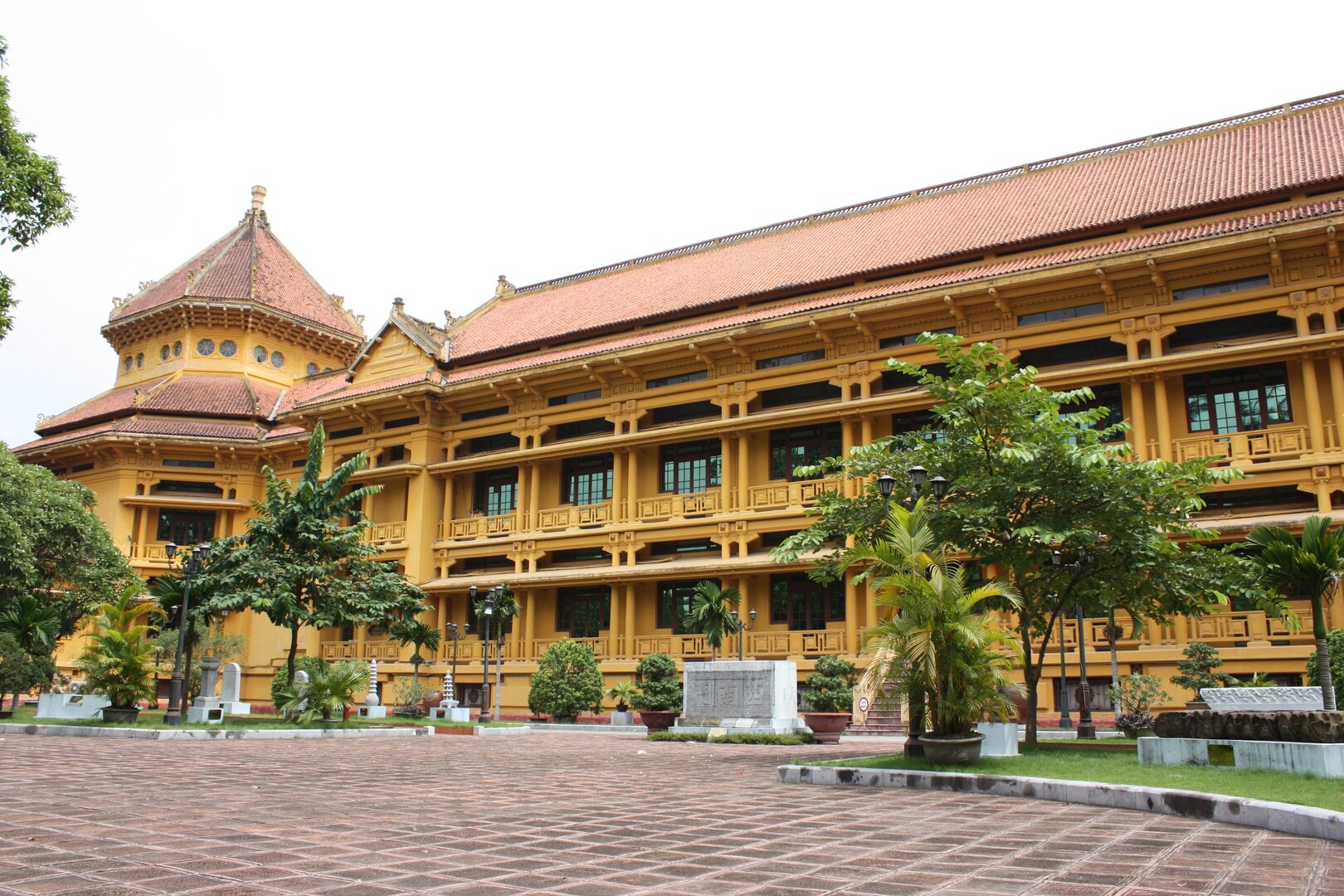
Picture yourself at the head of Tràng Tiền street, just behind the Nhà hát Lớn opera house, close to the river. Among the rooflines, one octagonal mass rises up and pulls your eye.
Picture yourself at the head of Tràng Tiền street, just behind the Nhà hát Lớn opera house, close to the river. Among the rooflines, one octagonal mass rises up and pulls your eye. Step inside and that mass turns out to be the great hall: octagonal in plan, open through the storeys. The shape was not invented by a European architect. It is borrowed from the nhà bát giác, the eight-sided pavilion long familiar in East Asian timber architecture. Here it was handed a very ordinary job: gather the crowd as it comes in, then send it out towards the galleries.
The building is an exhibit too
Work began in early 1926, on the site of the former museum of the French École française d'Extrême-Orient, the colonial research institute. An economic crisis stretched the build to six years, so the opening came only in 1932, presided over by Pierre Pasquier, Governor-General of Indochina, and the building took the name Louis Finot Museum, after its first director. The architects were Ernest Hébrard and Charles Batteur, and the result is counted among the works of the Indochinese style, the movement that tried to marry European structure to Asian form.
Are you curious where a house built to display the past stands in the story once it becomes the past itself? This site tells Vietnamese history from prehistory to the end of the Nguyễn dynasty in 1945, which means the very years its builders were at work fall inside that span. Out in the yard stand more than a hundred stone and terracotta pieces dating from the 2nd to the 20th century, among them a collection of Chăm stone sculpture and a collection running from the Lý dynasty to the Nguyễn. Indoors, the pre-1945 period alone accounts for close to 110,000 relics and antiquities, and 30 objects ranked as National Treasures.
The name it carries today dates from 2011, when the Museum of Vietnamese History and the Museum of the Revolution were merged into the Vietnam National Museum of History. It is open on almost every day of the week, and it is still doing its work: archaeological excavation, collecting, conservation, authentication, training. It heads the country's system of history and society museums. Which is to say the past here does not lie still behind glass; it is still being dug up, read again and given a place. So if an old colonial building now holds thirty National Treasures, who exactly is telling whose story?
Photographs
10 of 10 on fileAlistair Morrenger· Public domain (PD-self) · source
Daderot· CC0 · source
Gary Todd from Xinzheng, China· CC0 · source
Gary Todd from Xinzheng, China· CC0 · source
Gary Todd from Xinzheng, China· CC0 · source
Daderot· CC0 · source
Donald Trung· CC BY-SA 4.0 · source
Gary Todd from Xinzheng, China· CC0 · source
Daderot· CC0 · source
Daderot· CC0 · source
Enough to decide whether to go
- What it is
- Vietnam National Museum of History, site 1 — Vietnamese history from prehistory to the end of the Nguyễn dynasty in 1945
- The building
- Begun 1926, opened 1932; architects Ernest Hébrard and Charles Batteur
- Style
- Indochinese architecture, European and Asian combined; great hall octagonal in plan, open through the storeys
- Most worth seeing
- The open-air yard: over 100 stone and terracotta pieces, 2nd to 20th century, including Chăm stone sculpture
- National Treasures
- 30, within the prehistory-to-1945 holdings
- Entry
- Ticketed, a few tens of thousands of đồng
From someone who has been
The outdoor yard can be seen before you go inside, so come while the light holds: the museum opens by day, pauses around midday, and closes one day a week. Cameras and video cameras carry their own separate fee. Anyone who likes architecture will linger in the octagonal hall; anyone who wants the story to continue past 1945 has to cross town to the museum's second site on Trần Quang Khải.
Vibe
Tags
Source
The data on this place comes from three independent layers of sources, re-checked on 10 Sep 2026. The official website of the Vietnam National Museum of History (baotanglichsu.vn) provides the international trading name, the address, the exhibition scope of each site, the ticket schedule, the artefact figures, and the notice of 25 Nov 2025 about suspending visitors at the site at 01 Tràng Tiền from 15 Dec 2025. Dating and architecture come from an article of the Ministry of Culture, Sports and Tourism dated 16 Nov 2022 — a state source independent of the museum — including the construction start in Jan 1926, the opening in 1932, the two architects Ernest Hébrard and Charles Batteur, the Indochinese architectural style and the octagonal hall. Cửa Nam ward was checked against Resolution 1656/NQ-UBTVQH15 on the reorganisation of Hà Nội's administrative units. Photos are supplied by Wikimedia Commons, with licence and author given on each photo. Removed from this page: one address in the register that names the wrong district and uses an administrative level abolished on 1 Jul 2025; the details of the 'Keo Pagoda bell tower' and the dimensions of the octagon's sides, because all three places that mention them copy the same text; the image of the octagonal building as a 'lighthouse on the Red River', because only one essay by the museum itself mentions it. The number of National Treasures and the exhibition area still have many contradictory figures between sources, so this page states no single figure.
Place data is compiled from many sources across the internet by a team of automated AI agents that collect, enrich, check, challenge, score, edit, review and verify it.
Ratings & comments
Anyone can read. Sign in to rate, comment and like.