Bát Tràng, Hà Nội · Attraction
Bát Tràng Pottery Village
Picture yourself stepping into a line of Vietnamese folk verse you may have heard long ago — “If only I could marry you, I would buy Bát Tràng bricks to build our home” — and finding that brick still there, in the walls of a village across the Red River.
Picture yourself stepping into a line of ca dao, Vietnamese folk verse, you may have heard long ago — “Ước gì anh lấy được nàng / Để anh mua gạch Bát Tràng về xây”, roughly “If only I could marry you, I would buy Bát Tràng bricks to build our home” — and finding that brick still there, in the walls of a village across the Red River, not far from central Hà Nội. Bát Tràng is a pottery village still in production, where each household works as its own independent workshop. In the old hamlet, lanes wind between high walls, so narrow that you press against the wall when a motorbike comes through. The bricks here are fired hard, so the walls carry very little moss.
Bát Tràng Bricks: From a Folk Verse to a Village Still Making Pottery
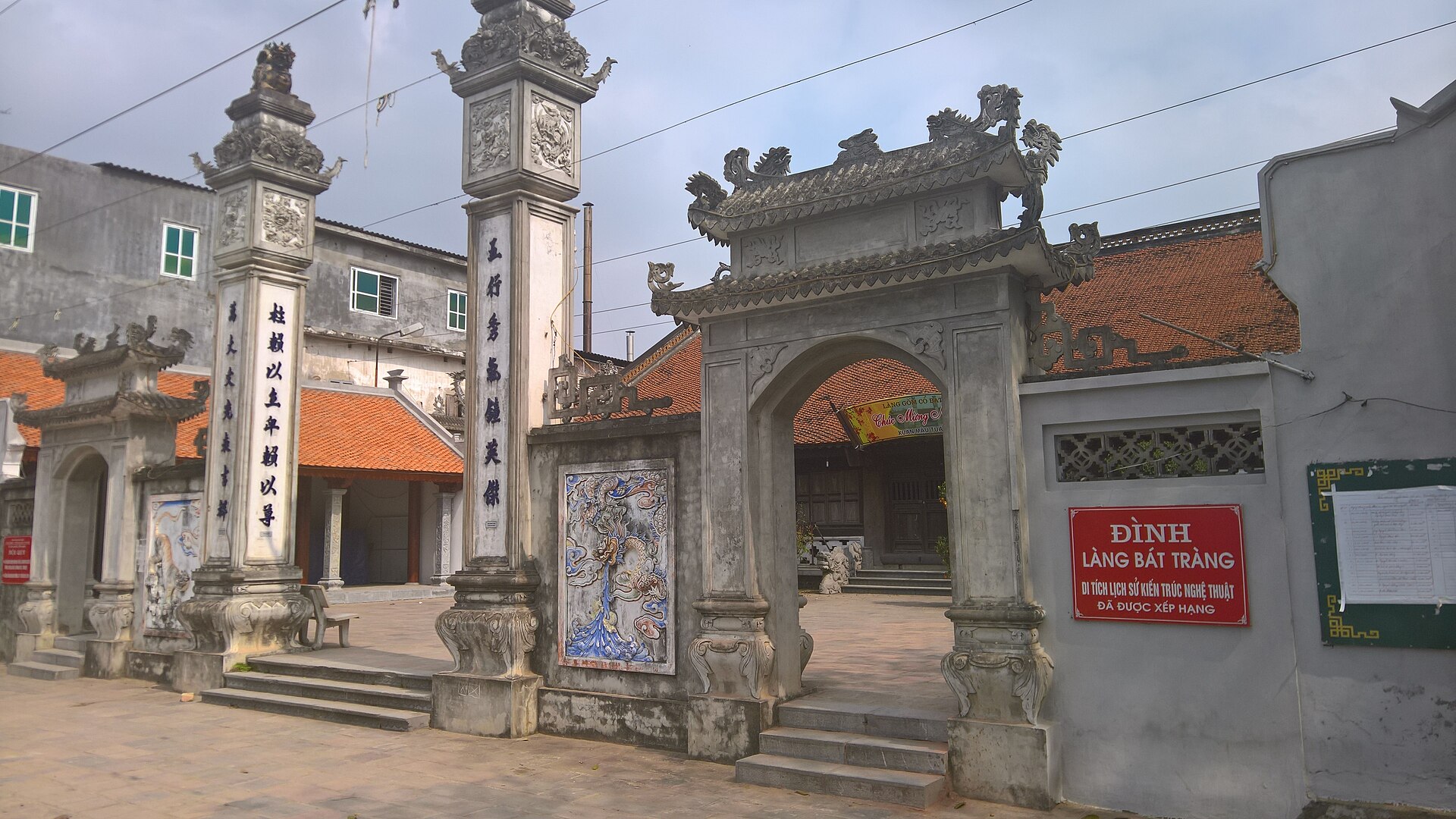
Legend has it the place was once called Bạch Thổ Phường — “the ward of white earth”. Old chronicles already mention the name of Bát commune in the 14th century, and by the 15th century Bát Tràng was a well-known pottery village: the Dư địa chí, a geography by the scholar Nguyễn Trãi, records that the village had to supply 70 sets of bowls and plates as part of the tribute sent to China’s Ming court. Bát Tràng ceramics from the 15th–16th centuries have been found as far away as Europe, the Middle East, Japan, Indonesia and the Philippines. The village đình (communal house), rebuilt in 1720, has a wide courtyard paved with Bát Tràng bricks, and its two side doors carry phrases that almost sum up the craft: “Thổ thành kim” — earth becomes gold — and “Nê tác bảo” — mud makes treasure.
Have you ever wondered where the brick in that verse came from? Villagers say it began as the protective casing stacked around pottery inside the kiln, fired again and again until it turned dense and hard, and only then was used to pave floors and build houses. Today the village fires its pottery in gas and electric kilns; wood-burning kilns belong to the past. But the past left marks: the lane walls still show black stains from the “coal cakes” once slapped onto them to dry — the coal was peeled away, the stains stayed. In hamlet 3 stands the last remaining bầu kiln, a chambered kiln named “Lò sông Hồng B”, its five vaulted chambers joined together like pieces of a seashell. It no longer fires, and is kept for visitors to see.
So what does heritage mean here today? Pottery-making has been national intangible cultural heritage since 2019; the village festival was recognised as national heritage at the end of 2024; the knowledge of preparing the traditional feast (cỗ) became national heritage in 2025. In 2025 the village received the World Crafts Council's title of World Craft Village for pottery. In hamlet 5, the Bát Tràng Pottery Centre rises as seven spiralling volumes that recall a potter’s wheel, while its interior recalls the bầu kiln — the work of architect Hoàng Thúc Hào’s team, winner of the Gold Prize at the National Architecture Awards 2022–2023. In 1994, he and his colleagues had drawn up a conservation plan for Bát Tràng titled “Give back to the earth what belongs to the earth”. As for the 17th-century Bát Tràng ceramic long đình (a miniature ceremonial pavilion), a national treasure, it is not in the village but in the Hà Nội Museum. What stays in the village is a craft that is still being practised.
Photographs
7 of 7 on fileEnough to decide whether to go
- What it is
- A working pottery village; each household is its own workshop
- Where
- Bát Tràng commune, Hà Nội — across the Red River, not far from the centre
- Earliest written trace
- Old chronicles mention Bát commune in the 14th century
- National heritage
- Pottery-making (2019) · village festival (2024) · feast-cooking knowledge (2025)
- Most worth seeing
- Old-hamlet lanes, Bát Tràng communal house, the last bầu kiln in hamlet 3, Bát Tràng Pottery Centre
- Fees
- Wander the village and pottery market freely; a few spots inside sell tickets
From someone who has been
You can wander the village and the pottery market freely; only a few spots inside sell tickets. To catch the village festival — newly recognised as national heritage — come in the second lunar month. Don’t stop at the market: walk deep into the old-hamlet lanes, look for the coal stains on the walls and the bầu kiln in hamlet 3, and decide for yourself what a craft that no longer burns wood has kept from its past.
Vibe
Tags
Source
The identity and heritage value of the pottery craft come from the Department of Cultural Heritage record: the craft saying 'Nhất xương, nhì da, thứ ba dạc lò' (first the body, second the skin, third the firing), the five ash-glaze lines, the old name Bạch Thổ Phường, Decision 4610/QĐ-BVHTTDL of 20 Dec 2019, and the fact that the village now fires with gas and electric kilns. The same record states that the knowledge of preparing feasts was inscribed in 2025. The year 2019 was cross-checked with Hà Nội Mới; the figure 'year 2023' from Nhân Dân was rejected. Historical material (the Bát – Khối dyke breach of 1352, the Dư địa chí recording 70 sets of bowls and plates as tribute to the Ming, Bát Tràng pottery found in Europe, the Middle East, Japan, Indonesia and the Philippines) comes from the National Museum of Vietnamese History and the Government Electronic Newspaper (2010). The king's name 'Trần Nhân Tông' tied to the year 1376 in the Government Newspaper article was rejected because the dating is wrong. The scene of the old hamlet, the blank stele at the văn chỉ (Confucian temple site) and the story of the high walls against robbers come from a Hà Nội Mới article (2023). The 'Sông Hồng B' gourd-shaped kiln comes from Dân Việt (2022); the pottery market and the Ceramic Center come from VnExpress (2025); the Gold Prize of the National Architecture Award of the Ceramic Center comes from Sài Gòn Giải Phóng (2023). The village festival's recognition as national heritage follows An ninh Thủ đô and Tuổi Trẻ (Mar 2025). The title 'World Craft Village for Ceramics' was awarded by the World Crafts Council (WCC), according to VietnamPlus (Feb 2025) and the WCC's own page; articles attributing this title to UNESCO were rejected. The administrative unit follows Resolution 1656/NQ-UBTVQH15; the address 'Gia Lâm district' in older articles is a level that has been abolished. The information that entering the village is free of charge appears only at VinWonders. Excluded because of contradictions or lack of an independent source: every figure for the village's age (500, 700, a thousand years), the dating of the gourd-shaped kiln, the number of royal decrees, the number of doctoral laureates, Giáp Hải's native place, and details found only on Wikipedia about the Mẫu temple, the Mạc noble house and the Dutch East India Company.
Place data is compiled from many sources across the internet by a team of automated AI agents that collect, enrich, check, challenge, score, edit, review and verify it.
Ratings & comments
Anyone can read. Sign in to rate, comment and like.