Đặc khu Phú Quý, Lâm Đồng · Landmark
Phu Quy Sovereignty Flagpole
Picture the red flag with a yellow star that every Vietnamese child learns at school, only this one measures 4 by 6 metres and flies from a 22.6-metre pole on a hilltop of an island, facing the East Sea.
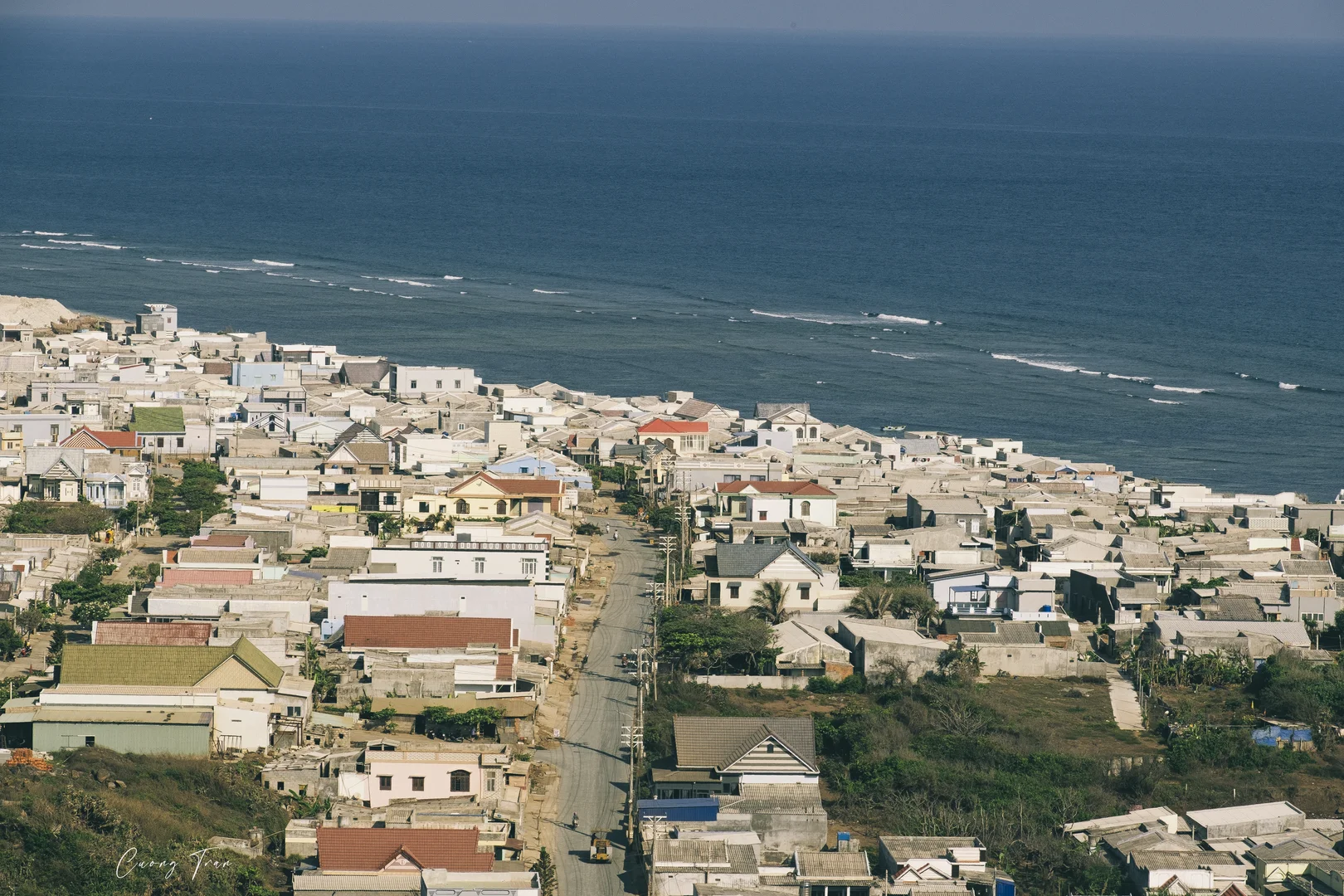
This is the National Sovereignty Flagpole on Phú Quý island, usually just called the Phú Quý Flagpole. It stands on the eastern tip of Chuối hill, in Triều Dương hamlet. Below it lies Gành Hang: black cliffs rising straight out of the sea, shaped into all kinds of forms by volcanic lava, wrapped around a crescent-shaped beach with rocky points reaching into the water.
A flag raised by the young, and kept by them
The flagpole is still very young. Construction began on 17 June 2015 and it was inaugurated on 12 August 2015, as part of the programme "Students for the Nation's Seas and Islands". It was led by the Central Committee of the Ho Chi Minh Communist Youth Union (Trung ương Đoàn) and the Central Committee of the Vietnam Students' Association, together with BIDV, and was presented as a gift from the country's youth and students to mark a Party Congress. It is one of seven flagpoles raised on seven frontline islands: đảo Trần, Bạch Long Vĩ, Hòn La, Cù Lao Xanh, Phú Quý, Côn Sơn and Thổ Chu. At the inauguration, Mr Phạm Quynh, an elderly resident of Triều Dương hamlet, said he felt honoured that the island now had a sovereignty flagpole.
At the top of the steps is a square courtyard facing the East Sea. In its centre stands a four-sided base, 5.2 metres tall and clad in white-grey granite, bearing the national flag, the national emblem, the country's official name and the geographic coordinates of the flagpole itself. Above it, the flag is sewn from durable fabric to withstand the sea wind. One thing you will not see: a reinforced-concrete foundation sunk deep beneath the rock, built the way foundations are built for lighthouses. And in the courtyard grows a tropical almond tree (cây bàng), planted after a flag ceremony in June 2023.
Have you ever wondered what gives meaning to a structure only a little over ten years old? Here, the answer is young people. Students helped build it; the island's youth union is entrusted with its grounds; many youth groups and the Coast Guard have come here to hold flag ceremonies, such as the "Tôi yêu Tổ quốc tôi" ("I love my Fatherland") ceremony held by Ho Chi Minh City youth in early 2024. Almost every visitor to the island stops by. When does a heritage begin: the day the foundation is poured, or the day the first young people come back to stand beneath the flag? Perhaps you have to stand on that hilltop, facing the sea, to answer it.
Enough to decide whether to go
- What it is
- The National Sovereignty Flagpole on Phú Quý island, one of seven on frontline islands
- Where
- Eastern tip of Chuối hill, above Gành Hang beach, Triều Dương hamlet, Phú Quý island (now part of Phú Quý Special Zone, an island-level administrative unit of Lâm Đồng province)
- Inaugurated
- 12 August 2015
- Built by
- The Ho Chi Minh Communist Youth Union Central Committee and the Vietnam Students' Association, with BIDV
- What to see
- A 4 x 6 m flag on a 22.6 m pole; a granite base bearing the national emblem and official name
- Kept by
- The island's youth union, which looks after the grounds
From someone who has been
The flagpole faces the East Sea, so it is mentioned as a place to watch the sunrise on the island. Once you are up there, don't rush back down: a visitor in 2017 described combining the climb up Chuối hill with swimming and looking at coral at Gành Hang just below.
Vibe
Tags
Source
The full name ‘Cột cờ chủ quyền Tổ quốc tại đảo Phú Quý’ (Sovereignty Flagpole of the Fatherland on Phú Quý Island) comes from Báo Bình Thuận (13 Sep 2017). The location was cross-checked against OpenStreetMap: a flagpole node carrying the Vietnamese flag, read on 26 Sep 2026. The position on the eastern spur of Đồi Chuối, above Gành Hang beach, comes from Báo Tin tức (TTXVN, 9 Aug 2019), Báo Bình Thuận (2017) and Vietnam Hội nhập (6 Nov 2023). The groundbreaking date, the inauguration date, the implementing unit, the area and the components come from Báo Nhân Dân (12 Aug 2015), matching Báo Chính phủ and Công an Nhân dân from the same period. The name of the programme ‘Sinh viên với biển đảo Tổ quốc’ (Students and the Fatherland's Seas and Islands) comes from Báo Cao Bằng, republished from Nhân Dân. The height of 22.6 m, the 4 x 6 m flag and the seven-flagpole project come from Báo Tin tức (2019). The granite-clad base, the decoration on top of the base, the steps and the square grounds come from Báo Bình Thuận (2017) and Vietnam Hội nhập (2023). The volcanic rock face at Gành Hang comes from Vietnam Hội nhập (2023). The residents' words at the inauguration come from Báo Chính phủ (2015). The bàng tree (Indian almond) and the youth union's care of the grounds come from VOV (17 Jun 2023). The flag-raising ceremonies come from Báo Tin tức (2019), Người Lao Động (1 Feb 2024) and Tiền Phong (10 Mar 2024). That visitors often stop by comes from VnExpress (29 May 2022), and the sunrise-watching from Dân Việt (14 Apr 2026). Phú Quý special zone has belonged to Lâm Đồng Province since 1 Jul 2025 according to Tuổi Trẻ (30 Jun 2025). Left out on purpose, and why. The material of the shaft is not stated, because one source says reinforced concrete and another says the pedestal is iron. The line ‘Gành Hang rocky hill, 45 m high’ from Dân Việt was dropped, because it conflicts with three other sources that all place the flagpole on Đồi Chuối. The cost is not stated, because the sources disagree (1.2 and 1.26 billion VND). The number of steps is not stated, because no source gives it; the commonly seen figure of 120 steps belongs to the lighthouse. Tickets and opening hours are not stated, because there is no source yet. Some articles once counted as cross-confirmation were in fact republications of the same original, so they were counted as one source. This page has no photo: in the open photo archive, the photos of the flagpole all keep full author rights or forbid commercial use. Last checked on 26 Sep 2026.
Place data is compiled from many sources across the internet by a team of automated AI agents that collect, enrich, check, challenge, score, edit, review and verify it.
Ratings & comments
Anyone can read. Sign in to rate, comment and like.