Đặc khu Phú Quý, Lâm Đồng · Landmark
Phu Quy Lighthouse
Picture yourself leafing back through the 1883 Treaty of Huế, a name that may ring a bell from Vietnam's history, and coming across an unfamiliar place name: Poulo-Cécir-de-Mer. That is Phú Quý Island, and the treaty allowed the French to build a lighthouse on the island.
Poulo-Cécir-de-Mer was the island's official name under the French protectorate. In folk usage it is also called Cù lao Thu or Cù lao Khoai xứ (cù lao means an island). Today, on the summit of núi Cấm, the highest of the island's three hills, a lighthouse is still at work. It does not sit behind museum glass. When darkness falls it switches itself on, then turns without stopping.
Phú Quý Lighthouse: a heritage site still on duty
According to the lighthouse keeper, in French times the island had a light in a different spot. For the present light, the managing unit records 1997 as the year it was established. The tower is square in plan, not the round column many people picture when they think of a lighthouse. It stands roughly twenty metres tall, with a lantern room and a balcony, on top of a two-storey station house painted yellow. Because the tower already sits on a hilltop, the light shines from more than 120 m above the sea: white, flashing in groups of two, sweeping the full circle.
So what does this heritage still mean today? The answer is surprisingly plain: it still does its job. The light lies 6–12 nautical miles from an international shipping lane. It marks the island's position, serves as a landfall light guiding vessels in and out of the waters off Phan Thiết, and ships far offshore can still see it. The keeper says foreign sailors call it the eye of the sea. Are you curious why a solar-powered light that switches on and turns by itself still needs people on watch? In 2021 the station had six staff. Their duty is clear: if the light goes out it must be fixed within fifteen minutes; if it cannot be, they switch on a backup light and issue a notice to mariners. The station also keeps watch over the surrounding sea. According to the keeper, on the night of 9 November 2006 a storm with gusts of force 14 blew out all the glass, knocked the lamp away and damaged the solar power system. Three people were at the station that day. Repairs took almost a month, and the lamp was replaced with a domestically made system.
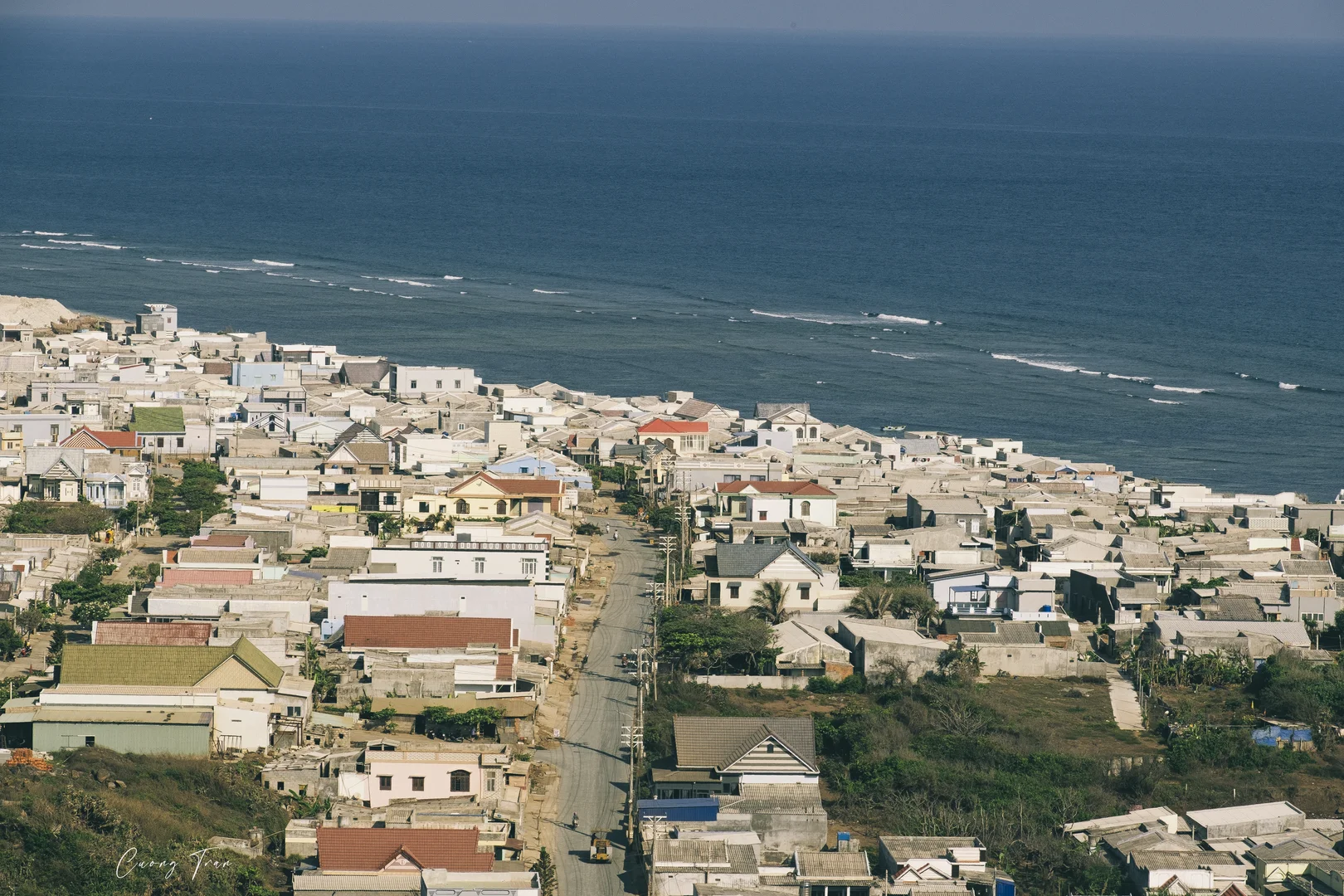
From up here you can see the whole island, a field of wind turbines with white blades, and further out the islets (hòn) of Trứng, Đen and Trào. Right beside the lighthouse stands the Hồ Chí Minh Torch, 19.5 m tall, a figure that echoes Hồ Chí Minh's birthday, 19 May. Officials, soldiers and residents of the island raised the money for it themselves, many climbing up to lend a hand on their weekends off, and it was inaugurated in 2011. The square around the torch is where islanders pay their respects to him and report their achievements on major holidays. Two structures share one hilltop: one the islanders built for themselves, the other shining for the ships passing offshore. More than a century ago, putting a light on this island was still a line of text in a treaty. Today people still stay awake so that a light on the hill does not go out. Would you like to stand at the foot of the tower just as night falls, and watch it switch itself on?
Enough to decide whether to go
- What it is
- A working, staffed lighthouse, managed by the maritime safety service
- Location
- Summit of núi Cấm, north-west corner of Phú Quý Island, Phú Quý special zone (đặc khu, an island-level administrative unit), Lâm Đồng province
- Year established
- The managing unit records 1997 as the year it was established
- The light
- White, group flashing 2, 15-second period, 360° coverage
- Getting up
- At the end of the road up to Linh Bửu pagoda (chùa Linh Bửu), then roughly one hundred and twenty stone steps on foot
- Tickets
- No entrance ticket is sold
From someone who has been
Motorbikes can ride to the foot of the hill; from there it is roughly one hundred and twenty stone steps under dense tree cover, with stone benches to rest on along the way. This is a working station rather than a visitor attraction; at times visitors are allowed up the steep steel stairs inside to the railing at the top of the tower. If you can choose, come to the island in the south-wind season, when the trees on the hill are lush. In the north-wind season boats to the island are sparse, sometimes a whole week apart, and the trees on the hill turn ragged. Best for anyone drawn to seafaring stories, or who wants to take in the whole island from one spot.
Vibe
Tags
Source
The name and location of the light come from OpenStreetMap (object 1272966038, read on 26 Sep 2026). These coordinates match those printed in a Báo Bình Thuận article from 2017. The English name comes from English Wikipedia. The University of North Carolina Lighthouse Directory (edited 16 Mar 2024) gives the position on Núi Cấm, the square shape of the tower, the two-storey station house, the yellow colour of the lantern room and station house, the focal height and the flash pattern of the light. The Vietnam Maritime Administration's table of lighthouse status gives the tower height and the focal height. The page of the Southern Vietnam Maritime Safety Corporation, read through an Internet Archive copy of 12 Jun 2024 because the original page could not be accessed on 26 Sep 2026, gives the year of establishment, 1997, and the fact that the light guides ships offshore of Phan Thiết. Báo Pháp lý (2021) records the station head's words: the story of the French-era lamp being elsewhere, the name ‘eye of the sea’, the solar-powered light, the duty at the station, the 2006 storm, the view from the tower and the two wind seasons. Báo Nhân Dân (Jun 2026) gives the climb of about 120 stone steps and the sight of visitors going up to the railing at the top of the tower. Báo Thanh Niên (27 Jun 2025) gives the island's three mountains and the founding of Phú Quý special zone from the three communes of Tam Thanh, Ngũ Phụng and Long Hải. Báo Dân tộc và Miền núi (2017, republished from Báo Bình Thuận) gives the light's place under the maritime safety sector. VnExpress's Phú Quý guide (published 29 May 2022, edited 7 May 2026) gives that no tickets are sold and that the way up is at the end of Chùa Linh Bửu road. A TTXVN (Vietnam News Agency) dispatch in Báo Quốc tế (2011) gives the Hồ Chí Minh Torch. French Wikipedia gives the 1883 Treaty of Huế (Hiệp ước Huế) and the old name Poulo-Cécir-de-Mer. Left out on purpose, and why. The line ‘one of the highest-positioned lighthouses in Vietnam’ was dropped, because according to the Vietnam Maritime Administration this light's focal height is far lower than Mũi Dinh, Vũng Tàu and Bãi Cạnh. The colour of the tower body is not stated, because sources say grey, black and yellow. The building material of the tower is not stated, because one source says stone and another says concrete. The year the station began is not stated, because sources give 1994, 1996 and 1997; this page gives only the year of establishment according to the managing unit. The exact tower height and range are not stated, because the sources disagree. The name of the keeper and the name of the current managing unit are also not stated. This page has no photo: the open photo archive has no photo of the lighthouse that meets the standard, and the only one that was ever on Wikimedia Commons was deleted on 14 Jan 2025 over suspicion of not being correctly sourced. Last checked on 26 Sep 2026.
Place data is compiled from many sources across the internet by a team of automated AI agents that collect, enrich, check, challenge, score, edit, review and verify it.
Ratings & comments
Anyone can read. Sign in to rate, comment and like.