Hoi An Ancient Town, Da Nang · Religious site
Assembly Hall of the Fujian Chinese Congregation
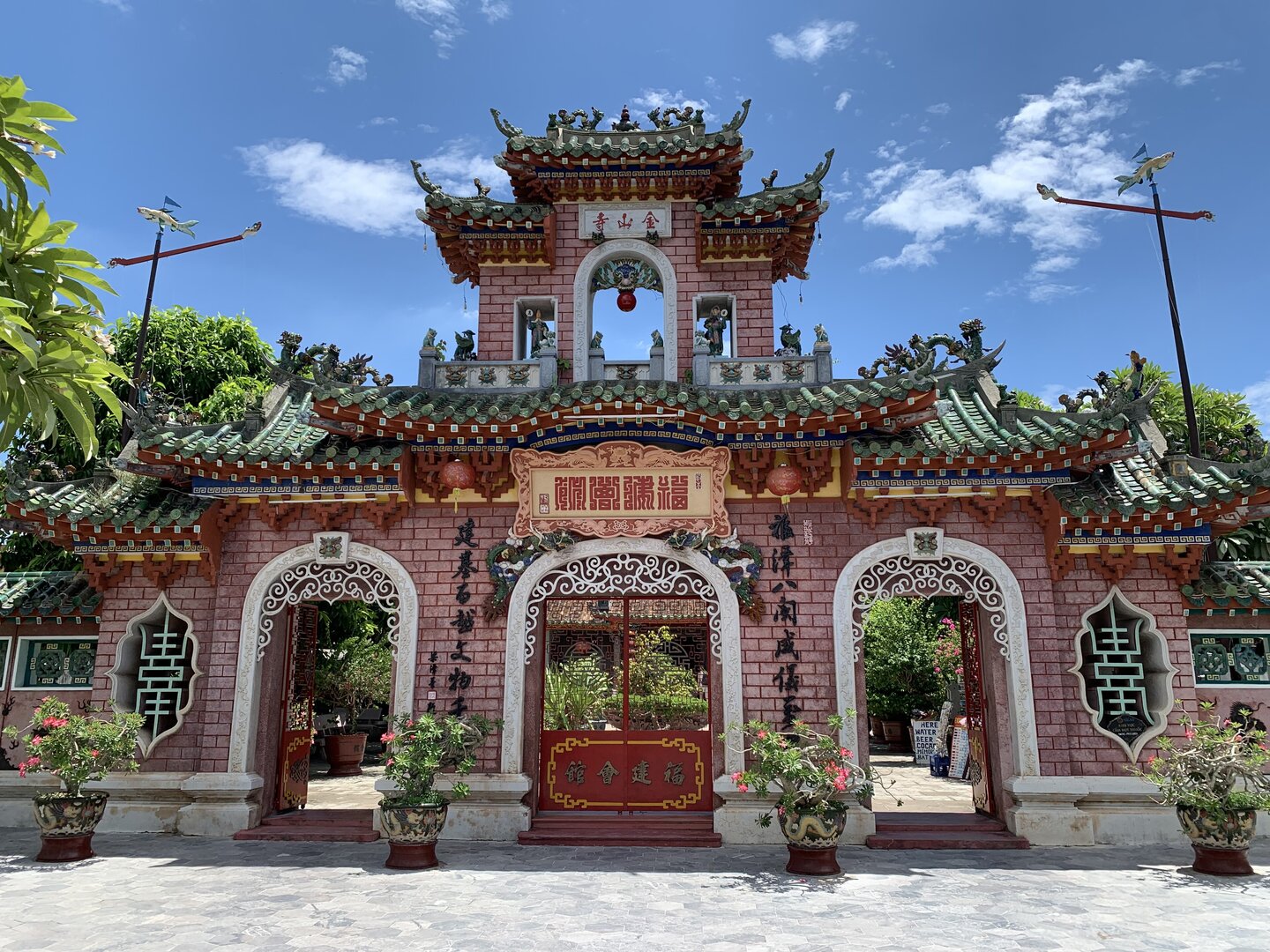
Picture yourself stopping in front of a gate roofed in green glazed tubular tiles, and high above it, between a sun god and a moon god, four stone characters naming a temple that no longer exists.
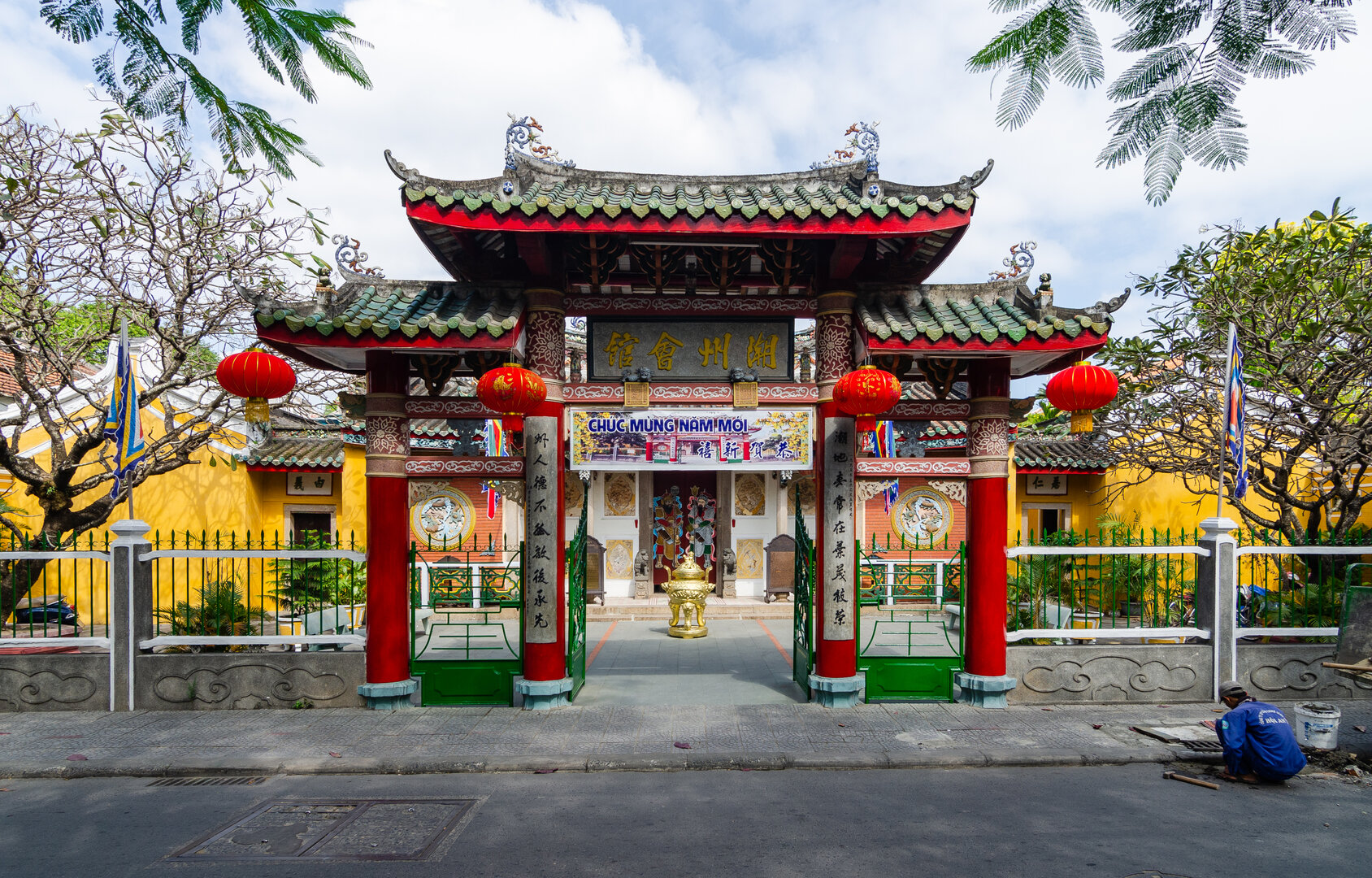
Picture yourself stopping in front of a gate roofed in green glazed tubular tiles, stylised animal figures running along seven tiers of roof, long and short. High up sits a miniature gate-tower, with statues of a sun god and a moon god on either side of four stone characters: Kim Sơn Tự. Yet this is not a temple by that name. This is the hội quán — the assembly hall — of the Phước Kiến (Fujian) Chinese community in Hội An, and the name on the gate belonged to what stood on this ground before it.
The assembly hall people still come back to
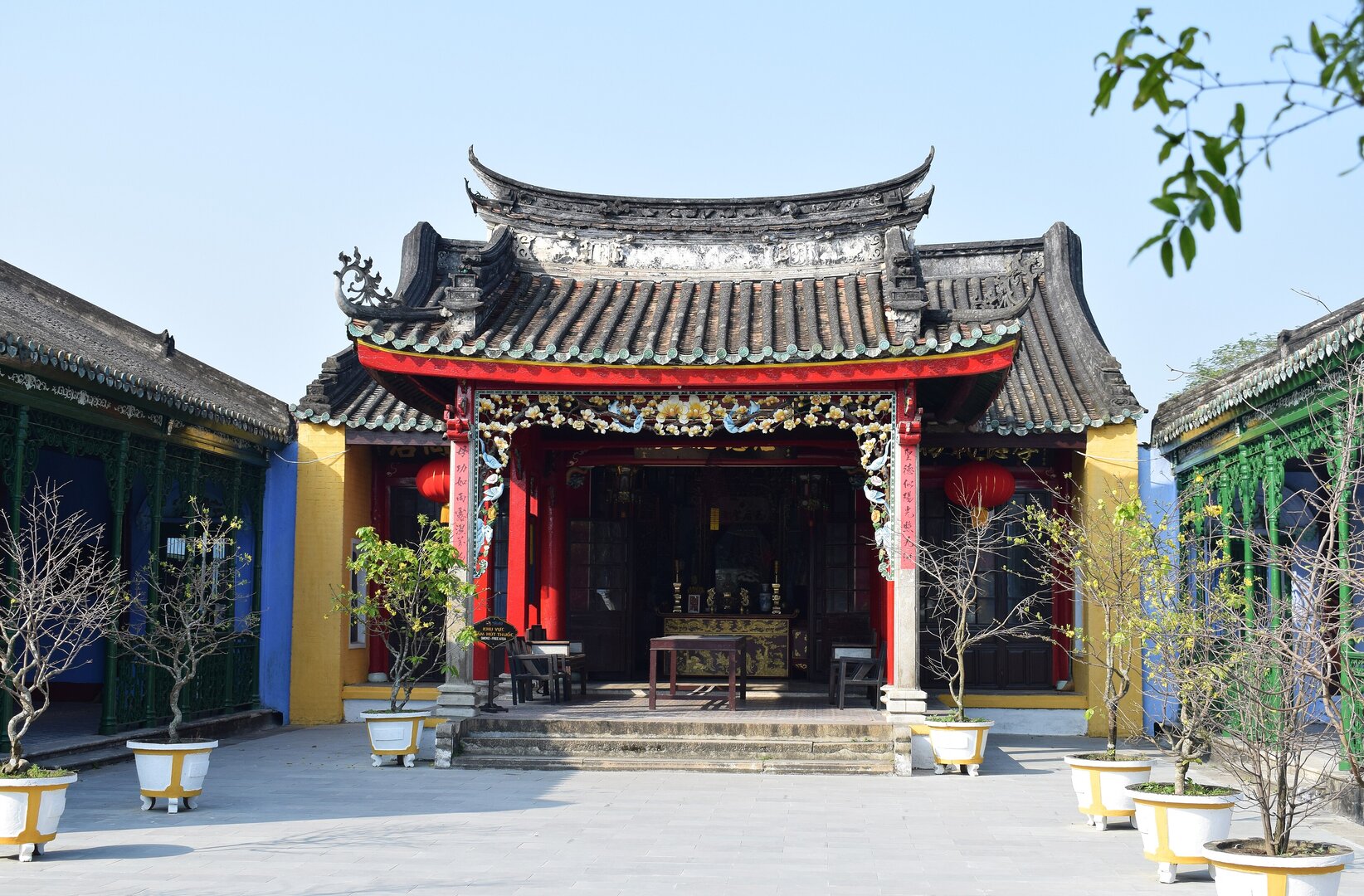
In 1697, merchants from Phước Kiến bought that old temple ground and built their meeting place on it, keeping the name Kim Sơn Tự. In 1757 the Phúc Kiến congregation carried out a major restoration, replacing thatch and bamboo with brick and tile, and renamed it Phước Kiến Hội quán. The main hall is dedicated to Thiên Hậu Thánh Mẫu, the goddess who rescues those who make their living at sea; in front of her stands an altar to the Buddha Quan Âm, and set back on either side are Thiên Lý Nhãn and Thuận Phong Nhĩ. The rear hall honours Lục Tánh — six Phước Kiến forefathers who rose against the Qing to restore the Ming and failed — along with the God of Wealth, three goddesses of conception and the twelve midwife goddesses. Are you curious what a community that lived by sea trade prayed for more than three hundred years ago? Here the god of waters, the god of money and the gods of children stand side by side in one compound: a place to pray for trade and to pray for a child.
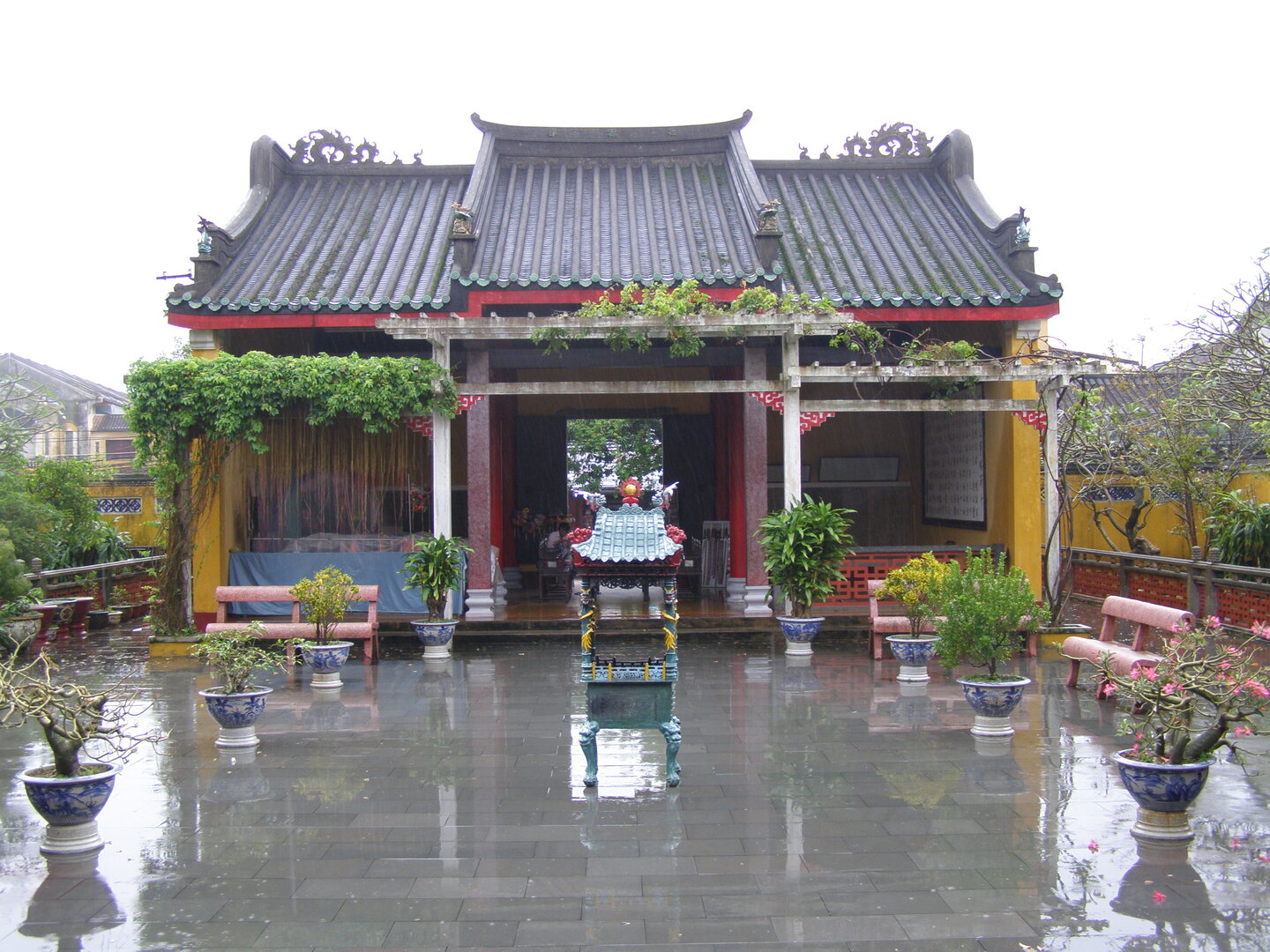
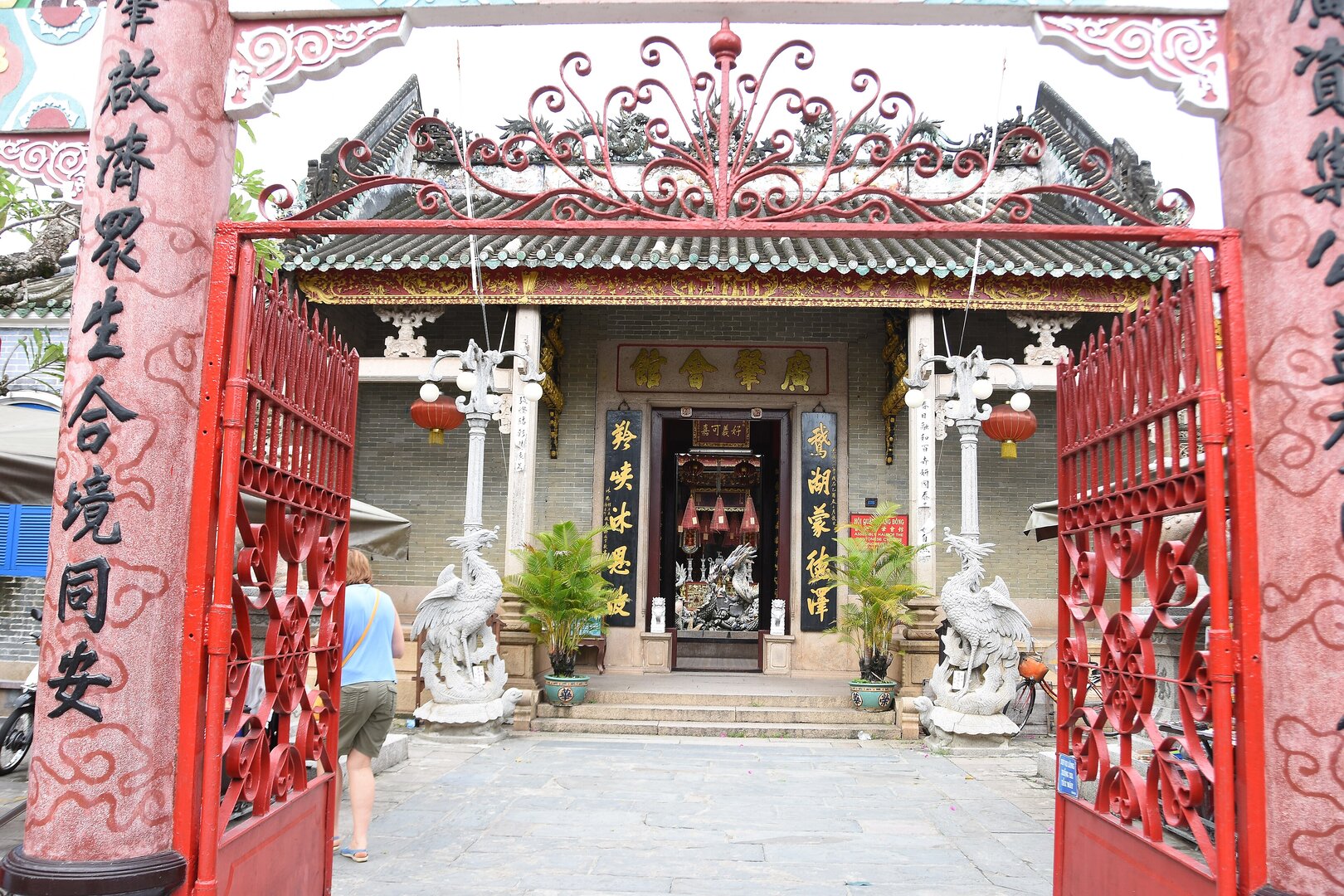
From the street to the main hall you cross three courtyards. First the outer gate, then a low courtyard with a pond shaped like an apricot blossom, five carp tilting their heads back to spout water above a sun motif; then steps up, the courtyard before the triple gate, the triple gate itself, and the inner courtyard. On the outer wall of the front hall, two relief panels tell this place's two founding stories outright: the six forefathers storming the citadel, and Thiên Hậu going to the rescue of a sinking ship. The main doors are two thick, heavy leaves of ironwood bearing four characters you will have seen on village gates and family altars: Quốc thái, dân an — a peaceful country, a settled people. To the left of the altars in the main hall stands a model trading junk about two metres long. In the courtyard before the rear hall, a huge cement dragon coils over the ornamental fish pond, its scales and details assembled from broken bowls and ground glass. Eighty-six columns rest on stone bases rather than being sunk into the ground, and the hall was built on a high foundation, so the floods of Hội An rarely reach the worship area.
More than three hundred years on, this place still does the three things it was made for: worshipping the gods, honouring the congregation's forefathers, and serving as a meeting place for people from the same homeland. A managing board runs it, caretakers keep it, worship has never lapsed; descendants of the Phước Kiến congregation working far away, including abroad, still send money home for repairs. In the middle of the second lunar month, thousands return from many provinces for the forefathers' rites: lanterns and flowers strung from the gate to the main hall the afternoon before, the ceremony with traditional Phước Kiến offerings the next morning, lion and unicorn dancing at night. The Nguyên tiêu festival of the first full moon in Hội An — one of the hall's four annual occasions — is now on the national list of intangible cultural heritage. There is an entrance fee, paid through the Old Town sightseeing ticket. So when would you rather meet this place — on a quiet day, when the three courtyards hold only you and the caretaker, or on a feast day, when they fill with the descendants of the people who built it?
Photographs
9 of 9 on fileEnough to decide whether to go
- What it is
- The assembly hall of the Phước Kiến (Fujian) community in Hội An, and a temple to Thiên Hậu Thánh Mẫu; formal name Phước Kiến Hội quán – Kim Sơn Tự
- Founded
- 1697, then named Kim Sơn Tự; major restoration and renaming in 1757
- Status
- National-level historical and cultural relic, listed in 1990
- Most worth seeing
- The seven-tiered triple gate, the two relief panels on the front hall's outer wall, the model trading junk in the main hall, the broken-porcelain dragon in the rear courtyard
- Four annual occasions
- Nguyên tiêu on the first full moon; vía Bà Mụ and vía Lục Tánh in the second month; vía Thiên Hậu in the third — all by the lunar calendar ('vía' means a deity's feast day)
- Entry
- There is a fee; the hall is among the sites you can choose with the Old Town sightseeing ticket
From someone who has been
In the evening the streets around the hall are given over to pedestrians and non-motorised vehicles, so plan to arrive on foot. If you come for the architecture, don't rush the courtyards: the two open sky-wells, the buffalo-horn ridge lines and the assembled relief work are the craft of the carpenters and masons of Kim Bồng village. If you come for the atmosphere, choose the feast days in the middle of the second lunar month, when the Phước Kiến descendants gather in the greatest numbers.
Vibe
Tags
Source
The identity, the house number 46 Trần Phú and the coordinates for this page were built from OpenStreetMap (way 320722329) and then cross-checked against Vietnamese Wikipedia and the Đà Nẵng city tourism portal — the three sources agree on the address and on the Chinese-character name 福建會館. The heritage content (built in 1697 on the site of Kim Sơn Tự pagoda, restored and renamed in 1757, the arrangement of worship, the Tam-shaped (三) layout, the two reliefs, the model merchant junk, the 11 xà cò (roof brackets), the craftsmanship of the Kim Bồng village artisans and the four festival occasions in the year) comes from the monument's dossier and feature articles of the Hội An Centre for Cultural Heritage Management and Conservation, read on 7 Sep 2026. The ticket structure and the vehicle-ban hours come from the Centre's own notice of 26 Jan 2026; the fact that the assembly hall is in the group of selectable sites on the new ticket has so far been confirmed only through the VnExpress guide updated on 16 Apr 2026, not through the official list. We have dropped three pieces of information that are widely copied: the ticket split of ‘80,000 VND for Vietnamese / 120,000 VND for international visitors’ (the operator's notice divides by number of sites visited, not by nationality), the ticket being ‘valid for 24 hours’ (in practice it is used throughout the stay, up to 3 days), and the opening hours ‘7:00–17:00’ (no operator source publishes separate hours for the assembly hall, and at least three different figures are in circulation). The founding year is still disputed — 1690, 1692, 1697 and 1792 are all in use; this page keeps 1697 following the monument dossier. The national monument ranking date is given only to the year 1990, because sources give 17 Feb 1990 while the monument dossier says the Ministry of Culture issued the certificate in Nov 1989, and the original decision number cannot be traced. Opening and closing times are left blank because no source knows them. The photos were taken by Chainwit., Christophe95 and RThiele, published on Wikimedia Commons under the CC BY 4.0 and CC BY-SA 4.0 licences; the credit for each photo is directly beneath it.
Place data is compiled from many sources across the internet by a team of automated AI agents that collect, enrich, check, challenge, score, edit, review and verify it.
Ratings & comments
Anyone can read. Sign in to rate, comment and like.