Nhuan Duc, Ho Chi Minh City · Attraction
Ben Dinh Tunnels
Picture yourself walking out of the cinema after “Địa đạo: Mặt trời trong bóng tối”, then, one morning, standing on the real ground of the Củ Chi tunnels at Bến Đình — and being invited to climb down.
Picture yourself walking out of the cinema after “Địa đạo: Mặt trời trong bóng tối” — literally “Tunnels: Sun in the Darkness” — director Bùi Thạc Chuyên's film about the Củ Chi tunnels, released in April 2025 for the 50th anniversary of the Liberation of the South. Then, one morning, you are standing on the real ground at Bến Đình, and you are invited to climb down. The director has said that before making it he had no film about the Củ Chi tunnels to look to for reference; former Củ Chi guerrillas served as advisers to the production. Half a century on, to tell it right, people still have to ask the guerrillas themselves.
Bến Đình Tunnels: a secret kept down to the last blade of grass, now lit for visitors
Bến Đình is one of the two sites of the Củ Chi Tunnels Historical Relic Site; the other is Bến Dược. From 1968 to 1975, the Huyện ủy — the district Party Committee of Củ Chi — chose it as the base from which it led and directed Củ Chi's troops and people. In wartime this was more than 100 hectares of forest on high, firm ground that rarely caved in, lying alongside the Sài Gòn River — so when the area was swept, there was a way to fall back toward the river. Have you ever wondered how people dug tunnels without leaving a single handful of earth to give them away? With hoe blades and baskets woven from bamboo. The dug-out soil was poured into flooded bomb craters, shaped into termite mounds, or spread over the fields and ploughed in. Around a tunnel mouth, even a blade of grass that was broken or smeared with earth, or a leaf torn in an unusual way, had to be put right. According to the relic site's own account, American soldiers called Củ Chi the “Underground Village” and a “Dangerous Secret Zone”; in 1967 the district of Củ Chi was awarded the title “Đất thép thành đồng” — roughly, “Land of Steel, Citadel of Bronze”.
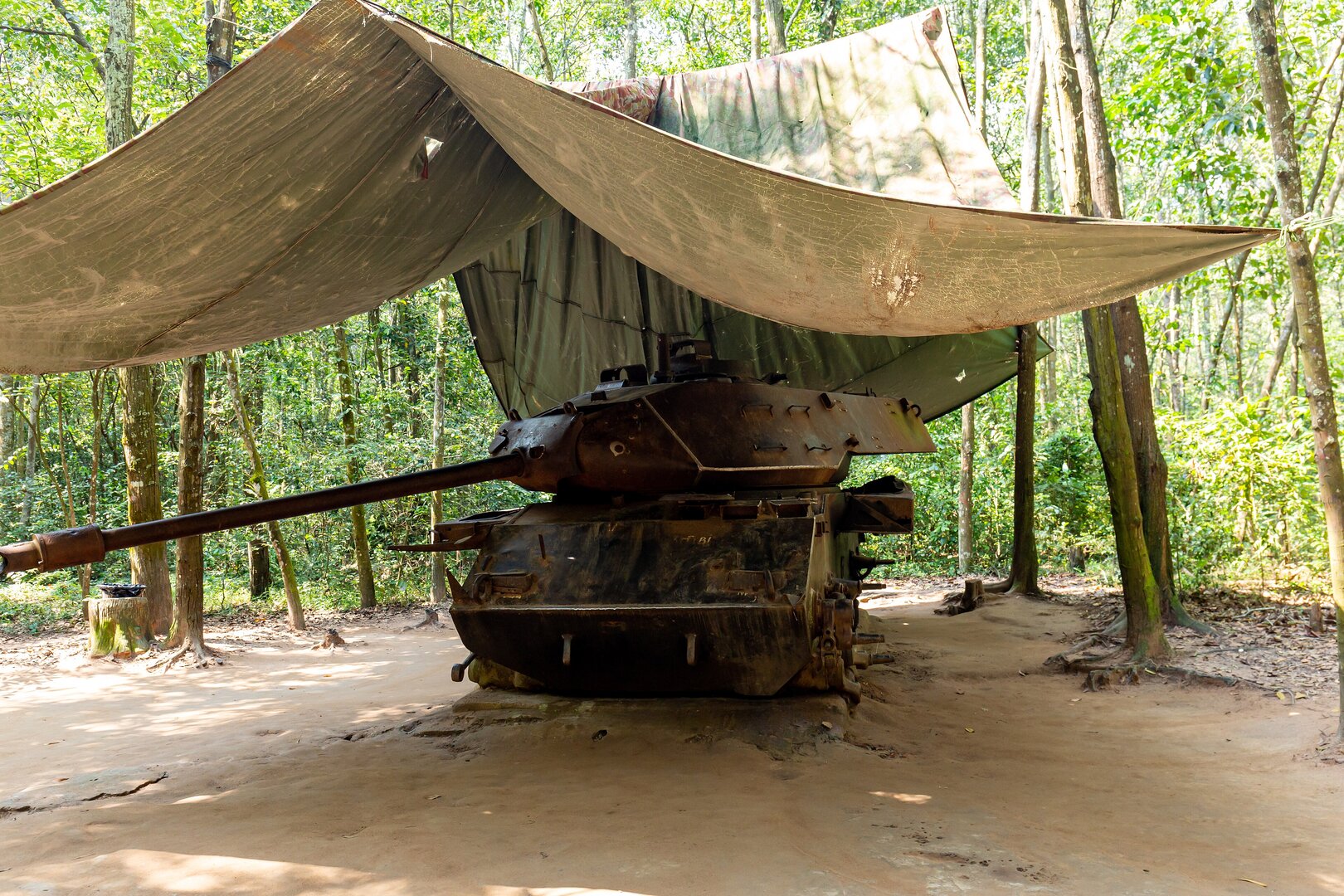
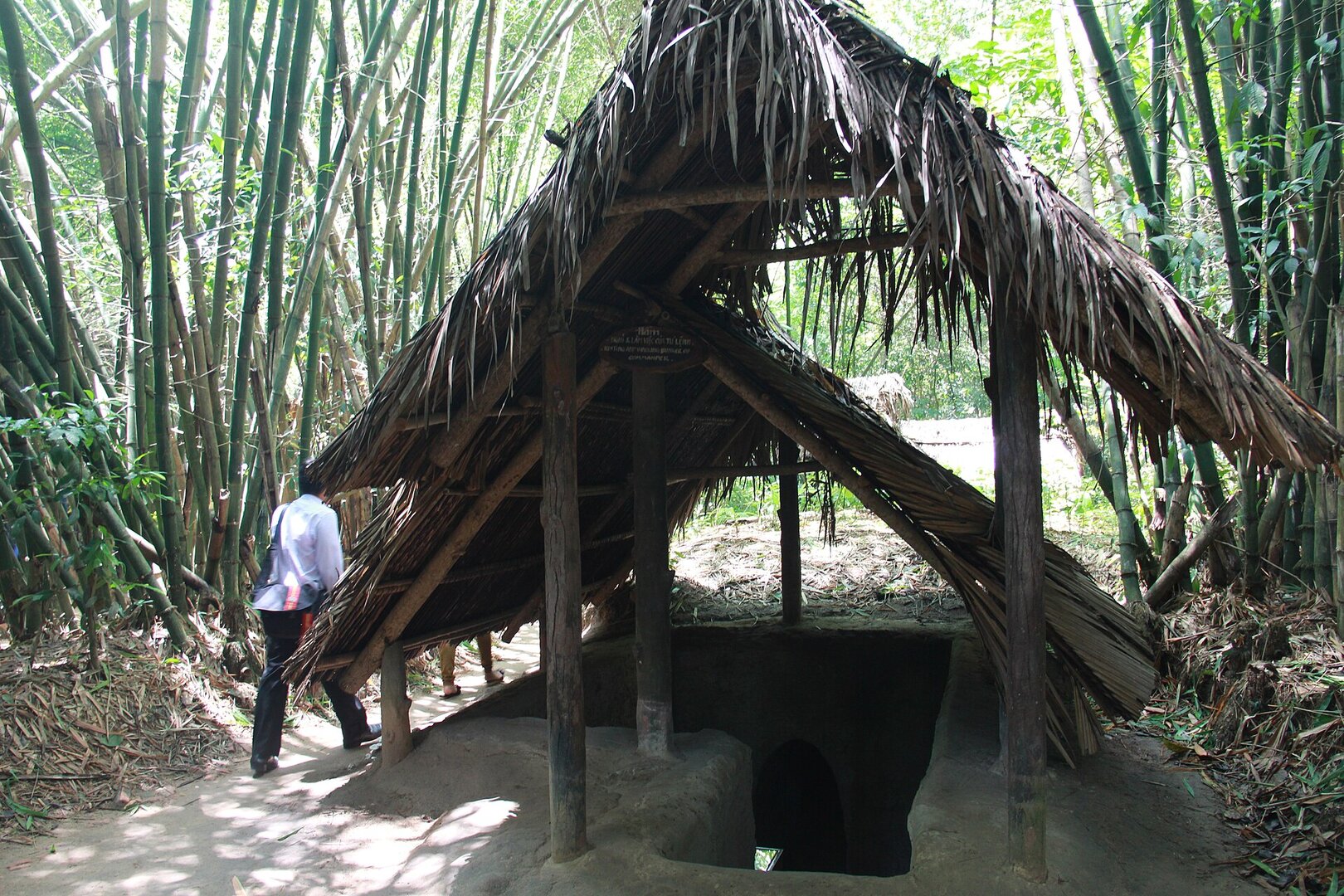
Today Bến Đình is still open to visitors, and what once had to be hidden is opened up for you to see. The tunnel sections for visitors have been widened and fitted with lights. Bến Đình has one detail of its own: a tunnel that passes beneath Provincial Road 15. You will find air vents disguised as termite mounds; a Hoàng Cầm stove — a kitchen that hid its smoke underground — with its smoke chamber and smoke outlets; the bunker where the Secretary of the district Party Committee lived and worked, and the meeting-hall bunker at the heart of the base. In the middle of the forest lies the wreck of an American M41 tank, hit by a mine the guerrillas laid in 1970. There are also reconstructed areas showing guerrillas at rest and tunnel digging, and a recreated craft-village house for making rice paper, distilling liquor and milling rice.
The gunfire is still here — but now it echoes from a national-defence sports shooting range, where visitors can try firing. The visit ends at a souvenir area with objects made from shell casings and dép râu, sandals made from old tyres; on the Sài Gòn River, a restaurant on the water serves country dishes of Đông Nam Bộ, the southeastern region of southern Vietnam. And the place still does the work it was kept for: teaching those who come later about the revolutionary tradition. A tunnel network that survived because no one could see it is now lit so that everyone can. When you climb back up to the surface, what will you carry out of a place where people once kept a secret down to the last leaf?
Photographs
9 of 9 on fileBalon Greyjoy· CC0 1.0 · source
Jorge Láscar from Australia· CC BY 2.0 · source
Balon Greyjoy· CC0 1.0 · source
Gary Todd from Xinzheng, China· CC0 1.0 · source
Matthew Blissett· CC BY-SA 3.0 · source
Ludovic Lubeigt· CC BY-SA 2.0 · source
Ganesh Dhamodkar· CC BY 4.0 · source
Balon Greyjoy· CC0 1.0 · source
Jorge Láscar from Australia· CC BY 2.0 · source
Enough to decide whether to go
- What it is
- Base of the Củ Chi district Party Committee (1968–1975); one of the two sites of the Củ Chi Tunnels Historical Relic Site — the other is Bến Dược
- Where
- Nhuận Đức commune, Hồ Chí Minh City · on Provincial Road 15, beside the Sài Gòn River
- Status
- National relic since 2004; together with Bến Dược, a Special National relic since 2015
- Don't miss
- The tunnel under Provincial Road 15 · the Hoàng Cầm stove · the district Party Secretary's bunker · the M41 tank wreck
- Can you visit today?
- Open to visitors, in the daytime, every day of the week; admission is charged
From someone who has been
The visit begins with a documentary film in the hall — don't skip it; it gives everything you see afterwards a frame. People who are afraid of confined spaces, or who have a history of asthma or heart conditions, are advised not to go into the tunnels; the trenches, the M41 tank and the exhibition house of home-made weapons can still be seen above ground. Best for anyone who has just seen the film and wants to see a real stretch of the Củ Chi tunnels with their own eyes.
Vibe
Tags
Source
The history, features and services at Bến Đình come from the website of the Củ Chi Tunnels Historic Site, the unit that directly manages the place, and from the monument record on the portal of the Department of Cultural Heritage, cross-checked on 11 Sep 2026. The new administrative address (Nhuận Đức commune) and the ranking milestones come from the list of monuments compiled by the Hồ Chí Minh City People's Committee in Apr 2026: national monument in 2004, special national monument in 2015. Opening hours come from the footer of the historic site's website. The fee for foreign visitors comes from the notice of 19 Jan 2026 from the historic site, matching the earlier rate reported by Dân trí on 15 Apr 2025. Visitor numbers come from Báo Quân khu 7 (9 Jun 2025). The fact that some tunnel sections have been widened and fitted with lights, and the health advice for crawling through tunnels, come from VnExpress (10 Sep 2020 and 14 Apr 2025). The date Củ Chi received the title 'Đất thép thành đồng' (Land of Steel, Citadel of Bronze) comes from Thanh Niên (15 Sep 2024). The Tết Mậu Thân story comes from Vietnamese Wikipedia. We do not use the sentence 'Bến Đình was rebuilt, Bến Dược still has the original tunnels', because no dated article confirms it. We do not give the year the tunnels were first dug, because sources give 1948 and 1946 and contradict each other, and we drop both figures for the length of the system (about 250 km and more than 200 km) because they differ. The superior managing body of the historic site after the 2025 reorganisation could not be established, so only the directly managing unit is recorded. The year the M41 tank hit a mine (1970) and the dates of the District Party Committee base (1968–1975) have only one source so far, the historic site's own page. Photos come from Wikimedia Commons, with author and licence credited for each photo.
Place data is compiled from many sources across the internet by a team of automated AI agents that collect, enrich, check, challenge, score, edit, review and verify it.
Ratings & comments
Anyone can read. Sign in to rate, comment and like.