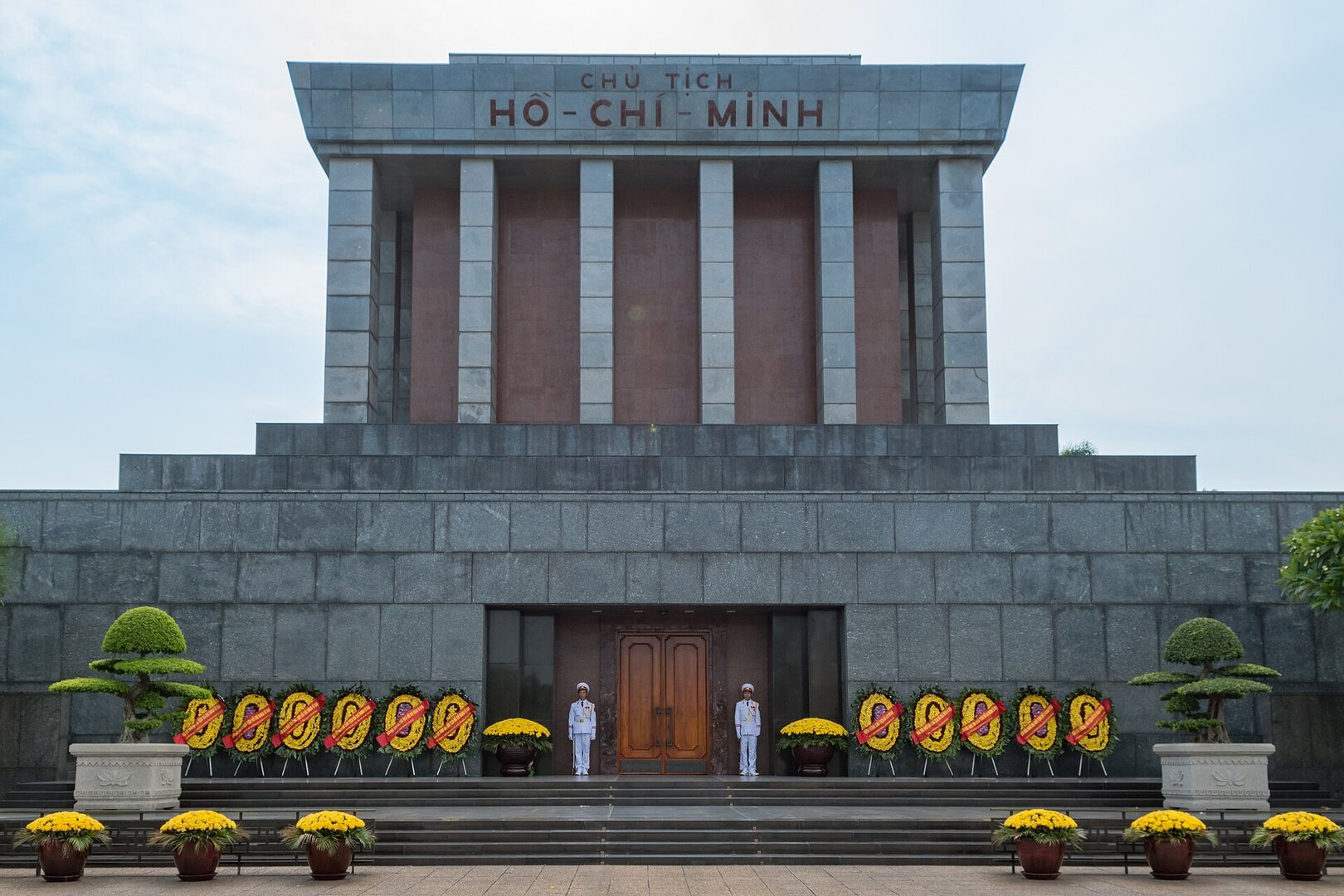
Hồ Chí Minh (Ho Chi Minh) Mausoleum
Quảng trường Ba Đình, Hà Nội · Landmark
Quick facts
- Address
- Số 1 Hùng Vương, Hà Nội
- Coordinates
- 21.03678, 105.83469Directions
Where next?
Compiled by AI · source-checked
Picture opening the literature textbook Vietnamese students use in ninth grade, turning to a poem that begins with a row of bamboo — then closing the book and standing before the very place that poem is about.
Picture opening Ngữ văn 9 — the Vietnamese literature textbook for ninth grade — to the poem "Viếng lăng Bác" ("Visiting Uncle Hồ's Mausoleum"). It opens with the image of a row of bamboo. The poet, Viễn Phương, was a southerner who came to see the Mausoleum just after it was inaugurated; he dated the poem April 1976, and the composer Hoàng Hiệp later set it to music. The place he came to is the Hồ Chí Minh Mausoleum, also called Lăng Bác — "Bác", literally "uncle", is the affectionate way Vietnamese refer to Hồ Chí Minh. It stands on Ba Đình Square, where President Hồ Chí Minh read the Declaration of Independence on 2 September 1945, founding the Democratic Republic of Vietnam.
A Ninth-Grade Poem, and a Monument Many Regions Helped Build
In his Testament, Hồ Chí Minh wished to be cremated and have his ashes placed in the country's three regions. On the morning of 29 November 1969, the Politburo decided to preserve his body for the long term and build a mausoleum, so that the people, above all those in the South, could come to pay their respects. Are you curious how the building's shape was chosen? In 1970, more than 200 designs from 16 teams were exhibited in many localities for public comment: 745,487 visits were recorded, and 34,022 people gave feedback. Soviet and Vietnamese architects worked on it together, taking inspiration from Lenin's Mausoleum without copying it. People from every region sent materials — cement from Hải Phòng, yellow sand from Kim Bôi, stone from Chùa Thầy, precious timber from along the Trường Sơn range — and the Soviet Union donated twenty thousand pieces of granite and marble. Construction began on 2 September 1973; nearly two years later, on 29 August 1975, the Mausoleum was inaugurated and held its first viewing ceremony.
Seen from the square, the Mausoleum leans against nothing: a 21.6-metre block faced in dark grey granite rises from the open space, topped by a three-tiered roof that echoes the curved roofs of traditional Vietnamese architecture, and by the words "Chủ tịch Hồ Chí Minh" ("President Hồ Chí Minh") set in Cao Bằng jade stone. Cycad palms stand in front of and behind it, rows of bamboo line the south and north sides, and a frangipani tree grows on each side of the main entrance; an honour guard always stands at the door. Inside, the entrance hall wall is faced with pink-veined granite, a backdrop for the words "Không có gì quý hơn độc lập, tự do" ("Nothing is more precious than independence and freedom") and Hồ Chí Minh's gilded signature. The chamber holding his body is lined with Hà Tây marble, rectangular slabs set upright from floor to ceiling, recalling the wooden planks of his stilt house. The body lies in a glass case, dressed in a faded khaki suit, with a pair of rubber sandals at its feet.
Today the Mausoleum still does exactly what it was built for: preserving the body of President Hồ Chí Minh and holding viewing ceremonies for Vietnamese people and international visitors, under the Mausoleum Command of the Ministry of Defence. Viewings take place in the morning, and the Mausoleum closes for one period each year for routine maintenance. Many people first met that row of bamboo in a poem. When you stand among the bamboo at Ba Đình yourself, what will "Nothing is more precious than independence and freedom" mean to you today?
Photographs
8 of 8 on fileEnough to decide whether to go
Written by Vietlume · from the sources listed under Sources
- What it is
- The mausoleum preserving the body of President Hồ Chí Minh, on Ba Đình Square, Hà Nội
- Inaugurated
- 29 August 1975, after nearly two years of construction
- Look closely at
- The Cao Bằng jade lettering on top; the Hà Tây marble chamber recalling his stilt house
- Viewings
- In the morning; closed for one maintenance period each year
- When visiting
- Dress modestly and keep silent
Good to know before you go
If you studied "Viếng lăng Bác" at school, reread it before you go. Once there, notice the greenery around the Mausoleum: bamboo from Cao Bằng, chò nâu trees from the Hùng Kings' Temple, and ban flowers from Điện Biên were all sent by localities to be planted here. Remember to dress modestly and keep silent inside.
Vibe
Tags
Source
Last verified 15 Sep 2026
- History
- hochiminh.vnWikipediatapchisonghuong.com.vn +1 · checked 15 Sep 2026
- Address & location
- hochiminh.vn · checked 15 Sep 2026
All 7 sources
- hochiminh.vnwebsite
History · Address & location · Other details · checked 15 Sep 2026
- Wikipediaopen encyclopedia
History · Name · Other details · checked 15 Sep 2026
- tapchisonghuong.com.vnwebsite
History · checked 15 Sep 2026
- baovanhoa.vnnewspaper
History · checked 15 Sep 2026
- tuoitre.vnnewspaper
On-site experience · checked 15 Sep 2026
- nhandan.vnnewspaper
Other details · checked 15 Sep 2026
- thivien.netwebsite
Other details · checked 15 Sep 2026
Read the full note
Data on the Hồ Chí Minh Mausoleum is assembled from several source layers, rechecked on 15 Sep 2026. The location and the address 1 Hùng Vương were cross-checked between OpenStreetMap and Vietnamese Wikipedia; the entity was also cross-checked against Wikidata. Most of the dates and architectural description come from the introduction to the Mausoleum on hochiminh.vn (posted 15 Nov 2022), including: the decision to preserve the body on 29 Nov 1969, the public consultation of 1970, the Vietnam–Soviet agreement of 9 Feb 1971, groundbreaking on 2 Sep 1973, the construction milestones of 1974, the height of 21.6 m, granite, Cao Bằng jade stone, Hà Tây marble, wooden doors, materials sent from every region and the 14 ha grounds. The inauguration date of 29 Aug 1975 follows Báo Văn hoá, which shares its archival source with hochiminh.vn. The will's wish for cremation, the invitation of Soviet experts in 1969, the body in a glass casket, the layout along the square's axis, the guards and the dress code come from Vietnamese Wikipedia. The assessment that the Mausoleum is a joint product of Soviet and Vietnamese architects and not a copy of Lenin's Mausoleum follows Tạp chí Sông Hương (2021). The poem 'Viếng lăng Bác' follows Thi Viện. The morning visiting schedule and the renovation period of 4 Sep–2 Nov 2026 follow Tuổi Trẻ (9 Aug 2026, citing an announcement of the Mausoleum Command), the Government Electronic Portal and Báo Nhân Dân (3 Sep 2026); the Mausoleum Command's own page could not be reached on 15 Sep 2026. Rejected: the story of an entrance fee (sources say free, 25,000 VND or 50,000 VND, with no first-party source); the width and sides of the Mausoleum (four different figures); the number of grass plots on the square (176, 210 or 240); the claim that the Mausoleum is an 'original' Lenin Mausoleum designed by a Russian architect; the main door being made of wood (hochiminh.vn says it is faced with stone); an honour guard of 34 people; instructions on the assembly point and bag deposit; seasonal visiting hours. Not yet established, so not stated: the ward after the 2025 reorganisation, the Mausoleum's own heritage ranking, the exact position of the 1945 rostrum relative to the Mausoleum, and the figure of 79 cycad trees.
Source-checked by Vietlume: compiled by AI from public sources, then checked against each source above before publishing.
Star ratings & comments
Anyone can read. Sign in to rate, comment and like.