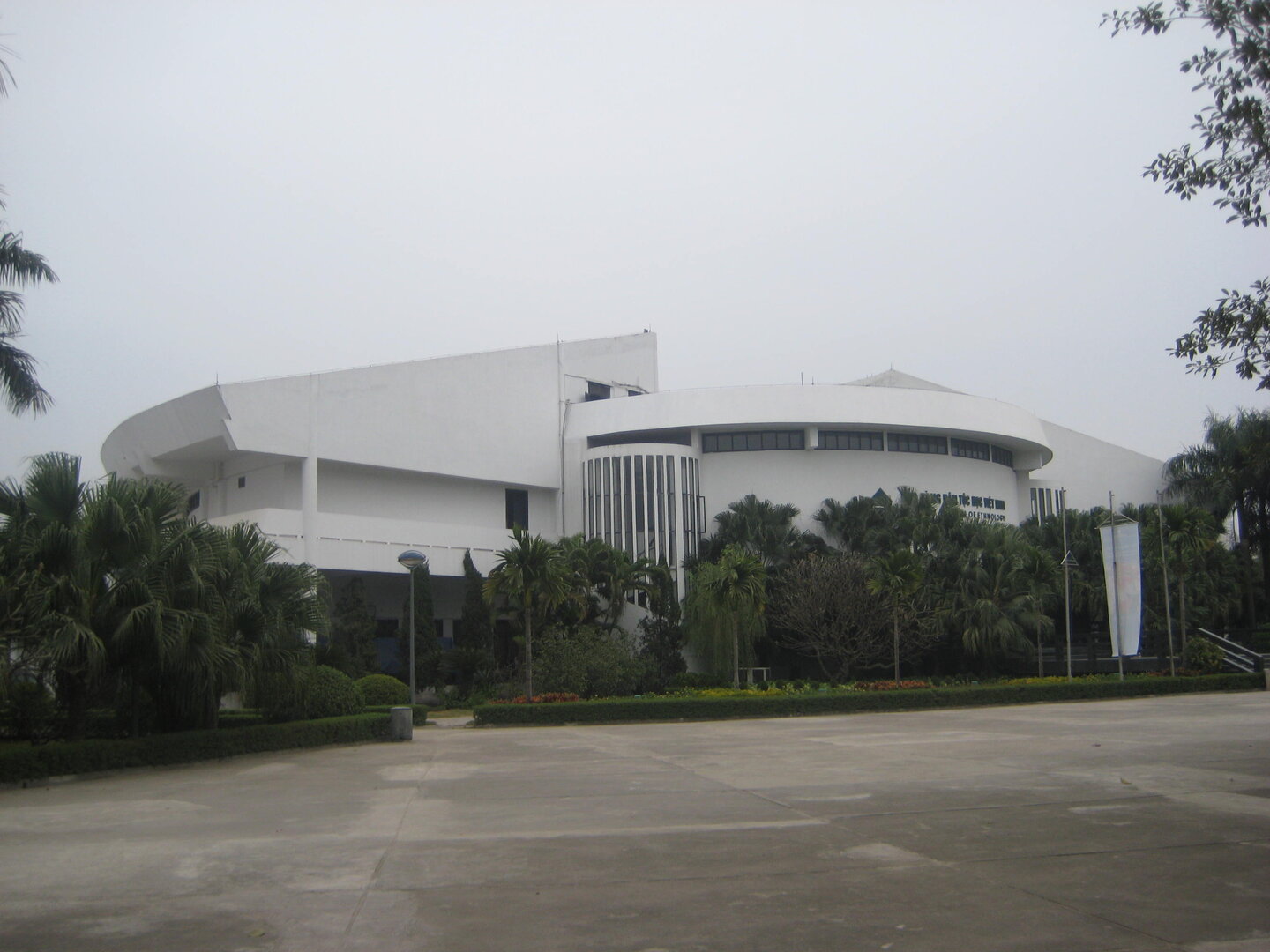
Vietnam Museum of Ethnology
Nguyen Van Huyen, Hanoi · Museum
Quick facts
- Address
- Nguyễn Văn Huyên, Nghĩa Đô, Hà Nội
- Coordinates
- 21.04008, 105.79884
Where next?
Compiled by AI · source-checked
In 2023 a museum in Hà Nội invited thirteen Ê Đê craftsmen from the village of Ky to restore the Ê Đê longhouse exactly to its original form, and had to order thatch grass from as far as Sơn La, because in the very cradle of the house there was not enough material.
Picture a Hanoi street named after a scholar who once wrote a thesis on the stilt houses of Southeast Asia — and just behind that street's fence, ten real stilt houses, raised by people from the villages themselves, with their own materials, their own techniques, and their own rituals. Not scale models. Full-size buildings you can walk into. The name on the street sign is Nguyễn Văn Huyên (1905–1975), the late Minister of Education and the first Vietnamese to defend a doctoral thesis in letters at the Sorbonne, in 1934; his secondary thesis was titled "An Introduction to the Study of Stilt Houses in Southeast Asia". Ninety years later, his youngest son became the museum's first director — and the garden of that museum, on that street, is a collection of stilt houses built for real.
Ten Real Houses, and Thatch Fetched from the Border
The Vietnam Museum of Ethnology grew out of a single room of the Institute of Ethnology: a research team that expanded into a museum, rather than an attraction built for visitors. It was established by a decision of the Prime Minister in 1995 and inaugurated in late 1997, during the summit of French-speaking nations held in Hanoi, in the presence of Vice President Nguyễn Thị Bình and French President Jacques Chirac. The grounds of nearly 4.5 hectares hold three parts: the Bronze Drum building, designed by architect Hà Đức Lịnh, a Tày man, after a Đông Sơn bronze drum; the open-air Architecture Garden; and the four-storey Kite building for what lies beyond Vietnam's borders. Inside the Bronze Drum building, more than fifteen thousand objects are arranged neither by province nor by date, but by language family, language branch and ethnic group — and by terrain, from the lowlands upward. The arrangement is itself an argument.
What stays with people longest, though, is outdoors, along paths through grass and trees and an artificial stream that runs year-round toward the pond with its water-puppet pavilion. The Ê Đê longhouse here is 42.5 metres long, rebuilt after a family's house made in 1967 in buôn Ky — buôn being an Ê Đê village — with an entrance stair carved from a single block of wood. That length is not for show: a longhouse shelters one extended matrilineal family, so the bigger the family, the longer the house. Some once ran to around 200 metres, and into the 1970s many still measured 50 to 60. Beside it stands a Ba-na nhà rông, a communal house nearly 19 metres tall, raised in 2003 by forty villagers from Kon Rbàng in Kon Tum whose main tool was the axe. The Hà Nhì house has rammed walls of clay mixed with gravel about 45 centimetres thick, built by twenty people over fifty-six days. The Hmông house is made entirely of pơmu wood, and by day someone inside can use a stick to nudge one roof plank aside and drop an extra band of light onto the spot where the weaving is done. And the Việt house of Mrs Cố Hợi from Thọ Xuân, Thanh Hoá, built in 1906, was deliberately kept low — custom forbade a house taller than the village communal hall, and that province gets storms.
Are you curious how much thatch a roof like that takes, and what happens when the grass no longer grows in enough quantity where the house was born? In 2023, when the longhouse roof was repaired, the Central Highlands no longer had enough thatch for its own house; the museum had to order thatch from Sơn La, up against the Việt–Lào border, and the roof alone took some twenty tonnes. Thirteen Ê Đê craftsmen came from buôn Ky to Hanoi and worked for nearly two months — no ordinary builders were hired, because the museum's working principle is that the people of a culture make their own house. The same spirit runs through the 2006 exhibition on life in Hanoi during the bao cấp years, the subsidy era, assembled from ration coupons, old bicycles, kerosene stoves and residents' own accounts, and it spilled out of the museum into a wave of nostalgia in the city's cafés. Today this is still a research body at work: its staff keep publishing on objects newly told — the books of the Pà Thẻn, the sacred ceramic-bodied drum of the Dao Họ. How much of itself can a society keep, when the material that made it no longer grows where it used to? The answer is not in a display case. It is on the roof you are standing under, a few steps in from the street.
Photographs
12 of 12 on fileEnough to decide whether to go
- Working hours
- Tuesday08:30–17:30
- Wednesday08:30–17:30
- Thursday08:30–17:30
- Friday08:30–17:30
- Saturday08:30–17:30
- Sunday08:30–17:30
- MondayClosed
*Opening hours can change on public holidays, during maintenance, or for private events.
Written by Vietlume · from the sources listed under Sources
- What it is
- A museum of ethnology and a working research body under the Vietnam Academy of Social Sciences
- Since when
- Established 1995, inaugurated 1997; the Architecture Garden built between 1998 and 2006
- Three parts
- Bronze Drum building (indoor galleries) · Architecture Garden (open air, about 2 ha) · Kite building (Southeast Asia and the wider world)
- Most worth seeing
- Ten vernacular buildings of ten ethnic groups, raised and repaired by the communities themselves
- Labels
- Vietnamese, English and French; guides available in Vietnamese and English
- Where
- Nguyễn Văn Huyên, Nghĩa Đô, Hà Nội
Good to know before you go
The museum is open as usual, during daytime hours, and charges admission. Take it slowly and it fills half a day, since most of that time goes to the garden — pick a dry day. No flash in the galleries, and bringing a camera or video camera in carries a separate charge, so budget for it if you plan to shoot a lot. No food or drink inside; the houses in the garden and the objects are to be looked at, not touched or sat on. Children enjoy it most around Tết, the Lunar New Year, and the Mid-Autumn Festival, when the museum runs its own programmes. Coming as a group? Split up: the museum itself advises schools to send one class at a time, spread through the year, rather than the whole school at once.
Vibe
Tags
Source
- Opening hours
- vass.gov.vn
- Prices
- vass.gov.vn
- Still open
- vass.gov.vn
- History
- vass.gov.vnInternet Archivenhandan.vn +4
- Address & location
- vass.gov.vn
All 7 sources
- vass.gov.vnofficial site
Opening hours · Prices · Still open · History · Address & location · Nature · Contact · Other details
- Internet Archiveweb archive
History · Nature · Other details
- nhandan.vnnewspaper
History · Other details
- baovanhoa.vnnewspaper
History
- hanoi.gov.vnpublic authority
History · Other details
- baotanglichsu.vnnewspaper
History
- Wikipediaopen encyclopedia
History
Read the full note
Opening hours, ticket prices, camera fees, rules and group-visit regulations were read directly on the official website of the Vietnam Museum of Ethnology (vme.vass.gov.vn), verified on 10 Sep 2026 — on the live page, not an archived copy. The two-level address 'Nguyễn Văn Huyên, Nghĩa Đô, Hà Nội' is also published by the museum itself there and was cross-confirmed by Người Hà Nội newspaper (11 Apr 2026); the older version gave the district level, which was abolished on 1 Jul 2025, so it is not used. The dates — establishment decision on 24 Oct 1995, inauguration on 12 Nov 1997, open to the public from 13 Nov 1997 — together with the grounds of nearly 4.5 ha and the Architecture Garden of about 2 ha built 1998–2006, come from the museum's own History page via an Internet Archive copy. The dimensions and construction of each house (Ê Đê longhouse, Ba-na communal house, Hà Nhì rammed-earth house, Tày stilt house, Hmông house, Gia-rai and Cơ-tu tomb houses, Chăm compound and Việt house) come from the museum's permanent exhibition pages, 2016 archive copy. The story of repairing the longhouse roof in 2023, with 13 Ê Đê craftsmen travelling to Hà Nội and 20 tonnes of thatch grass ordered from Sơn La, comes from Nhân Dân newspaper. Photos were contributed by the Wikimedia Commons community, credited photo by photo. Four things were rejected and do not appear on this page: the old camera fees of 50,000 VND per camera and 500,000 VND per camera (read from a 2024 archive copy; the fee schedule has changed in both the figures and the unit of charge); the figure of '11 vernacular buildings' on Vietnamese Wikipedia (the correct figure is 10 — the Khmer ghe ngo is a boat, not a house); the information on the current director on Wikipedia (more than four years out of date); and the area of 4.4 ha, built from a secondary source. Three things are left blank because the sources are insufficient: the start year of construction of the Cánh diều (Kite) building (the museum itself publishes two different years on two of its pages), the water puppet performance schedule by weekday (no official page publishes it), and the total number of artefacts (the figure of 15,000 was counted up to around 2000 so it does not describe the scale today).
Source-checked by Vietlume: compiled by AI from public sources, then checked against each source above before publishing.
Star ratings & comments
Anyone can read. Sign in to rate, comment and like.