Đặc khu Phú Quý, Lâm Đồng · Religious site
Linh Son Pagoda - Phu Quy
Picture the phrase "mưa thuận gió hòa" — "timely rain, gentle wind", a wish you may well have heard many times — being murmured in a leaf-roofed hut halfway up a mountain on an island, by a woman praying that the fishermen would come home safe.
As the story goes, that leaf hut dates from 1866. It was built by Mrs. Trần Thị Tấn, a woman of Phú Quý island. She climbed Cao Cát mountain to chant sutras, praying for kind weather and for the safety of those at sea. The question worth asking today is not how old the pagoda is, but who still keeps that prayer. The answer is close at hand: fishermen still come up to worship and pray for luck before every trip out to sea, and islanders call Cao Cát "the Sacred Mountain".
Linh Sơn Pagoda — where Phú Quý island still prays for those who go to sea
According to the island's elders, in 1913 the lý trưởng (village headman) and the village notables rallied people to contribute their labour, replacing the leaf hut with a solid, tile-roofed building. Only then did the main hall and the stone path from the foot of the mountain appear; as the story goes, the pagoda was once called "Linh Sơn Thanh long cổ tự". Seven restorations followed: in 1958 the fired roof tiles were replaced with cast cement tiles, in 1972 the pagoda was enlarged, and the biggest works ran from 1992 to 1996. During that round, whenever a boat brought materials over from the mainland, islanders unloaded them onto the shore and carried them up the mountain, working through the night.
Are you curious how a pagoda lives without a monk? In 2022 it had gone more than a hundred years without a resident abbot. Its care fell to respected islanders and a nun, while women of the commune took turns doing công quả — volunteer work for the temple. Islanders also pass on a rumour: male monks sent to lead the pagoda never stayed more than a year, and people guess that its founder, unlucky in love, did not care for men living there. That is hearsay. What you can see is that Buddhist lay followers on the island still take turns keeping watch at the pagoda and welcoming pilgrims.
The way up is roughly a hundred stone steps with a handrail, under the shade of old trees. The pagoda sits with its back against a rock face, under sloping and rounded roofs; a boulder in front bears two carved lines: "Khen ai khéo tạo cảnh chùa / Trên sơn, dưới thủy bốn mùa xanh tươi" — "Praise whoever so skilfully made this temple scene / Mountain above, water below, green through all four seasons". In the main hall a 2 m statue of Shakyamuni Buddha sits on a lotus throne, the roof pillars carry dragons in relief, and at the back are memorial tablets for those who helped found the pagoda. More stone steps behind the main hall lead to the summit: a statue of Quán Thế Âm (Guanyin, the bodhisattva of compassion) rests on a large boulder, surrounded by black rocks stacked like honeycomb and worn by rain and wind into spirals, grooves and mushroom shapes — the remains of a volcanic dome. From here you can see most of the island: the tomb of Thầy Sài Nại on black rocks to the east, the lighthouse on Cấm mountain to the west, the Ngũ Phụng sea wall to the north.
Photographs
1 of 1 on fileThái Nhi (vi.wikipedia)· Public domain (PD-user) · source
Enough to decide whether to go
- What it is
- The islanders' pagoda, still an active place of worship
- Where
- Halfway up Cao Cát mountain, northern Phú Quý island (Phú Quý special zone, Lâm Đồng province)
- Beginnings
- A leaf hut built by Mrs. Trần Thị Tấn — by local account, in 1866
- Don't miss
- The Quán Thế Âm statue on the summit, among black volcanic rocks
- Getting up
- About a hundred stone steps with a handrail, under the trees
- Today
- Lay followers take turns keeping watch and welcoming pilgrims
From someone who has been
Islanders say the spot where the Quán Thế Âm statue stands is the best place to watch sunset and sunrise, so late afternoon often brings people up to burn incense. On holidays, at Tết (Lunar New Year) and on full-moon days, pilgrims come in large numbers. This is still where fishermen come before heading out to sea — if you want to see how a prayer more than a century old is still spoken, go up one afternoon and stand among them.
Vibe
Tags
Source
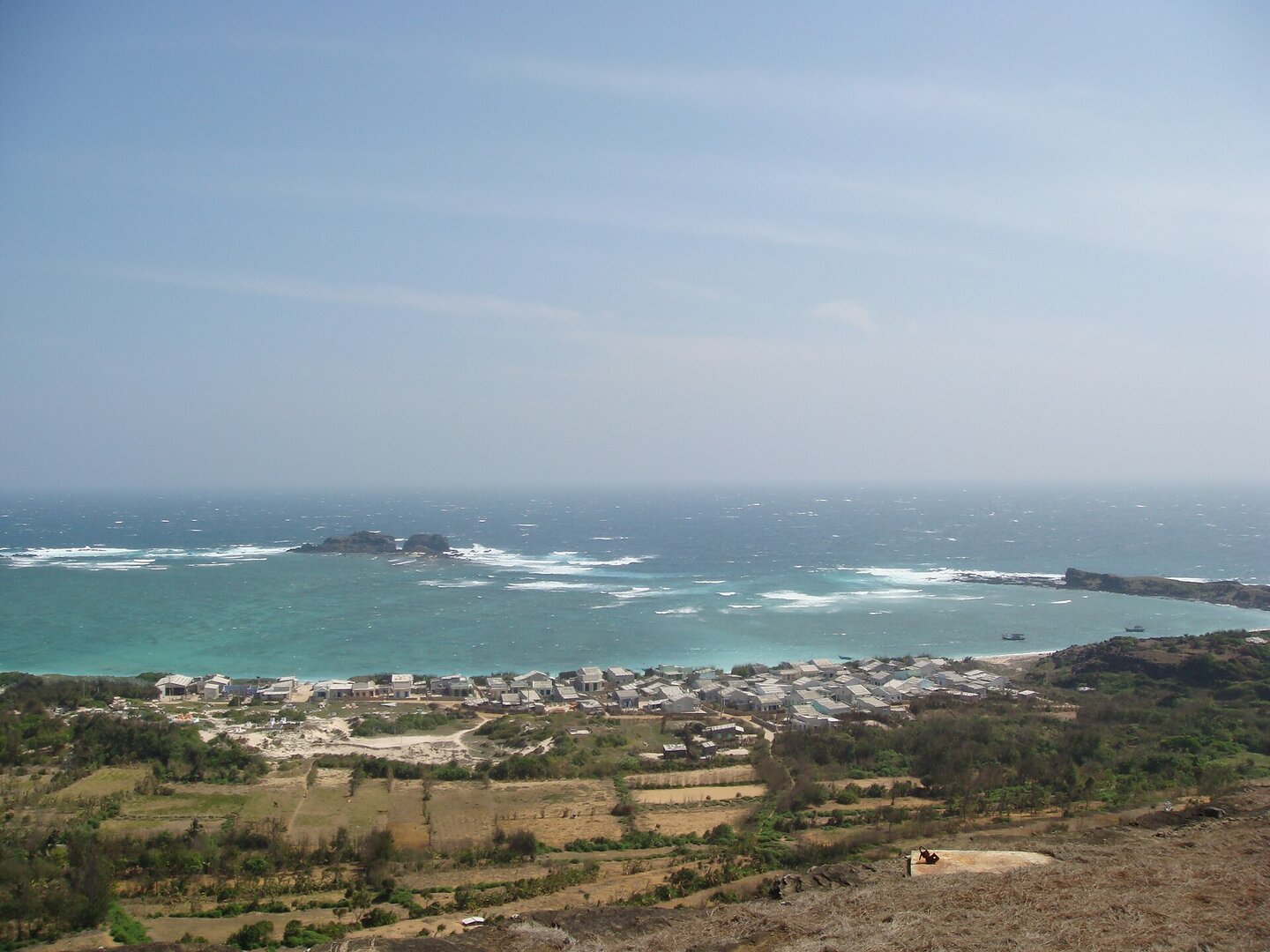
The history of the pagoda (a leaf-thatched hermitage built in 1866 by Mrs. Trần Thị Tấn, rebuilt in 1913, the old name 'Linh Sơn Thanh long cổ tự', 7 renovations, islanders contributing labour) and the view from the top of Cao Cát come from an article in Nông nghiệp và Môi trường newspaper of 17 May 2022. That article records the words of the pagoda's caretaker and of elders on the island, so the years are oral accounts, with no relic dossier to check against. In the article, the sexagenary cycle name 'Bính Thân' paired with 1866 is wrong, and the surname of the pagoda's founder is recorded inconsistently between Trần and Nguyễn, so this page does not state the cycle name. Dân Việt newspaper of 7 Sep 2022 gives: the stone-step path up to the pagoda, the Quán Thế Âm (Avalokiteshvara) statue on the summit, the sunset-viewing spot, the crowds on holidays, and the fact that there was no abbot in 2022. Bình Thuận newspaper in 2023 gives: the pagoda leaning against a rock face, the poem carved in stone, the old-growth forest, and the fishermen's custom of praying for luck. Bình Thuận newspaper of 18 Jan 2024 gives: the layout of the main hall, the pagoda's position on the mountainside, and the black honeycomb rock on the summit. Vietnamese Wikipedia (read on 26 Sep 2026) gives: the volcanic origin of Cao Cát, and the fact that Long Hải commune was merged in full into Phú Quý special zone, Lâm Đồng province, under Resolution 1671/NQ-UBTVQH15. The pagoda's location is taken from the Google Maps pin (Plus code 7P2CGWWX+F8, read with a browser on 26 Sep 2026), then cross-checked against SRTM elevation and OpenStreetMap data. The unnamed OSM point at the water's edge that older data attributed to the pagoda is a different place of worship and was excluded. What is not stated, and why: the pagoda's elevation and the number of stone steps, because newspapers disagree (61 m and more than 106 m; 148 steps, 'over 100', 'nearly a hundred'); the material 'rare precious wood', because it contradicts the account of the 1913 rebuilding; the main hall's area of 110 m² with 3 tiers of roof, because it appears only on a marketing page; the English name, because there is no source; and the artefacts such as the bronze seal and the Great Bell, because they belong to a different Linh Sơn pagoda in Tuy Phong. The only photo is a public-domain photo by Thái Nhi on Wikimedia Commons. The uploader states the photo is 'Linh Sơn Pagoda in Phú Quý', but the frame shows only a view of the bay from above.
Place data is compiled from many sources across the internet by a team of automated AI agents that collect, enrich, check, challenge, score, edit, review and verify it.
Ratings & comments
Anyone can read. Sign in to rate, comment and like.