Tây Thiên, Phú Thọ · Religious site
Truc Lam Tay Thien Zen Monastery
Picture a temple of the same Zen lineage as Yên Tử, inaugurated in late 2005 on the slopes of Tam Đảo mountain — standing right on the stone foundation of a temple with traces from the Trần dynasty.
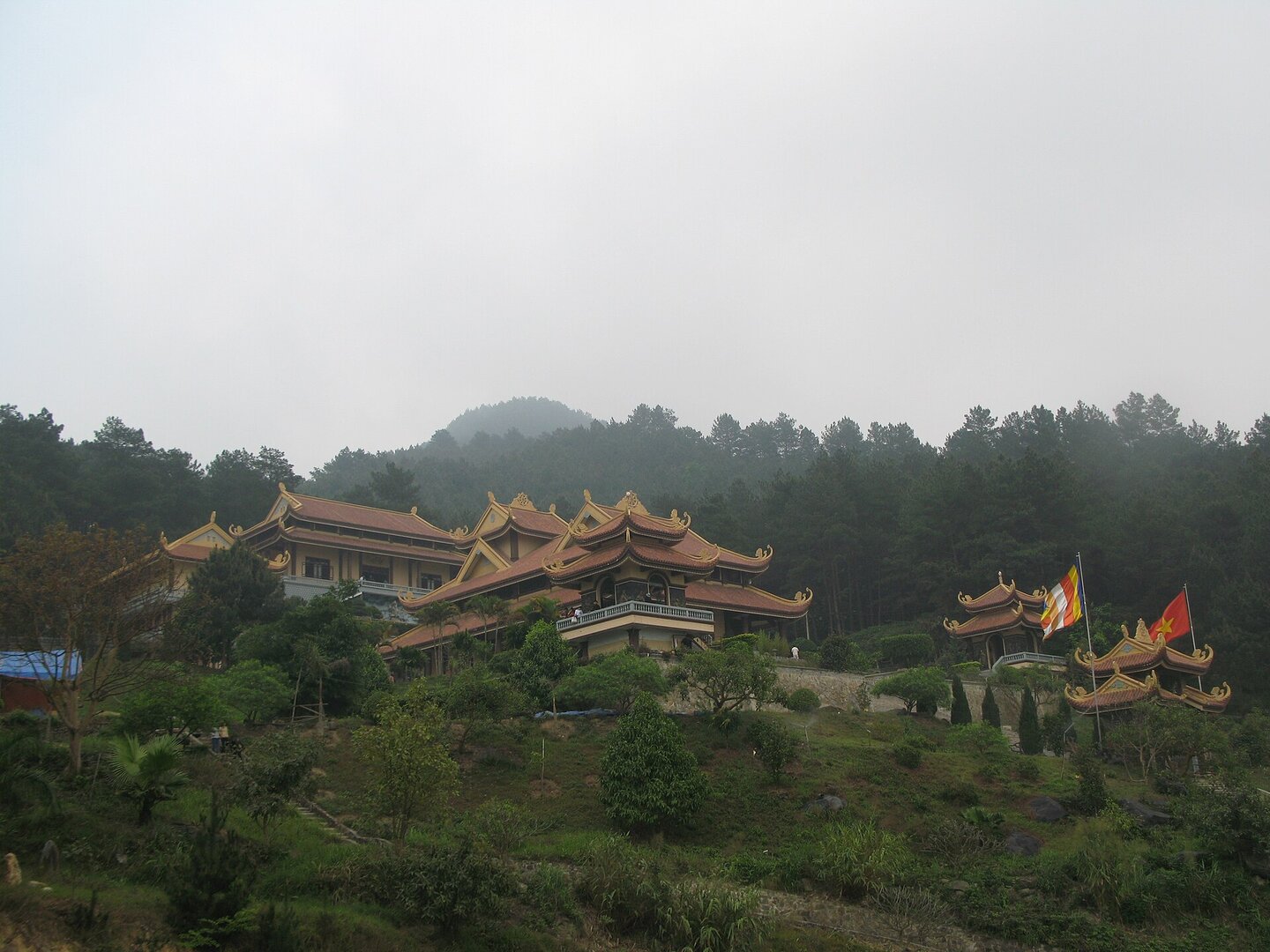
If the name Yên Tử means something to you, you already hold one thread. Thiền viện Trúc Lâm Tây Thiên — a "thiền viện" is a Zen monastery — belongs to the Trúc Lâm Yên Tử school of Vietnamese Zen, and the Nhà Tổ (Patriarchs' Hall) behind the main hall honours the school's three patriarchs: Trần Nhân Tông, Pháp Loa and Huyền Quang. The words "Tây Thiên" come straight from Buddhist scripture, where they name India. The monastery sits halfway up the mountain, with forest behind it and the plains below in front; seen from the foot of the mountain, it drifts in and out of the clouds.
A new temple on Trần-dynasty stones
The idea came from Zen master Thích Thanh Từ, head of Trúc Lâm Zen Monastery in Đà Lạt, after local authorities travelled all the way to Đà Lạt to ask for a monastery at Tây Thiên, in the hope of reviving the Zen tradition of the Trần dynasty. The person who surveyed the site, chose the foundation and ran the construction was Thích Kiến Nguyệt. As the builders tell it, the first survey found no trace of the old temple, so the team planned to build on low, flat ground; the master insisted that restoring an ancestral seat meant building on the old temple's foundation. On a later trip, guided by local people, the team cleared the undergrowth and crossed a dry stream bed before they found the foundation of Thiên Ân Thiền Tự, its stone embankment still there. On the day the first stone was laid in 2004, local Buddhists carried water up from the foot of the mountain, two buckets at a time, to cook for guests — the grounds then had only an old dry well and a small spring. Later, the monastery piped water from the head of a stream, across three mountains.
So what makes a temple inaugurated in late 2005 part of a heritage? The answer lies beneath it. Archaeology at the Đền Thõng area identified traces of Buddhist architecture from the Trần dynasty, with artefacts reaching into the Nguyễn dynasty, Vietnam's last. The old temple may have fallen into ruin as early as the Early Lê period, been rebuilt smaller, rebuilt again, and finally left as ruins. In the view of the project's initiator, Tây Thiên is where Buddhism arrived early in Vietnam; researchers say this has not been proven, and what is certain is that from the Trần dynasty onward it was a major Buddhist centre of Đại Việt, the old name of the Vietnamese state. The surrounding Tây Thiên – Tam Đảo historic site was ranked a Special National Monument in 2015; the monastery itself is a new building.
Its builders wanted it to carry the mark of its own era rather than copy 16th–17th-century temples, while keeping the character of a traditional Vietnamese pagoda. Climb the many stone steps to the tam quan, the three-entrance temple gate, and you meet a pair of parallel verses made by stonemasons from Ninh Bình: "Tây Thiên tổ ấn khơi nguồn Phật; Vĩnh Phúc thiền tông thắp sáng tâm" — roughly, the patriarchs' seal at Tây Thiên opens the source of the Buddha, and the Zen school of Vĩnh Phúc lights up the mind. The main hall, Đại Hùng Bửu Điện, rises 17 m in the centre on four great pillars, with a bell tower and a drum tower on either side. The statues of the Buddha, bodhisattvas and patriarchs are carved from sandstone — a deliberate contrast with Yên Tử, where the statues are bronze. The great bell weighs 2 tonnes and was cast in Huế; the drum body was made from a single log of jackfruit wood from the forests of Gia Lai. Wood carvers from Hà Tây and Đồng Kỵ, stonemasons from Ninh Bình and Thanh Hoá, and roofers from Hà Nội, Nam Định and Bắc Ninh all had a hand in it. Not everyone finds it harmonious: an article in Kiến trúc (Architecture) magazine in 2005 remarked that, seen from below, the monastery is massive — it looms ("án") rather than hides ("ẩn") in nature the way traditional Vietnamese pagodas do. But this is not only a place to look at: it is a centre of practice, and many families from Hà Nội send their children up for retreat courses.
Photographs
4 of 10 on fileEnough to decide whether to go
- What it is
- A Zen monastery of the Trúc Lâm Yên Tử school, and a centre of practice
- Where
- On the slopes of Tam Đảo mountain, Đại Đình commune, Phú Thọ province
- Built
- First stone laid in 2004, inaugurated in late 2005, on the foundation of Thiên Ân Thiền Tự
- Oldest layer
- Traces of Trần-dynasty Buddhist architecture
- Worth seeing
- Sandstone statues, the great bell cast in Huế, the jackfruit-wood drum from Gia Lai, the Patriarchs' Hall
- Part of
- The Tây Thiên – Tam Đảo historic site, Special National Monument (2015)
From someone who has been
Before you start up the stone steps, stop at the foot of the mountain and look up once. At the top, don't skip the exhibition house beside the main hall: its artefacts from many dynasties were found before the monastery was built — the old part of a new temple. Lovers of pagoda architecture will have plenty to argue about. Then ask yourself: does this temple loom or hide — and what should the heritage of our own time look like?
Vibe
Tags
Source
The story of building the monastery — the foundation-stone ceremony in 2004, the opening at the end of 2005, a survey that did not find the foundation of Thiên Ân pagoda and a later one that crossed a dry stream and finally met a stone-edged foundation, the day of laying the stone when Buddhists carried water in pairs of buckets up from the foot of the mountain, the decision to choose sandstone instead of bronze — comes from the account by Thích Kiến Nguyệt, who surveyed and directed the construction in person, published on Thư viện Hoa Sen and read through an Internet Archive copy dated 11 Mar 2010; it is a first-hand source but carries no publication date. The dating of the old pagoda foundation follows a research article by the National Museum of Vietnamese History (2022); this article only confirms Trần-dynasty traces, so the phrasing 'Lý–Trần period' and the account of 'destroyed by Ming invaders' were not used. The special national monument ranking in 2015 for the Tây Thiên – Tam Đảo area follows the file of the Department of Cultural Heritage. The garden layout and the pair of parallel sentences at the three-door gate follow Báo Thái Nguyên (2011) — this article copies Wikipedia almost word for word so it counts as one source. The artefact exhibition hall and landscape follow Giác Ngộ (17 Feb 2009). The assessment 'one of the three largest Zen monasteries in Vietnam' is from Tuổi Trẻ in 2006 and was only true at that time. The architectural remark 'commanding rather than hidden' is from an article in Tạp chí Kiến trúc (Architecture Magazine) issue 11/2005, cited via an essay published on Tu viện Quảng Đức. The current administrative unit — Đại Đình commune, Phú Thọ province — follows the full text of Resolution 1676/NQ-UBTVQH15 of 2025; every phrasing 'Tam Đảo district, Vĩnh Phúc province' is a place name from before the reform of 1 Jul 2025. Rejected and left off the page: the 49 m Quốc thái dân an Buddha statue and the Bát Giác library (sources contradict each other on the start date and none confirms completion), the floor area of the main hall and the construction cost (sources differ), the custom of not burning votive paper (only one source from 2009), information on a road for vehicles up to the site (undated), and three details that cite the wrong address from a Giác Ngộ article. Photos were taken in 2009–2010 by Bùi Thế Tâm (CC BY-SA 3.0) and Phó Nháy (public domain), from Wikimedia Commons.
Place data is compiled from many sources across the internet by a team of automated AI agents that collect, enrich, check, challenge, score, edit, review and verify it.
Ratings & comments
Anyone can read. Sign in to rate, comment and like.