Phường Bến Thành, TP. Hồ Chí Minh · Landmark
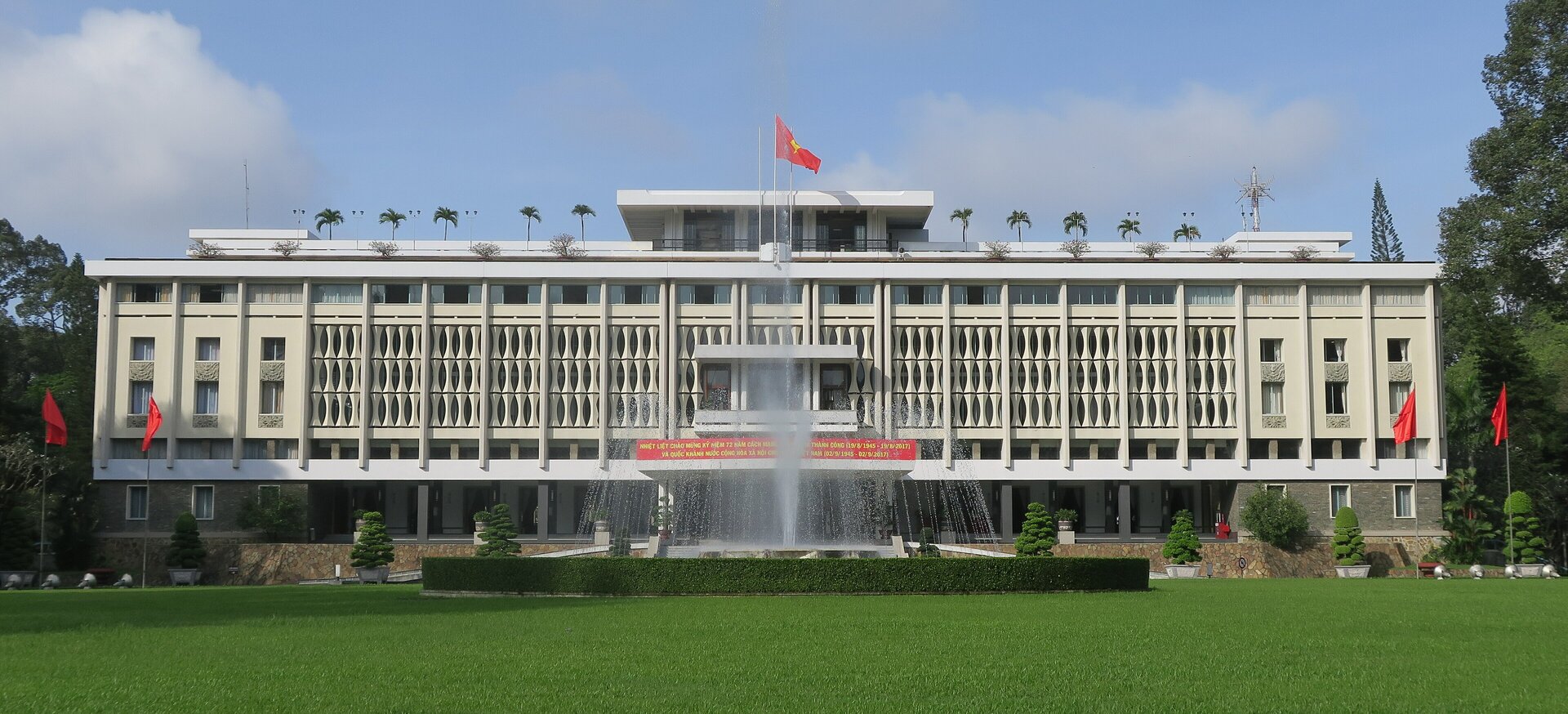
Independence Palace
Picture a photograph you have almost certainly seen somewhere: a tank shoving a gate open and driving straight in.
Picture a photograph you have almost certainly seen somewhere: a tank shoving a gate open and driving straight in. That gate is still standing in the same spot, in the middle of Ho Chi Minh City. The difference is that today people buy a ticket and walk through it.
The power left, the building stayed
The site began with the drawing of a Frenchman who was scattering buildings across Asia's trading ports. On 23 February 1868, Admiral–Governor Pierre-Paul de la Grandière laid the first stone: a block of blue granite from Biên Hoà, holding a lead box of newly minted gold, silver and copper coins bearing the image of Napoleon III. The palace raised on it was drawn by the Paris architect Achille-Antoine Hermitte in the neo-Baroque manner — the same man who drew Hong Kong's first City Hall and the Sacred Heart Cathedral in Guangzhou. Then, in 1887, Cochinchina was folded into the Indochinese Union, the post of Governor was demoted to Lieutenant Governor, and that rank was considered too low to live here, so another residence was built nearby. A palace finished with nobody grand enough to occupy it, left for most of the colonial period as a place for the occasional reception.
The building you see today is the second one. On 27 February 1962, two aircraft of a coup faction bombed the palace and destroyed the entire left wing; Ngô Đình Diệm chose not to repair it but to demolish it completely and build anew on the same ground. He ordered the work, then was assassinated in 1963 and never saw it completed in 1966. Its architect was Ngô Viết Thụ, winner of the Premier Grand Prix de Rome in 1955 — the highest honour of the Beaux-Arts tradition in France — and to this day the only Asian architect to have received it. Are you curious how an architect writes a written character into a building? Seen from above, the floor plan forms the Chinese character Cát (吉), meaning good fortune. The façade adds further characters carrying the senses of prosperity, sovereignty, and the responsibility of whoever holds power.
Up on the rooftop helipad you will find two circles painted in red. They mark the exact positions of the two bomb craters of 8 April 1975, when the undercover pilot Nguyễn Thành Trung faked a technical fault with a hand signal to break from his formation, turned back to bomb the palace, and landed in liberated territory; beside them sits a bomb fragment carrying his own signature. Just over three weeks later, on 30 April, tank 843 rammed the side gate and stalled on the spot, tank 390 knocked the main gate open, and inside, the entire cabinet was already waiting to surrender. The surrender itself was not read here: Dương Văn Minh was driven to the Saigon radio station, while the palace was where he was held. The two tanks standing in the grounds today are not the two from that day either — the originals sit in two museums in Hà Nội. What has stayed in place is the gate they struck. So what is left of a building once all its power is gone, other than the fact that it still stands there, open for you to walk in?
Photographs
9 of 9 on fileTerrazzo from Vernon Hills, IL, USA· CC BY 2.0 · source
Diego Delso· CC BY-SA 3.0 · source
Terrazzo from Vernon Hills, IL, USA· CC BY 2.0 · source
Nat4Eben· CC BY-SA 4.0 · source
Balon Greyjoy· CC0 · source
Balon Greyjoy· CC0 · source
Andrea Schaffer from Sydney, Australia· CC BY 2.0 · source
Terrazzo from Vernon Hills, IL, USA· CC BY 2.0 · source
Terrazzo from Vernon Hills, IL, USA· CC BY 2.0 · source
Enough to decide whether to go
- What it is
- A former presidential palace in central Ho Chi Minh City, now a heritage site open to visitors
- Address
- 135 Nam Kỳ Khởi Nghĩa, Bến Thành ward (an administrative unit below city level), Ho Chi Minh City; a second gate at 106 Nguyễn Du, on the exhibition-house side
- The present building
- Begun 1 July 1962, completed 1966; architect Ngô Viết Thụ
- Most worth seeing
- The rooftop helipad, with two red-painted circles marking the two bomb craters of 8 April 1975, and a bomb fragment signed by the pilot
- Names people mix up
- Reunification Hall (Hội trường Thống Nhất, named in November 1975 after the political consultative conference on reunification met here) is the name of the managing body; the heritage site is still named Dinh Độc Lập, the Independence Palace
- Getting in
- Ticketed; open during the day, every day of the week including weekends and Tết holidays, except during special events (verified 31/08/2026)
From someone who has been
Tickets come as a combined one for both the palace and the exhibition house, or for just one of the two — if you have come this far, take both. The gate at 135 Nam Kỳ Khởi Nghĩa sells tickets throughout opening time, while 106 Nguyễn Du sells them over a narrower stretch, so the main gate is the safer entrance. Anyone who loves architecture should save their energy for the façade and the rooftop; anyone with small children can take the electric shuttle around the grounds.
Vibe
Tags
Source
Data compiled from Decision 1272/QĐ-TTg of 12 Aug 2009 of the Prime Minister, the list of monuments of the Hồ Chí Minh City People's Committee drawn up on 14 Apr 2026, Resolution 1685/NQ-UBTVQH15, the dossier of the Department of Cultural Heritage, Nhân Dân newspaper and OpenStreetMap. Ticket prices and visiting hours are not recorded because the sources contradict one another. Photos are from Wikimedia Commons, credited individually. Verified on 31 Aug 2026.
Place data is compiled from many sources across the internet by a team of automated AI agents that collect, enrich, check, challenge, score, edit, review and verify it.
Ratings & comments
Anyone can read. Sign in to rate, comment and like.