Quảng Ngãi · Nature · Island
Ly Son Island
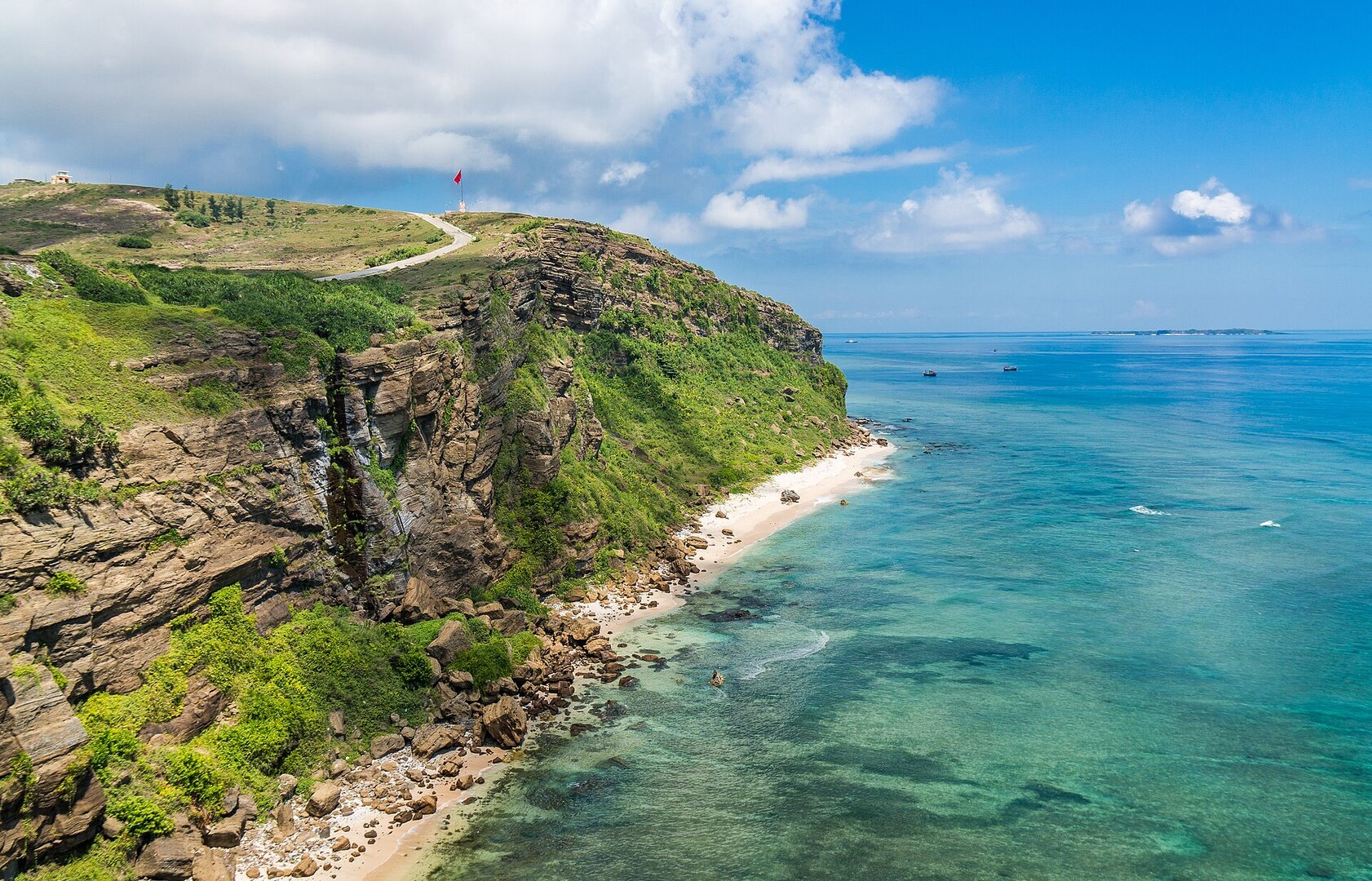
A volcanic island off Quảng Ngãi, formerly called Cù lao Ré: layered basalt cliffs, the arched Tò Vò gateway by the sea, a freshwater lake on the crater of the Thới Lới volcano and coral reefs in a marine protected area. Reach it by high-speed boat from Sa Kỳ port; boats stop running when the sea is rough.
01What people come for
Visitors come to watch the sunset at the Tò Vò arch, the sunrise on the side of Hòn Mù Cu, to walk along the Hang Câu cliff at the foot of Thới Lới, and to swim, paddle SUP, and take a basket boat to see the coral at Đảo Bé. The coral reef lies within the Lý Sơn Marine Protected Area, established in 2016. Live coral cover is low and is being protected and restored (Quảng Ngãi Department of Agriculture and Environment).
02Illustrated map
Outline, roads and the islets around come from OpenStreetMap. Each pictogram is a verified point; where they crowd, they are moved apart with a dot at the true spot.
Getting there and around
You get to the island by high-speed boat from Sa Kỳ port, about 15 nautical miles away. Between the main island and Đảo Bé there are separate boat and speedboat routes. Both routes stop when the sea is rough. On the main island visitors usually rent motorbikes or electric cars; on Đảo Bé there are electric cars, tuk-tuks and motorbike taxis.
Before you go
In the dry season the sea is usually calmer, falling roughly in April–August. From September to February the following year the sea is often rough, boats may stop for several days and visitors can be stuck on the island; even in mid-April there has been a case of boats stopping because of cold air. Since late June 2026, the path up to the shrine of Chùa Đục and to the Giếng Tiền volcanic crater has been temporarily closed because of the risk of landslides; as of the checking date of 24 Sep 2026, no source says it has reopened. The sea around the island has big waves and offshore currents, and no source says there are lifeguards; in April 2026 a student died while swimming at Gò Sóng near Tò Vò. On the summit of Thới Lới, do not climb over the guard rail to the cliff edge, and do not climb on the Tò Vò arch.
What this place is
Lý Sơn is a volcanic island, formerly called Cù lao Ré. According to a folk explanation, the name exists because the island once had many ré plants. A basalt base forms the Tò Vò sea arch in Tây An Vĩnh hamlet on the west of the main island, and the Thới Lới peak, nearly 170 m, is the island's highest summit and has a freshwater lake on top.
Busy and quiet times
April–June is the peak, with many visitors. Over the 30 Apr–1 May 2025 holiday, visitor numbers rose 3–4 times compared with ordinary days and the boats had to add trips. Sunset at the Tò Vò arch is usually very crowded.
Photographs
20 of 20 on fileKim Yong Soo/Doosan … · CC BY 3.0 · source
Kim Yong Soo/Doosan … · CC BY 3.0 · source
Đôi Ta Đi · CC BY-SA 4.0 · source
Kim Yong Soo/Doosan … · CC BY 3.0 · source
Kim Yong Soo/Doosan … · CC BY 3.0 · source
Kim Yong Soo/Doosan … · CC BY 3.0 · source
minhphuc_99kdd · Public Domain Mark 1.0 · source
Kim Yong Soo/Doosan … · CC BY 3.0 · source
Bẩu Bẩu (Bao Nguyen) · CC BY 2.0 · source
minhphuc_99kdd · Public Domain Mark 1.0 · source
minhphuc_99kdd · Public Domain Mark 1.0 · source
Kim Yong Soo/Doosan … · CC BY 3.0 · source
zcmgyu (Zc D. Gyu Photography) · CC BY 2.0 · source
Đôi Ta Đi · CC BY-SA 4.0 · source
minhphuc_99kdd · Public Domain Mark 1.0 · source
Nghiem DangVi · CC BY 3.0 · source
Kim Yong Soo/Doosan … · CC BY 3.0 · source
Bẩu Bẩu (Bao Nguyen) · CC BY 2.0 · source
Kim Yong Soo/Doosan … · CC BY 3.0 · source
The story
Lý Sơn — what the volcanoes left behind, and what islanders did with it
You may know the name Lý Sơn from its garlic before you know the island. The volcanoes were here long before any field. Lý Sơn is a volcanic island. Traces of many volcanic craters remain on the Big Island, on the Small Island and on the seabed. Lava that erupted a very long time ago formed the basalt that the whole island stands on. The island's old name is Cù lao Ré (cù lao is an old Vietnamese word for island). Folk explanation says it comes from the ré plant that once grew wild here. The Big Island (đảo Lớn) sits in the middle. The Small Island (đảo Bé, also called Cù Lao Bờ Bãi) lies to the north, and the little islet of Hòn Mù Cu lies east of the Big Island.
Vibe
Tags
Source
The old name Cù lao Ré, the structure of Big Island, Small Island and Mù Cu rock, and the distance to Sa Kỳ port come from vi.wikipedia (article Lý Sơn) and Tuổi Trẻ (27 Jul 2024), cross-checked against OpenStreetMap and Wikidata coordinates. The location and the national monument ranking of the Tò Vò gateway (Sep 2025) come from the Quảng Ngãi Department of Culture, Sports and Tourism and Sài Gòn Giải Phóng newspaper (10 Sep 2025). The ranking of Giếng Tiền mountain and Thới Lới (2020) and the height of Thới Lới come from VnExpress (2021). The route to the island and the periods when boats stop in rough seas come from VTV (23 Oct 2024), VOV (2025) and the Quảng Ngãi Department of Construction. The season to go and the season to avoid come from VnExpress (2020) and two travel-agency pages, Đất Việt Tour and PYS Travel; there is no meteorological source yet. Safety warnings come from Dân trí (23 May 2026 and 8 Jul 2026), Thanh Niên (26 Jun 2026) and Báo Xây dựng (20 Apr 2026). The marine protected area and coral reefs come from the Quảng Ngãi Department of Agriculture and Environment and a scientific paper from 2018. Not included: the number of craters and their dating, because the sources contradict one another; the area of the protected area and the number of species, because the figures differ and are old; a boat time of exactly 45 minutes, because only OpenStreetMap gives that figure; sightseeing and camping fees on Small Island, because the source is old. The idea 'Tò Vò gateway on the east side of the island' in a VnExpress guide is wrong and was rejected. Facts checked up to 24 Sep 2026.
Place data is compiled from many sources across the internet by a team of automated AI agents that collect, enrich, check, challenge, score, edit, review and verify it.
Ratings & comments
Anyone can read. Sign in to rate, comment and like.