Hương Sơn, Hà Nội · Attraction
Perfume Pagoda
Picture stepping out of “Em đi chùa Hương” (“Going to Perfume Pagoda”), a song you may already have heard, and into a real boat leaving Đục wharf, heading up the Yến stream between limestone peaks named Elephant, Sticky-Rice Tray and Rooster.
Picture stepping out of “Em đi chùa Hương” (“Going to Perfume Pagoda”), a song you may already have heard, and into a real boat leaving Đục wharf, heading up the Yến stream between limestone peaks named Con Voi (Elephant), Mâm Xôi (Sticky-Rice Tray) and Con Gà (Rooster). The song was set to music from the poem “Chùa Hương” by Nguyễn Nhược Pháp. Earlier, Chu Mạnh Trinh wrote “Hương Sơn phong cảnh ca”, a sung poem in the traditional hát nói form that now appears in Vietnam’s tenth-grade literature textbook. And in the spring of 1922 the poet Tản Đà, too short of money to join the festival, wrote a poem about rau sắng, a wild vegetable this area is known for.
Perfume Pagoda: the old lives in the stone, the living still take the boat
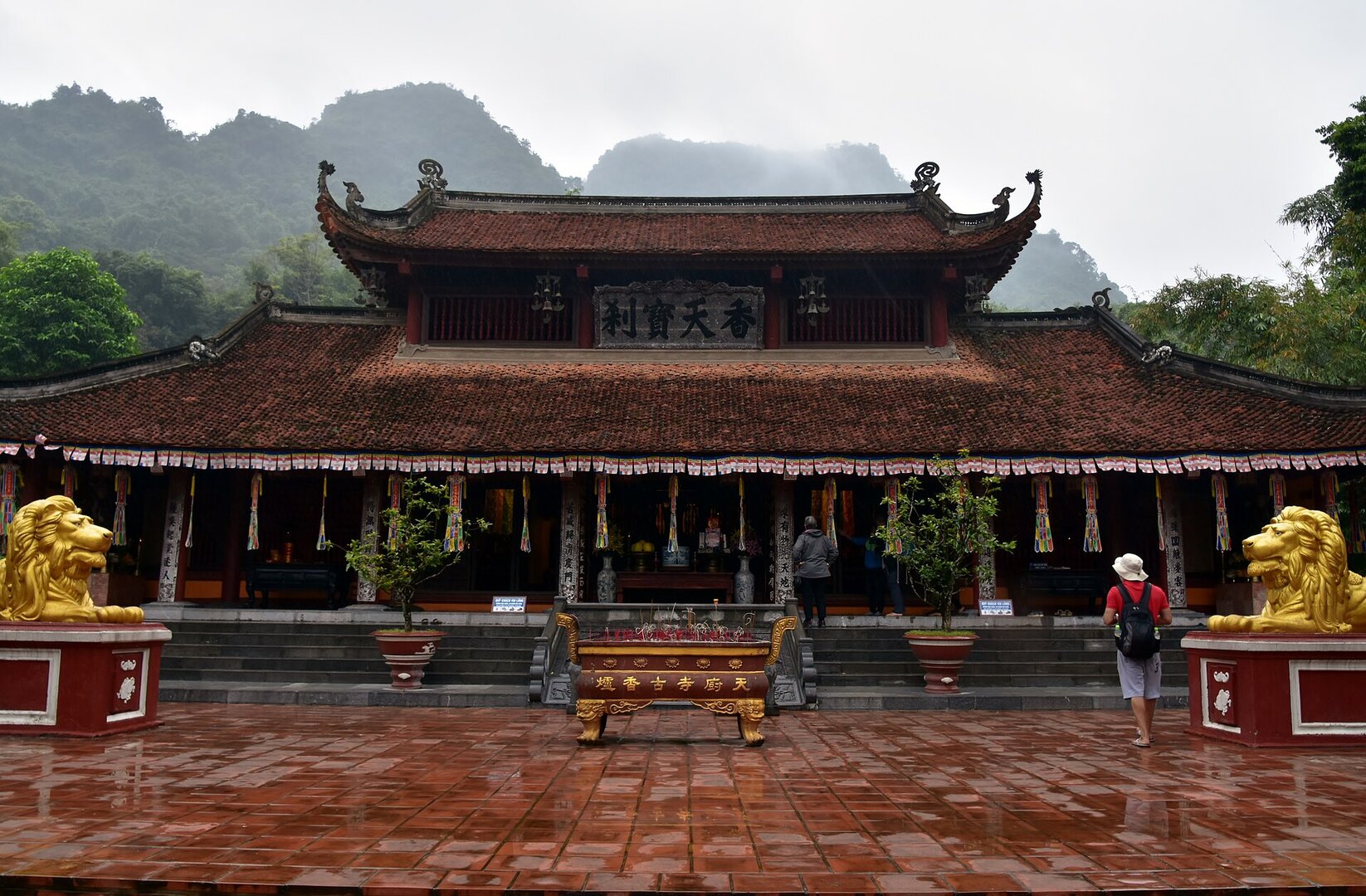
“Chùa Hương” (Perfume Pagoda) is the popular name for the Hương Sơn complex in Hương Sơn commune, Hà Nội: close to twenty temples, pagodas and caves spread across limestone hills, ranked a Special National Relic in 2017. Are you curious what a place written about this much still keeps in real life? The answer comes in two halves. Thiên Trù Pagoda, known as the Outer Pagoda, is where the traditional route continues on foot after leaving the boat at Trò wharf. The pagoda’s own account says that in 1467 King Lê Thánh Tông rested his troops in this valley and, reading the stars, found it lay under the Thiên Trù constellation, so he gave it that name. Most of the Thiên Trù you see today, though, is rebuilt: French troops burned it in 1947 and 1948, it was bombed in 1950, and reconstruction began in 1989. What remains from earlier times is the stupa garden, including the seventeenth-century terracotta Viên Công stupa, and a bell from the Tây Sơn period cast with four Chinese characters reading “Hương Tích động chung” (bell of Hương Tích cave). Rebuilding is nothing new here: Chu Mạnh Trinh himself took part in restoring this pagoda.
The other half is inside the rock. The Inner Pagoda is Hương Tích cave, reached through a large gate and down 120 stone steps to a mouth as wide as a dragon’s jaws. On the rock wall are a stele showing worship here since the seventeenth century, and the five carved characters “Nam thiên đệ nhất động” (the finest cave under the southern sky), dated 1770 and said by tradition to be in the hand of Lord Trịnh Sâm. Among the stalactites stands a statue of Quan Âm, the Bodhisattva of Compassion, carved from blue-grey stone in the Tây Sơn period. A Buddhist legend tells that Quan Âm, in the form of Princess Diệu Thiện, practised for nine years and reached enlightenment in this cave, which is why it is called Hương Tích, “fragrant traces”. People long ago named the stalactites in a farmer’s vocabulary: rice stack, silkworm tray, cocoon frame, gold tree, silver tree. Some have been worn smooth by years of visitors’ hands.
So what does this heritage mean today? Perhaps that it is still used as a real place of worship. Hương Sơn remains an active tùng lâm, a Buddhist monastic complex, and most festival-goers are worshippers who return every year. The Buddha does not stand alone here: the pagodas have shrines to the Mother Goddess, and Cửa Võng Temple honours Bà Chúa Thượng Ngàn, the Lady of the Upper Forest who watches over the mountains. By local telling, the festival’s opening day was once the villagers’ day for “opening the forest” early in the first lunar month. And for the 2026 festival, tickets were sold electronically and checked by QR code, while people still took the boat as generations before them did.
Timeline
- 1922And in the spring of 1922 the poet Tản Đà
- 1950it was bombed in 1950
- 1989and reconstruction began in 1989
- 2017ranked a Special National Relic in 2017
- 2026And for the 2026 festival
Photographs
8 of 10 on fileRichard Mortel from Riyadh, Saudi Arabia· CC BY 2.0 · source
Richard Mortel from Riyadh, Saudi Arabia· CC BY 2.0 · source
Bùi Thụy Đào Nguyên· CC BY-SA 4.0 · source
Richard Mortel from Riyadh, Saudi Arabia· CC BY 2.0 · source
Richard Mortel from Riyadh, Saudi Arabia· CC BY 2.0 · source
Richard Mortel from Riyadh, Saudi Arabia· CC BY 2.0 · source
Phil Whitehouse· CC BY 1.0 · source
Richard Mortel from Riyadh, Saudi Arabia· CC BY 2.0 · source
Enough to decide whether to go
- What it is
- The Hương Sơn complex: close to twenty temples, pagodas and caves; an active Buddhist monastic complex
- Where
- Hương Sơn commune, Hà Nội; the map pin sits at Thiên Trù Pagoda (the Outer Pagoda)
- Old things worth seeing
- The “Nam thiên đệ nhất động” inscription, the blue-grey stone Quan Âm statue, the Tây Sơn-period bell, the Viên Công stupa
- Getting there
- Boat from Đục wharf up the Yến stream to Trò wharf; from Thiên Trù to Hương Tích cave by mountain path or cable car
- Tickets
- Fees apply: a scenic-site ticket and a boat ticket at Đục wharf; the cable car is ticketed separately
- Festival season
- Spring, from after Tết (Lunar New Year) until around the third lunar month
From someone who has been
To see Perfume Pagoda as a living place, come during the festival, busiest from after Tết to the second lunar month, with boat races, mountain climbing, chèo folk opera and hát văn ritual singing. For a calmer visit, come outside festival season, when it is quieter and emptier. And if you ever studied “Hương Sơn phong cảnh ca” at school, this is your chance to stand before the words carved in the rock and see how much of the page is real.
Vibe
Tags
Source
Identity and location were checked independently through OpenStreetMap and Wikidata: the pin coincides exactly with the point 'Chùa Thiên Trù' on OpenStreetMap, and that point is tied to Wikidata Q7168306, which is the whole Chùa Hương complex. This row is the whole complex, with the pin placed at Thiên Trù pagoda. The administrative unit 'Hương Sơn commune, Hà Nội' comes from the Hà Nội Department of Culture and Sports (2026) and matches OpenStreetMap. The 2017 ranking as a special national monument comes from the Cultural Heritage page of the Ministry of Culture, Sports and Tourism, confirmed by Báo Tin tức (VNA); the 1962 national ranking milestone comes from nguoihanoi.vn and Doanh nghiệp và Tiếp thị (the original document could not be opened). The history of the 17th-century stele, the destruction of Thiên Trù pagoda in 1947–1950 and its reconstruction in 1989–1991, the features of Cửa Võng temple, Giải Oan pagoda, Đại Binh cave, Tiên Sơn cave and the Hương Tích Buddhist legend come from the pagoda's own site (chuahuong.org.vn). That site blocks automated access, so it was read through Internet Archive copies from 2021, 2022 and Apr 2026, checked against Vietnamese and English Wikipedia. Note that Vietnamese Wikipedia copies the pagoda's brief history almost word for word, so these two sources are not two independent confirmations. President Hồ Chí Minh's visit on 19 May 1958 comes from Báo Công an Nhân dân; the Sũng Sàm cave belonging to the Hòa Bình Culture comes from the Hà Nội Museum; the festival season comes from Báo Nhân Dân; the scenic-area ticket, boat ticket, cable car and e-ticket come from VnExpress (2026) and the Hà Nội Department of Culture and Sports (18 Feb 2026); the literary works come from VOH, Báo Pháp luật and the Government's Policy and Life Portal. All were read on 16 Sep 2026. Rejected: the title 'National tourist area' (Hà Nội only recognised it at city level in 2024); the date 'the year Mậu Tuất 1802' (the sexagenary cycle name does not match the year); the dynamic figures for cave dimensions, statue height and the year the bell was cast, found only in one roundup article; the claims 'longest festival in the country' and the 85% share of pilgrim visitors that the pagoda itself announced; and the sentence 'still keeps its ancient look' about Thiên Trù pagoda. There is no source from the heritage site's management board on opening hours, ticket prices or entry rules.
Place data is compiled from many sources across the internet by a team of automated AI agents that collect, enrich, check, challenge, score, edit, review and verify it.
Ratings & comments
Anyone can read. Sign in to rate, comment and like.