Vườn quốc gia Ba Vì, Hà Nội · Nature
Ba Vì National Park
Picture a collapsed church with no roof, standing in old-growth forest on Ba Vì mountain. It is what remains of a hill resort the French set up here in the early 20th century.
01What people come for
The wild sunflower season in late autumn and early winter, at its peak in November, in a forest with a walking trail of more than 3 km. According to the management board, the wild sunflowers were brought and planted by the French from the 1930s. A sea of clouds may be seen in the early morning around the 1,100 m level but no day is certain. Visiting the temple dedicated to Uncle Hồ on Vua Peak, 1,296 m high, and Đền Thượng, which worships Tản Viên Sơn Thánh, both require climbing more than a thousand stone steps. The cluster of blue cypresses (bách xanh) on the cliff near the summit includes two trees over 300 years old that have been recognised as Vietnam Heritage Trees since Feb 2024.
Getting there and around
About 60 km west of central Hà Nội: take Thăng Long Boulevard or National Road 32, enter provincial road 414 Sơn Tây – Đá Chông, then turn off following the signs. Tickets are bought at the gate at the foot of the mountain, with priority rates and a parking fee; large coaches can only go up to halfway up the mountain (Service prices page of the park, no date given). The park has community lodgings, a hotel and a resort; there are ranger stations at the forest gate and at the 1,100 m level.
Khoitran1957 · CC BY-SA 4.0 · source
Before you go
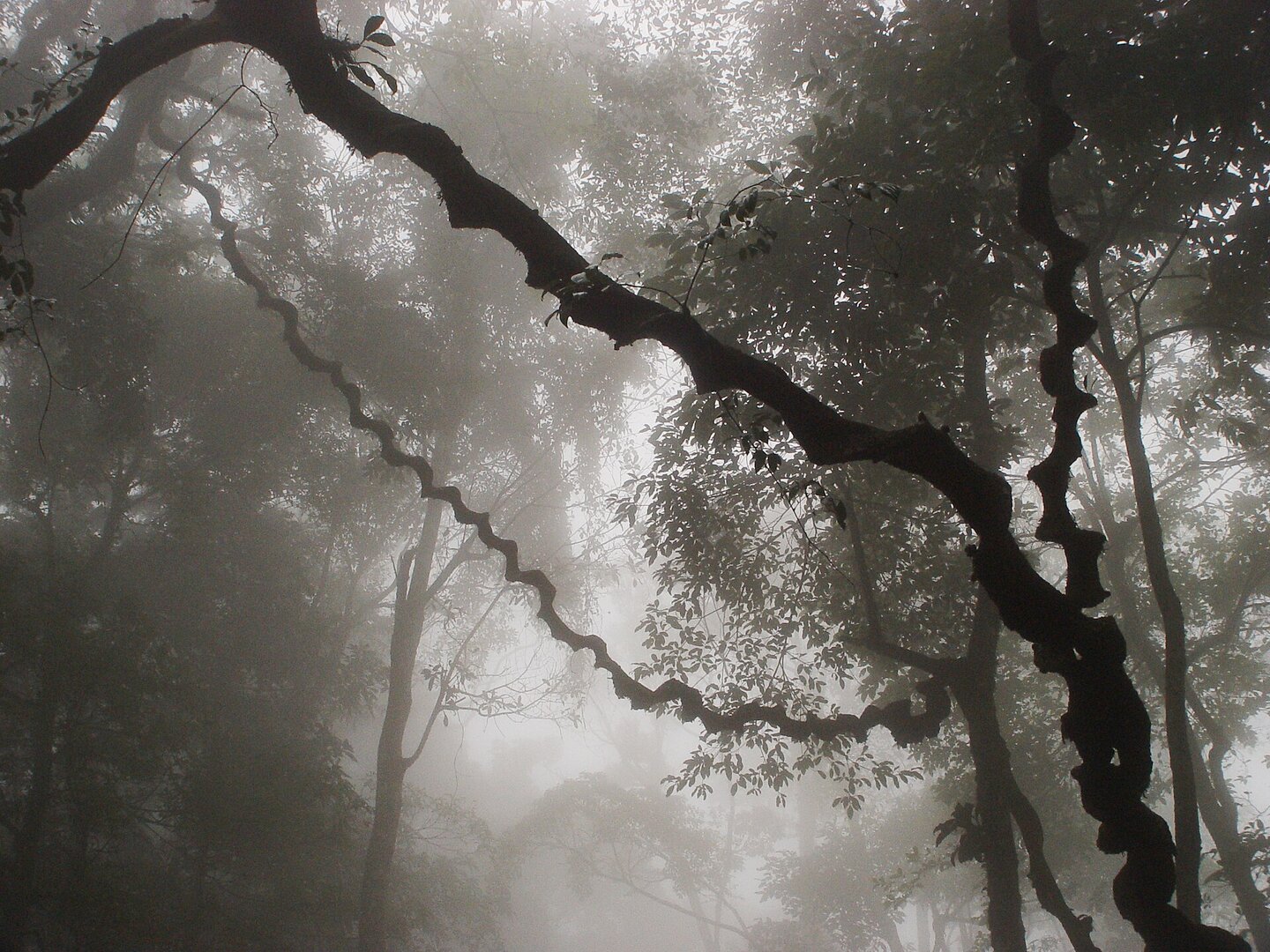
The road beyond the gate climbs steeply with many hairpin bends: check your vehicle and fill up with fuel first, wear low-soled shoes, and do not switch off the engine or let the vehicle coast when going downhill. The fog is sometimes so thick that people cannot see each other from a few dozen metres away (park management board). Summer often brings sudden thunderstorms; in rain and storms do not enter streams, trails, steep roads or dense forest, and do not shelter under large trees when there is thunder and lightning. Typhoon Yagi in 2024 caused landslides on the road from the 400 m level up to the 1,100 m level, and the stretch up to Đền Thượng was once closed to vehicles; the 2026 situation is not verified. Early mornings and evenings are colder than in the inner city, so bring a warm layer. Picking flowers, breaking branches, hunting and lighting fires against the rules are prohibited.
What this place is
A national park of more than 9,700 ha on the land of Hà Nội and Phú Thọ. The forest is divided into three evergreen types by altitude, mist covers the mountain almost all year, and it gets cooler the higher you go. In the early 20th century the French set up a hill resort here; today the forest still holds the ruins of a roofless church, an orphanage, a summer camp and a political prison.
Busy and quiet times
Late October into November, the wild sunflower (dã quỳ) season, is the busiest time: weekends easily bring traffic jams, with cars queuing in front of the ticket gate, so the park advises going on weekdays. Around the death anniversary and birthday of Uncle Hồ, the temple dedicated to him on Vua Peak is also crowded.
Eating
The restaurant at the 400 m level takes group bookings.
Photographs
15 of 15 on filePhó Nháy · CC BY-SA 4.0 · source
Steven C. Price · CC BY-SA 4.0 · source
Khoitran1957 · CC BY-SA 4.0 · source
Khương Việt Hà (Viethavvh) · Public domain (PD-self) · source
Nguyễn Mạnh Cường (Manhcuong23188) · Public domain (PD-user-w) · source
Khương Việt Hà (Viethavvh) · CC BY-SA 3.0 · source
Khoitran1957 · CC BY-SA 4.0 · source
Bem photography · CC BY 2.0 · source
Tycho (Shansov.net) · CC BY-SA 3.0 · source
Steven C. Price · CC BY-SA 4.0 · source
Quangnlnhe182394 · CC0 1.0 · source
Viethavvh (vi.wikipedia) · Public domain (PD-user-w) · source
Khương Việt Hà (Viethavvh) · CC BY-SA 3.0 · source
The story
Ba Vì National Park: an old hill station kept by the forest
Picture a collapsed church with no roof, standing in old-growth forest. Nearby are the ruins of an orphanage, a summer camp and a political prison. In the early 20th century the French turned these mountains into a hill resort. They built a livestock farm and rest houses at the 400 m mark (cốt 400; cốt means an elevation marker) and cut a road up to 1,000 m. The mountain's literary name is Tản Viên, meaning 'round parasol', because from a distance it looks round like a canopy. Today all of this lies inside Ba Vì National Park, about 60 km west of central Hanoi. So what did the people who came later do with what was left behind?
Vibe
Tags
Source
Most facts come from the website of the Ba Vì National Park Management Board, read in Sep 2026: the Overview page (area, founding year 1991, forest types, spiritual structures), the Climate page (fog, temperature by altitude, thunderstorms), the Flora and Fauna pages, the Tourist Spots and Routes page, Accommodation, Service Prices, the weather warning article of 29 Sep 2025, and the notice with guidance for visiting during the wild sunflower season of 2025 (the road in, advice for the mountain pass road, conservation rules, the crowded season). The distance from Hanoi and the endemic species come from the National Biodiversity Database. The news of landslides after Typhoon Yagi comes from VietnamPlus (2 Oct 2024). The sea of clouds and the height of Vua peak come from Dân trí (2024). The Heritage Tree of blue cypress comes from VnExpress (Feb 2024). Forest walking, the cactus garden and the French ruins come from VnExpress (2022, 2024). The summer-escape season comes from Tiền Phong (2024). The name Tản Viên, the history of the French hill resort and the year the temple to Uncle Hồ was built come from Vietnamese Wikipedia. Rejected and not included: the hypothesis of an ancient volcano 200 million years old (inconsistent with geological documents); cloud-hunting times by the minute and the figure of 15,000 visitors a day (true only for one season, one year); bus routes and tent rental prices for camping (old or conflicting sources, no document from the Park on the camping area); the detailed parking fee table (applied from 2019); the old area figure of 10,814 ha; detailed counts of animal and plant species (differing between surveys); the exact number of stone steps (sources disagree). Not yet verified: the condition of the road up to Đền Thượng (the Upper Temple) in 2026, the coordinates of the ticket gate, the safety of the stream bathing route and the forest fire season. Photos come from Wikimedia Commons, with author and licence credited on each photo.
Place data is compiled from many sources across the internet by a team of automated AI agents that collect, enrich, check, challenge, score, edit, review and verify it.
Ratings & comments
Anyone can read. Sign in to rate, comment and like.