Quốc Tử Giám Street · Religious site
Temple of Literature
Picture an enclosed expanse in the middle of Hà Nội, laid out in five successive spaces, where stepping in from the street leaves the traffic behind you.
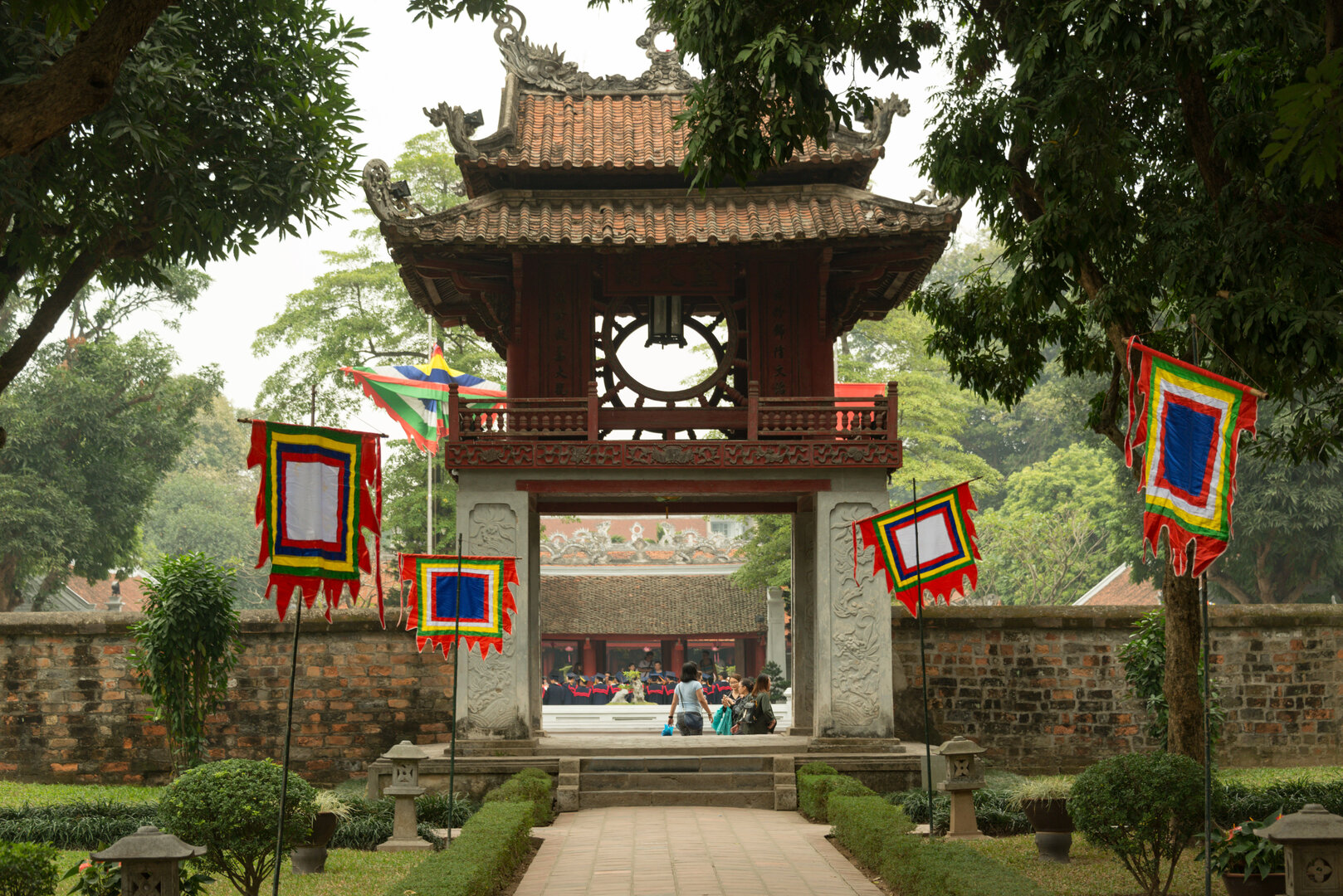
Picture an enclosed expanse in the middle of Hà Nội, laid out in five successive spaces, where stepping in from the street leaves the traffic behind you. This is Văn Miếu – Quốc Tử Giám: a temple of literature and, beside it, an imperial academy. The odd part is that you have almost certainly seen a piece of it already. The small pavilion with two tiers of roof, sitting on four brick pillars with its lower level open on all sides — Khuê Văn Các — is the image Hà Nội chose as its own emblem, and that choice is written into law. Not tall, not imposing, and yet it is what the whole city uses to introduce itself.
The Old School That Became a City's Face
Are you curious how people studied and sat examinations here nearly a thousand years ago? In 1070, King Lý Thánh Tông had Văn Miếu built to honour Khổng Tử — Confucius — and the earlier Confucian sages. Six years later, in 1076, King Lý Nhân Tông founded Quốc Tử Giám next to it, at first open only to the king's sons and the children of the nobility. Not until 1253 did King Trần Thái Tông enlarge the school to admit talented children of commoners as well. Then in 1370 the teacher Chu Văn An died and was enshrined at Văn Miếu, placed beside Confucius himself: a Vietnamese schoolmaster seated with the sage of the entire tradition he taught. Counting to 2026, Quốc Tử Giám turns 950 years old.
Once inside, what holds people longest is usually the stone stelae mounted on the backs of stone tortoises. In 1484 King Lê Thánh Tông ordered stelae raised to name the doctoral laureates, recording retroactively the examinations held from 1442 onward. More were once erected than stand today; 82 remain, naming more than 1,300 men who passed the highest imperial examinations between 1442 and 1779 — a roll of honour cut in stone. In 2010 those 82 stelae were recognised by UNESCO's Memory of the World Committee for Asia and the Pacific. Khuê Văn Các is best looked at from below: the upper level is timber, with two tiers of tube-tiled roof, pierced by four round windows, each ringed with small turned wooden bars radiating outward to stand for rays of light. Khuê is the constellation that governs literature, and the pavilion was built to say exactly that.
But the place did not come through those centuries intact. Around 1802–1805, when the capital moved to Huế, the school here ended its role as the national academy — and in that same year, 1805, Nguyễn Văn Thành, then Tổng trấn (governor-general) of Bắc Thành, had Khuê Văn Các built. Under French rule the site was turned by turns into a barracks for colonial infantry, a bugle school for the French expeditionary army, and a municipal infirmary; the French returned it to worship after protest from the public and from intellectuals. In 1947 French artillery brought down the Thái Học hall, leaving only foundations and stone columns; the Thái Học quarter you see today was reconstructed at the end of the twentieth century. So what actually survives here, when the timber and tiles all had to be raised again? From 1885 to now, painters have kept returning to the subject — Bùi Xuân Phái painted "Thăm Văn Miếu" (Visiting Văn Miếu) in 1984, and Trịnh Hữu Ngọc set up his easel on the spot through the 1970s. Perhaps you can only answer for yourself while standing under those four round windows, inside a place that stopped being a school more than two hundred years ago.
Timeline
- 1070Văn Miếu built in 1070
- 1076Quốc Tử Giám founded in 1076
- 1442recording retroactively the examinations held from 1442 onward
- 1947In 1947 French artillery brought down the Thái Học hall
- 2026Counting to 2026
Photographs
9 of 9 on fileEnough to decide whether to go
- What it is
- Văn Miếu honours Khổng Tử (Confucius) and earlier Confucian sages; Quốc Tử Giám, beside it, was the imperial court's school
- How old
- Văn Miếu built in 1070; Quốc Tử Giám founded in 1076
- Where
- 58 Quốc Tử Giám street, Hà Nội
- Most worth seeing
- The 82 doctoral stelae on stone tortoises, and the Khuê Văn Các pavilion
- Layout
- The grounds are divided into five successive spaces, one leading to the next
- Tickets
- Daytime visits are ticketed; a separate evening programme is also offered
From someone who has been
Daytime is for reading: walk all five spaces and linger at the stele garden and the Thiên Quang well. At night it is nearly a different place — the evening programme lights the old architecture, projects a 3D mapping show onto it, and puts you in front of a thầy đồ (a traditional scholar-calligrapher), with calligraphy to try and a woodblock print of Khuê Văn Các on dó, the traditional Vietnamese paper, to take home. Anyone drawn to writing, to old timber architecture, or simply curious about what an older society prized, tends to stay longer than planned.
Vibe
Tags
Source
dsvh.gov.vn, vanmieu.gov.vn, congluan.vn (17 Dec 2025)
Place data is compiled from many sources across the internet by a team of automated AI agents that collect, enrich, check, challenge, score, edit, review and verify it.
Ratings & comments
Anyone can read. Sign in to rate, comment and like.