Old Quarter · Museum · Landmark
Ma May Heritage House
Picture the familiar tube house of Hanoi's Old Quarter, with its slim frontage and a body that runs deep from the street, then step inside and find that it doesn't grow darker but keeps opening onto courtyards.
Picture the familiar tube house of Hanoi's Old Quarter (nhà ống, a long, narrow house), with its slim frontage and a body that runs deep from the street, then step inside and find that it doesn't grow darker but keeps opening onto courtyards. This is the Heritage House at 87 Ma May: a house built for both living and trading, dating from the 19th century and ranked a national relic (di tích quốc gia) in 2004. Today it is open to visitors, and there is an entrance fee.
A narrow tube house, so why is it so airy and bright?
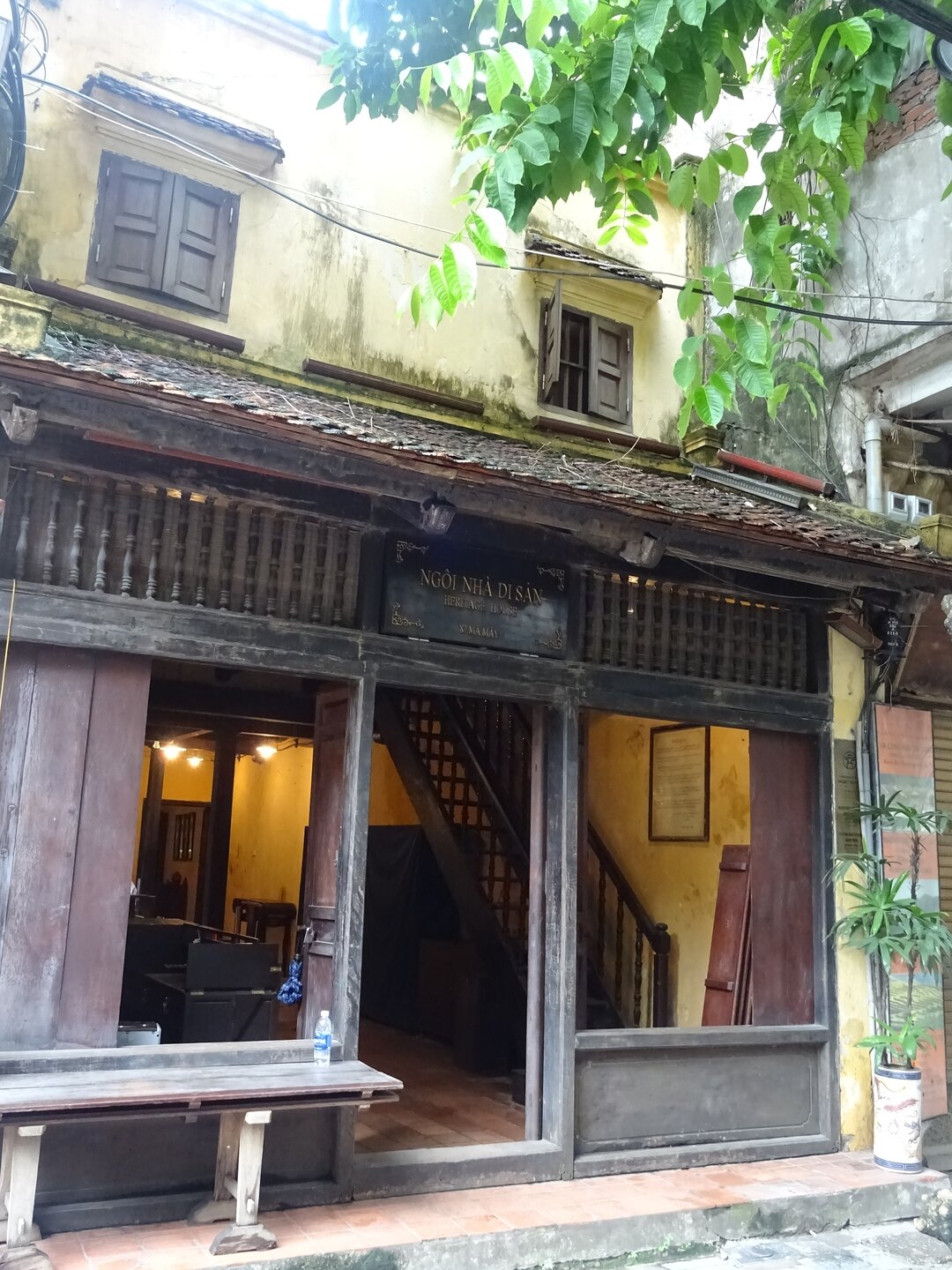
The frontage is only 5 metres wide, the house runs 28 metres back, and the rear is a metre wider than the front. Folk belief calls this kind of plot 'nở hậu', or 'widening behind', and holds that it brings good fortune later on. You walk through the house in the order it was once lived in. The front section, facing the street, was the shop. Its main door is a panelled door (cửa bức bàn) with a bolt, flanked by wide windows closed with removable sliding shutters made of solid wooden boards, and above them a band of turned wooden balusters runs the full width of the façade. A wooden staircase leads up to the reception room, and the altar room sits right beside the top of the stairs. Past the 'dry courtyard', where the owners once set out potted bonsai, comes the second section. Its ground floor held storage and the servants' quarters. Upstairs is the owner's bedroom, with doors carved with the four-seasons motif (tứ quý) and a front veranda roof built as a 'crab-shell' frame (vì vỏ cua) with softly carved plant patterns. The owner once drank tea and played Chinese chess (cờ tướng) on the front veranda, and the back veranda was once used for drying traditional Chinese herbal medicine (thuốc bắc). Next comes the 'water courtyard', partly a kitchen and partly a rainwater tank and washing place. The innermost section holds the outbuildings. On the upper floor there is also a middle room with a name worth remembering: 'the room for receiving old friends' (phòng tiếp cố nhân).
The house you see today is the result of a choice. Before 1945 a rice merchant lived here. After 1945 a Chinese merchant who sold herbal medicine bought the house to live and trade in. From 1954 to 1999, five families were assigned to live in it together. In 1999 the house was restored under an Old Quarter conservation partnership between Hanoi and the French city of Toulouse. A three-storey block added at the back and the partitions put up over the years were torn down to return the house to its original layout, and it then opened to visitors. After a pilot renovation within the Old Quarter conservation project, it became the model traditional house of Hanoi's Old Quarter. The press calls it a 'living museum' of old Hanoi's way of life, culture and architecture.
If you have ever lived in a tube house, do you know where its air and light come in? Here the answer sits in the middle of the house. Thanks to the two courtyards between its sections, a house this narrow still gets very good airflow and light. The gable walls shared with the houses on either side are built stepped in three tiers, both as decoration and to stop fire spreading and keep out damp. The outer walls are handmade solid brick laid in lime-and-sand mortar, with no cement. The roof slopes down on both sides and is covered with two layers of traditional Vietnamese tiles (ngói ta). The house also still does its work: it often hosts cultural activities around festivals and Tết (the Lunar New Year), such as folk performances, introductions to Tết customs, craft displays, tea and calligraphy. Then you step back out onto Mã Mây street and look at the narrow fronts on either side. Behind those doors, how many courtyards are left?
Photographs
7 of 7 on fileEnough to decide whether to go
- What it is
- A 19th-century tube house built for living and trading; the model traditional house of Hanoi's Old Quarter
- Heritage status
- Ranked a national relic in 2004
- Don't miss
- The dry courtyard, the water courtyard and the crab-shell veranda roof upstairs
- Entry
- Entrance fee charged
- Address
- 87 Mã Mây, Hoàn Kiếm ward (phường, an administrative unit under the city), Hanoi
- Street name
- Mã Mây combines the names of two old streets: Hàng Mã and Hàng Mây
From someone who has been
The house is open to visitors, and there is an entrance fee. Go slowly, in order, from the street-side shop back to the water courtyard, and don't miss the crab-shell veranda roof upstairs. Anyone living in a tube house now, and anyone who loves old timber and brick, will find plenty to take home. If you want to see the house with tea and calligraphy in it, come around festivals and Tết, when it often hosts cultural activities.
Vibe
Tags
Source
Architecture, layout, materials, interior, dating and the history of the successive owners follow the monument file 'Nhà số 87 Mã Mây' (House No. 87 Mã Mây) of the Department of Cultural Heritage. The 2004 national monument ranking also follows this file. The story of the 1999 restoration under the Hà Nội–Toulouse cooperation, removing the add-on extensions to restore the original layout, follows French Wikipedia, checked against the French Ministry of Foreign Affairs page on the Hà Nội–Toulouse old-quarter conservation cooperation since 1996. The role of a model house follows Nhân Dân newspaper (2018). The five families living together from 1954 to 1999 follows Hà Nội Mới (2015). The name of the room 'phòng tiếp cố nhân' (old-friends reception room) follows a Vietnam News Agency (TTXVN) photo published on VietnamPlus (7 Oct 2020). The Hoàn Kiếm ward address follows Resolution 1656/NQ-UBTVQH15 of 2025 on the reorganisation of Hà Nội's administrative units. The fee collection and e-tickets follow the Government Portal (6 Jan 2025). The reopening after renovation follows Hà Nội Mới (25 Jan 2026). The operator and holiday cultural activities follow Nhịp sống Hà Nội (2026). The name of Mã Mây street and its French-era name follow Vietnamese Wikipedia. What was rejected, and why: the construction year '1890', along with the two phrasings 'early' and 'late' 19th century, because the source lines differ by almost a century so only '19th century' is kept; the sentence 'everything was kept as it was', because it contradicts the restoration having removed the add-on extensions; ca trù singing, the 'street-trade stories' tour and the daily visitor numbers, because they are activities and figures from before the 2025–2026 renovation that nobody has confirmed are still accurate; opening hours, because there is no official source and the press gives at least four different time slots. All sources were opened and cross-checked on 11 Sep 2026. Photos are from Wikimedia Commons, by Christophe95 and Guerinf, licensed CC BY-SA 4.0.
Place data is compiled from many sources across the internet by a team of automated AI agents that collect, enrich, check, challenge, score, edit, review and verify it.
Ratings & comments
Anyone can read. Sign in to rate, comment and like.