Đền Hùng, Phú Thọ · Landmark
Hung Kings' Temple
Picture a day in the first part of the third lunar month, when the whole country stops work to remember one place — and that place is a real hill, 175 metres high, in Hy Cương commune, Phú Thọ province.
Picture a day in the first part of the third lunar month, when the whole country has the day off. That holiday is not tied to an event but to a real address: Nghĩa Lĩnh hill, 175 metres high, in Hy Cương commune, Phú Thọ province. The hill has carried other names over time — Hùng Vương sơn, Núi Cả, Nghĩa Cương, Hy Sơn, Bảo Thiếu Lĩnh — and the site around it spreads across several communes rather than sitting inside one fenced plot.
The Hill Behind a Day Off for the Whole Country
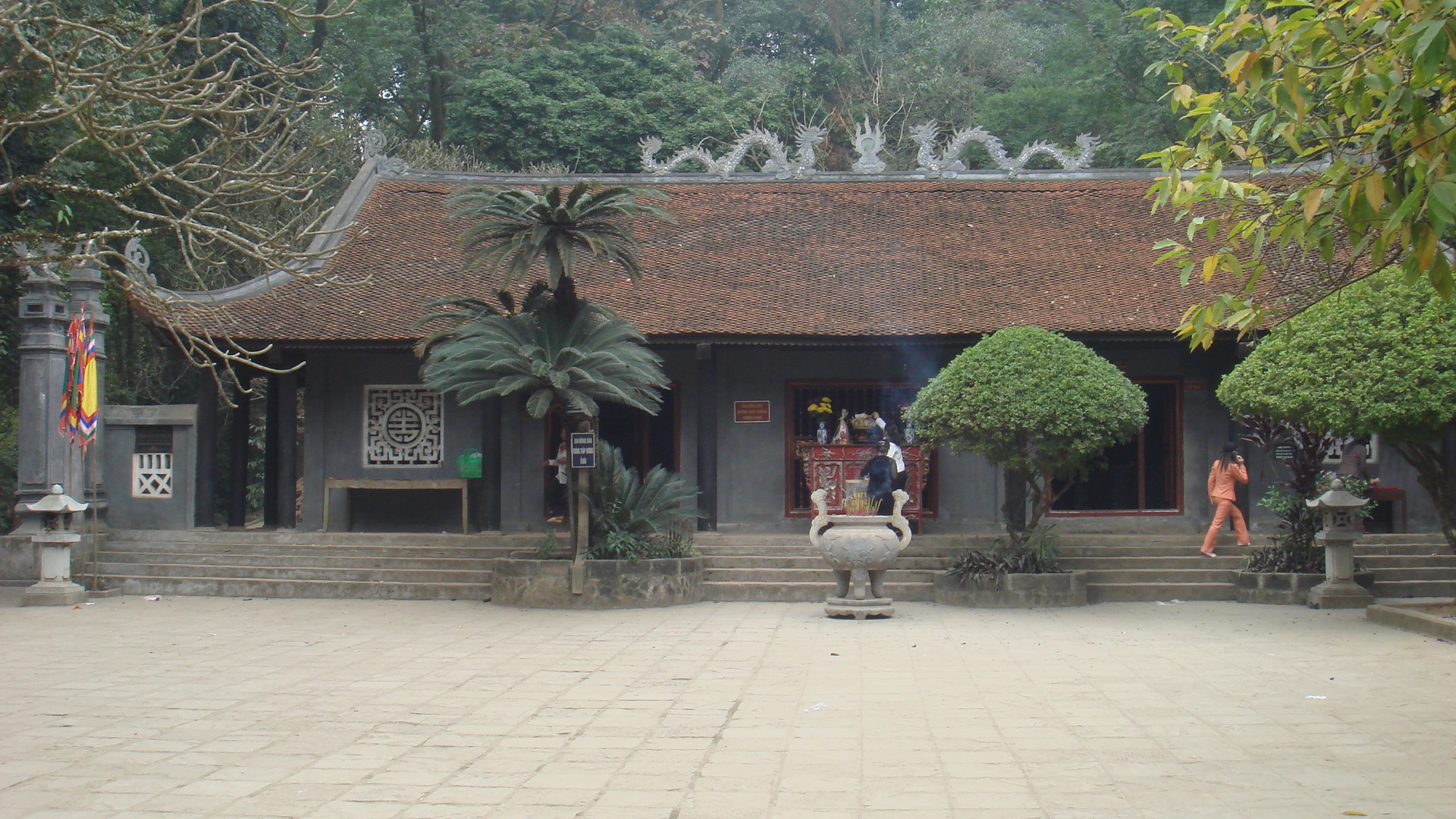
Visiting here means walking uphill, and the walk has an order to it. First the main gate, built in 1917: an arched structure of two storeys and eight roof tiers, its front face moulded with two armoured warriors, one holding a spear, the other a battle axe; across the middle of the first storey runs the inscription "Cao sơn cảnh hành", usually translated as "Climb the high mountain, see far and wide". Then đền Hạ, the Lower Temple, said by legend to be where Âu Cơ gave birth to a sac of a hundred eggs that hatched into a hundred children — fifty following their father to the sea, forty-nine following their mother to the mountains. Beside it stands Thiên Quang pagoda, with two monks' stupas whose tops are moulded as lotus flowers, and in front of its door a three-crowned cycad with a leaning trunk, estimated by researchers at around 800 years old. Another stretch of slope brings you to đền Trung, the Middle Temple, where a plain stone table with eight seats still sits in the yard, its surface darkened by time. At the summit is đền Thượng, the Upper Temple, whose classical name "Kính thiên lĩnh điện" means a hall for worshipping heaven — simple truss framing, no carving, built across four terraced levels.
Are you curious what a place like this still does today? It remains a working place of worship rather than an object on display: groups who wish to offer incense register in advance with the site management board and wait for confirmation, and the site still receives donations towards restoration. Around the grounds there are guides, electric shuttle carts, places to buy offerings, souvenirs, food and lodging. The heritage here has not stopped growing either: the temple to Mother Âu Cơ on Vặn hill was inaugurated at the end of 2004, and the temple to Lạc Long Quân on Sim hill in 2009 — both works of this century, added to a complex that was already centuries old.
Some things here say plainly that time has passed through. To the left of the Upper Temple stands a stone oath pillar just over a metre tall; the one standing there now is a newly made agate version, while the older pillar, found during a survey in the 1960s, has been moved into the Hùng Vương Museum. The bell hanging in Thiên Quang pagoda's bell tower carries no casting date, only the old administrative names of this very spot: "Đại Việt quốc, Sơn Tây đạo, Lâm Thao phủ, Sơn Vi huyện, Hy Cương xã, Cổ Tích thôn cư phụng". In the same museum sits the Hy Cương bronze drum, its face 93 cm across, the largest Đông Sơn drum yet known in Vietnam and now a national treasure. Lower down is đền Giếng, the Well Temple, whose rear chamber still holds the round Ngọc well, stone-lined, its water clear and cool all year — by legend the place where the two princesses Tiên Dung and Ngọc Hoa came to comb their hair by their own reflection.
The forest on the hill still keeps its many-layered shape, and the path is still the old path: up in stages, pausing at each temple. A day off that a whole country has kept for so long — would you like to find out where it began, by climbing that slope yourself once?
Photographs
10 of 15 on fileThang Nguyen· CC BY-SA 2.0 · source
Bùi Thụy Đào Nguyên· CC BY-SA 3.0 · source
Bùi Thụy Đào Nguyên (Thuydaonguyen)· CC BY-SA 3.0 · source
Khương Việt Hà (Viethavvh, vi.wikipedia)· Public domain (PD-user, tác giả tự từ bỏ quyền) · source
Thang Nguyen· CC BY-SA 2.0 · source
Hoài Hương· CC BY-SA 4.0 · source
Thang Nguyen· CC BY-SA 2.0 · source
Hoài Hương· CC BY-SA 4.0 · source
Hoài Hương· CC BY-SA 4.0 · source
Hoài Hương· CC BY-SA 4.0 · source
Enough to decide whether to go
- What it is
- Hung Kings Temple Historical Site — a complex of four temples, one pagoda and one tomb on and around Nghĩa Lĩnh hill
- Where
- Cổ Tích hamlet, Hy Cương commune, Phú Thọ province
- The route
- Main gate → đền Hạ and Thiên Quang pagoda → đền Trung → đền Thượng at the summit → down to đền Giếng
- Ranking
- Special national relic site since 2009
- UNESCO
- The worship of Hung Kings in Phú Thọ was inscribed as Intangible Cultural Heritage of Humanity in 2012 — the practice was inscribed, not the temple buildings
- Festival
- Hung Kings' commemoration on the tenth day of the third lunar month; the festival runs through the first ten days of that month, with palanquin processions from village communal houses up to the temples, Xoan singing and bronze-drum playing
From someone who has been
If you want to see this hill doing its work, come during the festival in the first part of the third lunar month, when palanquins are carried up from the village communal houses and bronze drums sound along the slope. If you want to hear it quiet, come on an ordinary day and pick clear weather: from up there you look out over the Bạch Hạc confluence, where the Red, Lô and Đà rivers meet, with the Tam Đảo range far to the east and Ba Vì to the south. Those are two quite different visits.
Vibe
Tags
Source
The information on Đền Hùng on this page comes from four layers of sources, checked on 13 Sep 2026. Its status as a special national monument comes from Decision 1272/QĐ-TTg of 12 Aug 2009, read directly on the Government's electronic portal. The architectural description of each component — the temple gate, Lower Temple (đền Hạ), Thiên Quang Pagoda, Middle Temple (đền Trung), Upper Temple (đền Thượng), the Hùng Vương Mausoleum, Well Temple (đền Giếng), the Temple of Ancestral Mother Âu Cơ and the Temple of Lạc Long Quân — comes from the file of the Department of Cultural Heritage (dsvh.gov.vn) and Tạp chí Xây dựng (Construction Magazine). Operating information, on-site services and how to register for group incense offerings come from the official portal denhung.vn, launched on 3 Feb 2026 to replace the old site that had run since 2008. The landscape and vegetation on Nghĩa Lĩnh mountain come from an article by the Vietnam News Agency. The UNESCO inscription in 2012 was of the Worship of Hùng Kings in Phú Thọ, not an inscription of the temple itself — this is a common confusion and was re-checked on UNESCO's page. Three figures were dropped because the sources contradict one another: the number of stone steps up to the temple (sources give 225, 539 and over 700; the Việt Trì city government page of 19 Nov 2019 gives a set of numbers that correctly adds up to 539, so the figure of over 700 was dropped), the area of the monument complex, and the height and discovery date of the Hy Cương bronze drum. The founding date from the time of Đinh Tiên Hoàng appears in only one reference source and not in the heritage file, so it is not included. The oath stone pillar beside the Upper Temple today is a newly made replacement; the old pillar was moved to the Hùng Vương Museum and its origin has never been established (Tuổi Trẻ, 14 Apr 2011). Opening hours and ticket prices are left blank because they are not on the official source.
Place data is compiled from many sources across the internet by a team of automated AI agents that collect, enrich, check, challenge, score, edit, review and verify it.
Ratings & comments
Anyone can read. Sign in to rate, comment and like.