Hồ Tây, Hà Nội · Religious site
Trấn Quốc Pagoda
Picture Thanh Niên Road, the street between West Lake and Trúc Bạch Lake that you may already have driven along, as an old dike leading out to a pagoda on an island. That pagoda still stands at the end of the road.
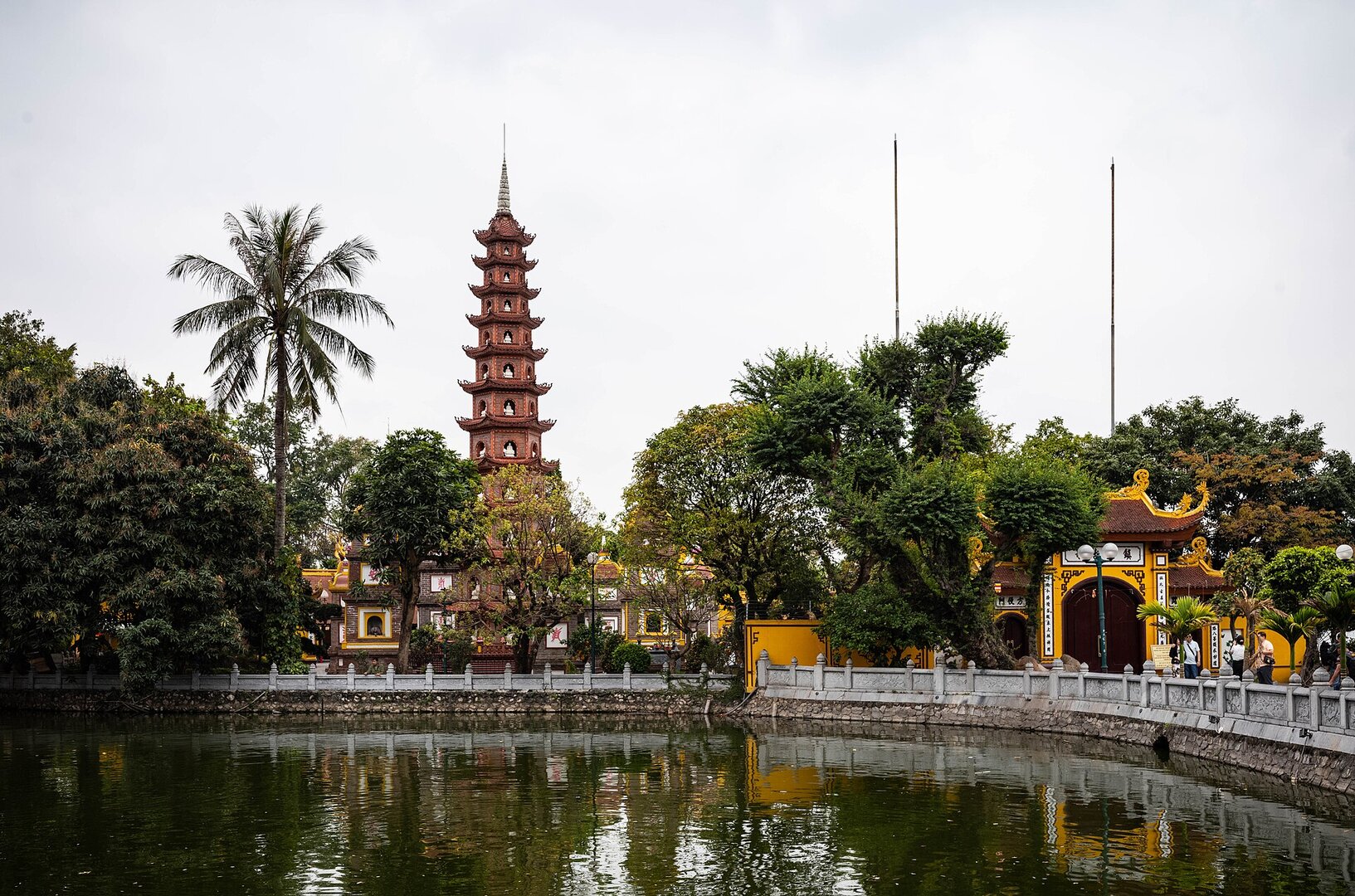
Picture Thanh Niên ("Youth") Road, the street between West Lake (Hồ Tây) and Trúc Bạch Lake, as it once was: the Cổ Ngư dike, leading out to a small island. On that island stands Trấn Quốc Pagoda, regarded as the oldest pagoda in Hanoi. When the pagoda was first moved here, there was no road, and people had to reach it by boat. Later, the people of two villages, Yên Phụ and Yên Quang, built up the Cổ Ngư dike, then a path from the dike to the pagoda. Today it is wrapped in dense trees and lake water, so even in the busy West Lake area it keeps a quiet, private space of its own.
Three names for guarding a country, at the end of Thanh Niên Road
Legend has it that the pagoda was founded in the time of Lý Nam Đế, in the 6th century, on a bank of the Red River in Yên Hoa village. Its first name was Khai Quốc, meaning "opening the country". Under the Lý and Trần dynasties it was regarded as the centre of Buddhism in Thăng Long, the old name of Hanoi. Under King Lê Thái Tông, after the Lam Sơn uprising, it was renamed An Quốc, "peace for the country". In the early 17th century the riverbank eroded, and the pagoda was moved onto Kim Ngư ("Golden Fish") island in West Lake, on the old foundations of the Lý-dynasty Thúy Hoa palace. During the Later Lê restoration it took the name Trấn Quốc, "guarding the country". Under Emperor Thiệu Trị it was renamed Trấn Bắc, yet people kept calling it Trấn Quốc, as they still do today. Aren't you curious why the court changed the name, but the people of Hanoi never changed what they called it?
You enter through the tam quan, a three-entrance gate that was rebuilt in recent times. Above the door are the words "Phương Tiện môn" (the Gate of Skilful Means), flanked by a couplet in Nôm, the old Vietnamese script: "Carriages and horses ring past on the worldly road / Mountains and rivers open before the Zen gate." From the gate you can already see an 11-storey, reddish-brown stupa rising above the dividing wall. Walk straight along the brick path by the lake and you reach the courtyard of the front hall, shaded by a wide-canopied bodhi tree. In 1959, Indian President Rajendra Prasad gave President Hồ Chí Minh a bodhi tree grown from a cutting of the tree at Bodh Gaya, where the Buddha attained enlightenment. It was planted here, and a stone stele beside it records its history. Across from it, as its counterpart, stands the Lục độ đài sen stupa, inaugurated in 2003 and crowned by a nine-tiered lotus. As the abbot explains, the lotus stands for Buddha-nature and the bodhi tree for awakened wisdom. Inside the pagoda, look for the gilded wooden statue of Shakyamuni entering Nirvana, which locals call the Reclining Buddha. If you turn left just after the gate, you come to a garden of 18th-century stupa tombs.
This heritage doesn't just sit still in stone steles. According to the abbot, hundreds of cuttings taken from the courtyard bodhi tree have been planted at pagodas across the country, including one at a pagoda on the Trường Sa (Spratly) Islands. The site was also once a hành cung, a royal retreat, of the Trịnh lords. The Nôm poem "Chùa Trấn Bắc" (Trấn Bắc Pagoda), often attributed to Bà Huyện Thanh Quan, opens with the line "Trấn Bắc hành cung cỏ dãi dầu", describing grass weathering on the old palace grounds. Soldiers burned only the rooms built around the pagoda, and the pagoda itself survived intact. Next time you pass along Thanh Niên Road, will you drive straight on, or turn in to the pagoda that the old dike once led to?
Photographs
10 of 10 on fileRB Photo· CC BY 4.0 · source
Gary Todd from Xinzheng, China· CC0 · source
Richard Mortel from Riyadh, Saudi Arabia· CC BY 2.0 · source
Jakub Hałun· CC BY 4.0 · source
Jakub Hałun· CC BY 4.0 · source
katiebordner· CC BY 2.0 · source
Gary Todd from Xinzheng, China· CC0 · source
Richard Mortel from Riyadh, Saudi Arabia· CC BY 2.0 · source
Jakub Hałun· CC BY 4.0 · source
Gary Todd from Xinzheng, China· CC0 · source
Enough to decide whether to go
- What it is
- A pagoda on a small island on the east side of West Lake, regarded as the oldest in Hanoi
- How old
- Said to date from the time of Lý Nam Đế, 6th century; moved to West Lake in the early 17th century
- Its names
- Khai Quốc → An Quốc → Trấn Quốc (for a time, Trấn Bắc)
- Don't miss
- The bodhi tree grown from a Bodh Gaya cutting, the 11-storey stupa, the gilded Reclining Buddha
- Getting in
- From Thanh Niên Road, between West Lake and Trúc Bạch Lake
- Status
- Listed as a national relic in the first round of listings, 1962
From someone who has been
For quiet, avoid the full moon of the first lunar month (Rằm tháng Giêng), when the pagoda is packed with worshippers. History lovers should give themselves time in the stupa garden and among the stone steles. With children, start with the story of the bodhi tree in the courtyard.
Vibe
Tags
Source
The history and names of the pagoda (the Lý Nam Đế era, the names Khai Quốc, An Quốc, Trấn Quốc and Trấn Bắc, the move onto the island in the early 17th century, the Cổ Ngư dyke) are compiled from the Tây Hồ 360 portal, the Hoàng thành Thăng Long site, the Người Hà Nội newspaper, the Phật giáo Hà Nội site and Vietnamese and English Wikipedia; accessed 15 Sep 2026. The Zen masters Thảo Đường and Thông Biện and the visit of Queen Mother Ỷ Lan to the pagoda in 1096 are based on Nguyễn Lang's Việt Nam Phật giáo sử luận and the translation of Thiền uyển tập anh on langmai.org; Zen master Khuông Việt is based on the scov.gov.vn portal. The bodhi tree of 1959 is per Công an Nhân dân (2019) and Thanh Niên (15 Oct 2023). The date of the stupa is per Tuổi Trẻ (27 Feb 2004). The listing as a monument in the first batch in 1962 is per the transcript of Decision 313-VH/VP of 28 Apr 1962 of the Ministry of Culture on caselaw.vn. The number of worshippers on the first full-moon day of the lunar year 2026 is per Dân trí (3 Mar 2026). The poem 'Chùa Trấn Bắc' is per Thi viện. The architecture, artifacts and routes within the pagoda are per 360.hncity.org and Vietnamese Wikipedia. Rejected: the listing year 1989 (the original document says 1962); the phrase 'one of the country's 12 great monuments' (12 is the number of items for Hà Nội alone); the sentence that Queen Mother Ỷ Lan 'often' held vegetarian feasts for monks (the original source records it only once); the monk's name 'Văn Phong' (the correct name is Vân Phong); 'the stupa built in 1998' (construction began in 1998, inaugurated in 2003); the claim that reclining Buddha statues are rare in the North (could not be verified). Not resolved, so not stated: whether the pagoda was moved in 1615 or 1616, the reign in which the name Trấn Quốc was given, the house number on Thanh Niên street, and the claim that the École française d'Extrême-Orient ranked the pagoda 'no. 10 in all Indochina'. Photos come from Wikimedia Commons (RB Photo, Jakub Hałun, Richard Mortel, katiebordner, Gary Todd) under the CC BY 4.0, CC BY 2.0 and CC0 licences stated on each photo.
Place data is compiled from many sources across the internet by a team of automated AI agents that collect, enrich, check, challenge, score, edit, review and verify it.
Ratings & comments
Anyone can read. Sign in to rate, comment and like.