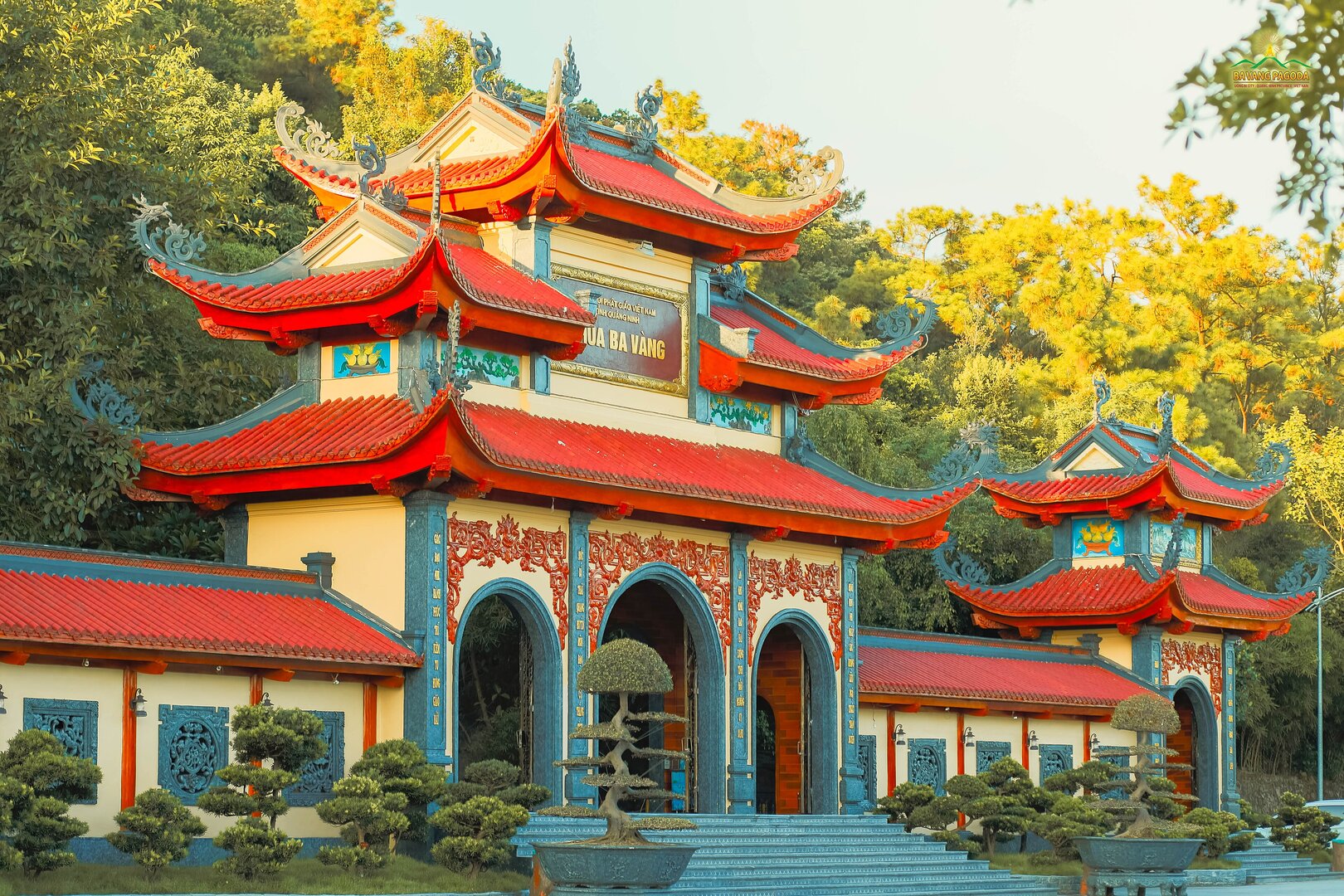
Phường Uông Bí, Quảng Ninh · Religious site
Ba Vang Pagoda
Picture a One Pillar Pagoda (chùa Một Cột), not in the heart of Hà Nội but in the middle of Bán Nguyệt (Half-Moon) Lake, halfway up a mountain in Uông Bí, Quảng Ninh. Around it stands a whole newly built pagoda complex. Of the old pagoda on this mountain, all that survives is a stone incense pillar with worn characters and a few other pieces.
Picture a One Pillar Pagoda (chùa Một Cột), not in the heart of Hà Nội but in the middle of Bán Nguyệt (Half-Moon) Lake, halfway up a mountain in Uông Bí, Quảng Ninh. Around it stands a whole newly built pagoda complex. Of the old pagoda on this mountain, all that survives is a stone incense pillar with worn characters and a few other pieces. This is Ba Vàng Pagoda. Its name in Chinese characters is Bảo Quang Tự, which means "precious light". It sits halfway up Thành Đẳng Mountain, a spur of the Yên Tử range, and looks out over the Bạch Đằng River. It is a sơn môn (a monastery belonging to a Zen lineage) of the Trúc Lâm Yên Tử Zen school, the Zen lineage founded by King Trần Nhân Tông. The pagoda explains the name "Ba Vàng" as the Tam Bảo, the Three Jewels of Buddhism: the Buddha, the Dharma and the Sangha.
Ba Vàng: a One Pillar Pagoda on the mountain, and a stone incense pillar with worn writing
The old layer is surprisingly thin. The province's heritage file dates the pagoda to the early 18th century, in the reign of King Lê Dụ Tông. The pagoda itself holds that it goes back to the Trần dynasty. It bases that on the patterns of old bricks and tiles: floor bricks decorated with a four-petal flower, a motif believed to date from the Trần period. The story goes that in 1987 an old farmer looking for his lost herd of cattle was told in a dream to climb the mountain. He stumbled and found bricks, tiles and a stone stele carved in classical Chinese script (chữ Nho). In 1988 the pagoda was rebuilt in wood, and in 1993 it became a small brick pagoda. Of the old pagoda, all that remains today is a stone incense pillar carved with the names of the pagoda and the mountain, its Chinese characters so worn they are very hard to read, a memorial stele for a Zen master, and a few stone column bases.
The pagoda you walk into today is a different building altogether. In 2011 work began on a new, large-scale complex, which was inaugurated in 2014. The way up starts at the Stone Gate, where statues of the Buddha's ten great disciples hold their alms bowls. Past the Middle Three-Entrance Gate (Tam Quan Trung) a small waterfall trickles through the rocks. Then comes the One Pillar Pagoda on Half-Moon Lake, and after it the Inner Three-Entrance Gate (Tam Quan nội), with a view over Uông Bí and the Bạch Đằng River. Along the courtyard corridors stand 18 Arhat (La Hán, the Buddha's enlightened disciples) statues, each carved from a single block of green stone and gilded. The main hall, Đại Hùng Bảo Điện, has two storeys and eight roofs. Inside, the statues, horizontal inscribed boards and parallel couplets are all finished in red lacquer and gold leaf. At the inauguration, a records organisation gave the pagoda the title "mountain pagoda with the largest main hall in Indochina".
So at a pagoda that is mostly newly built, where does the heritage lie? Are you curious what a Lê-era mountain pagoda once looked like, when all that is left is a stone pillar whose writing can barely be read? Perhaps the other half of the answer lies in what still goes on here. Behind the main hall, the upper floor of Phụng Tổ Đường, the Patriarchs' Hall, honours the Three Patriarchs of Trúc Lâm together with the founding master Tuệ Bích Phổ Giác. To the left of the main hall, the museum keeps a stele set on the back of a stone tortoise. Visitors still ask for water from Giếng Thần, the Sacred Well, to take home. The pagoda says the well has never run dry. The pagoda has also held a chrysanthemum festival several times at Tết Trùng Cửu, the Double Ninth festival, the first in 2013. It chose the chrysanthemum for its link to the poetry of the Third Patriarch Huyền Quang, and the festival has included calligraphy of his poem "Hoa cúc" ("Chrysanthemum"). Does a pagoda have to be old to count as heritage? Or is heritage what people today choose to keep, and how they keep it? Climbing Thành Đẳng Mountain is one way to find your own answer.
Photographs
5 of 5 on fileRachel41Ng (tải lên Commons) — ảnh mang logo Chùa Ba Vàng; EXIF ghi bản quyền Ban Văn hoá Chùa Ba Vàng· CC0 · source
Rachel41Ng (tải lên Commons) — ảnh mang logo Chùa Ba Vàng; EXIF ghi bản quyền Ban Văn hoá Chùa Ba Vàng· CC0 · source
Rachel41Ng (tải lên Commons) — ảnh mang logo Chùa Ba Vàng; EXIF ghi bản quyền Ban Văn hoá Chùa Ba Vàng· CC0 · source
Nghien87 — ảnh mang logo Chùa Ba Vàng· CC BY-SA 4.0 · source
Hangdo1409· CC BY-SA 4.0 · source
Enough to decide whether to go
- What it is
- A pagoda of the Trúc Lâm Yên Tử Zen school; provincial-level heritage site since 2007
- Where
- Halfway up Thành Đẳng Mountain, in Uông Bí, Quảng Ninh
- How old
- Early 18th century, reign of King Lê Dụ Tông; the present complex was built from 2011 to 2014
- Traces of the old pagoda
- A stone incense pillar, a Zen master's memorial stele, stone column bases
- Worth seeking out
- One Pillar Pagoda on Half-Moon Lake · 18 green-stone Arhat statues · the stone-tortoise stele in the museum
- Tickets
- No admission fee
From someone who has been
There is no admission fee. Ba Vàng is busiest in the spring festival season. If you want to take your time, avoid that season. If you do come during the festival season, the pagoda hands out free vegetarian meals to visitors. The path up to the Amitabha (A Di Đà) Buddha statue and the relic shrine is fairly steep. The pagoda suits people who already know Yên Tử and want to see another Trúc Lâm monastery, and anyone who likes looking for a few old stones inside a new building.
Vibe
Tags
Source
The pagoda's name, its provincial-level monument ranking in 2007, its type (History – Culture and Scenic Landscape), its Lê-dynasty date according to the file, and the restorations of 1988 and 1993 come from the Quảng Ninh Provincial List of Monuments with Decision 436/QĐ-UBND of 3 Feb 2026 of the Provincial People's Committee, published on the Quảng Ninh Department of Culture and Sports site. The ward name after the 2025 reorganisation was checked against the list of administrative unit reorganisations on the Government's Policy and Life portal; according to the same portal (24 Aug 2026), from 1 Sep 2026 Quảng Ninh is a centrally governed city. The Hán name Bảo Quang Tự, the explanation that 'Ba Vàng' means the Three Jewels (Tam Bảo), the 1987 legend, the visiting route, the Rừng thiền (Meditation Forest), the Giếng Thần (Sacred Well), the fact that no tickets are charged and the rhythm of study and practice come from the pagoda's own site, including a 2020 visiting guide; this is the pagoda's own account. The reading of 'Ba Vàng' as the Nôm name of Thành Đẳng mountain, the ancient brick patterns and the couplets of the 1993 pagoda come from Dân trí (2014). The relics of the old pagoda, the rebuilding in wood in 1988, the name of the founding Zen master and the start of new construction in 2011 come from VietNamNet; the inauguration date of 9 Mar 2014 from Zing News; the Trúc Lâm Yên Tử Zen lineage from Tiền Phong (2019); the architecture of the main hall and the Arhat corridor from the Công nghiệp Môi trường site and Báo Lào Cai; the shrine of the Three Patriarchs from Báo Quảng Ninh (2014); the Great Lecture Hall from Thanh Niên (22 May 2023); the chrysanthemum festival from Giác Ngộ (2013); the vegetarian meals in festival season from Đại biểu Nhân dân (17 Feb 2023); the number of visitors in the opening-of-spring season, the absence of food stalls and the free parking from Tuổi Trẻ (24 Feb 2026). We do not state: the altitude of 340 m, because the elevation model puts the pagoda at only about 200 m and the figure is a passage copied back and forth among many newspapers; the year 1676, because it is not a year of the Ất Dậu cycle; the birth and death years of the Zen master, the area of the main hall and the grounds, and the dimensions of the Quán Thế Âm statue and the stone incense pillar, because sources differ; the exact text inscribed on the stone incense pillar, because there are two different readings and the characters are worn; the orientation of the main hall, because two sources contradict each other; the story of the patriarch curing a serious illness, because it has only one source and a promotional tone; and the line 'the pagoda is crowded all year round', because the 2019 article containing it describes an earlier period and no recent source confirms it. 1706 is the figure recorded in the monument file; we do not treat it as an established founding year of the pagoda, because the inscription on the stone incense pillar, as reported in the press, may fall in 1705.
Place data is compiled from many sources across the internet by a team of automated AI agents that collect, enrich, check, challenge, score, edit, review and verify it.
Ratings & comments
Anyone can read. Sign in to rate, comment and like.