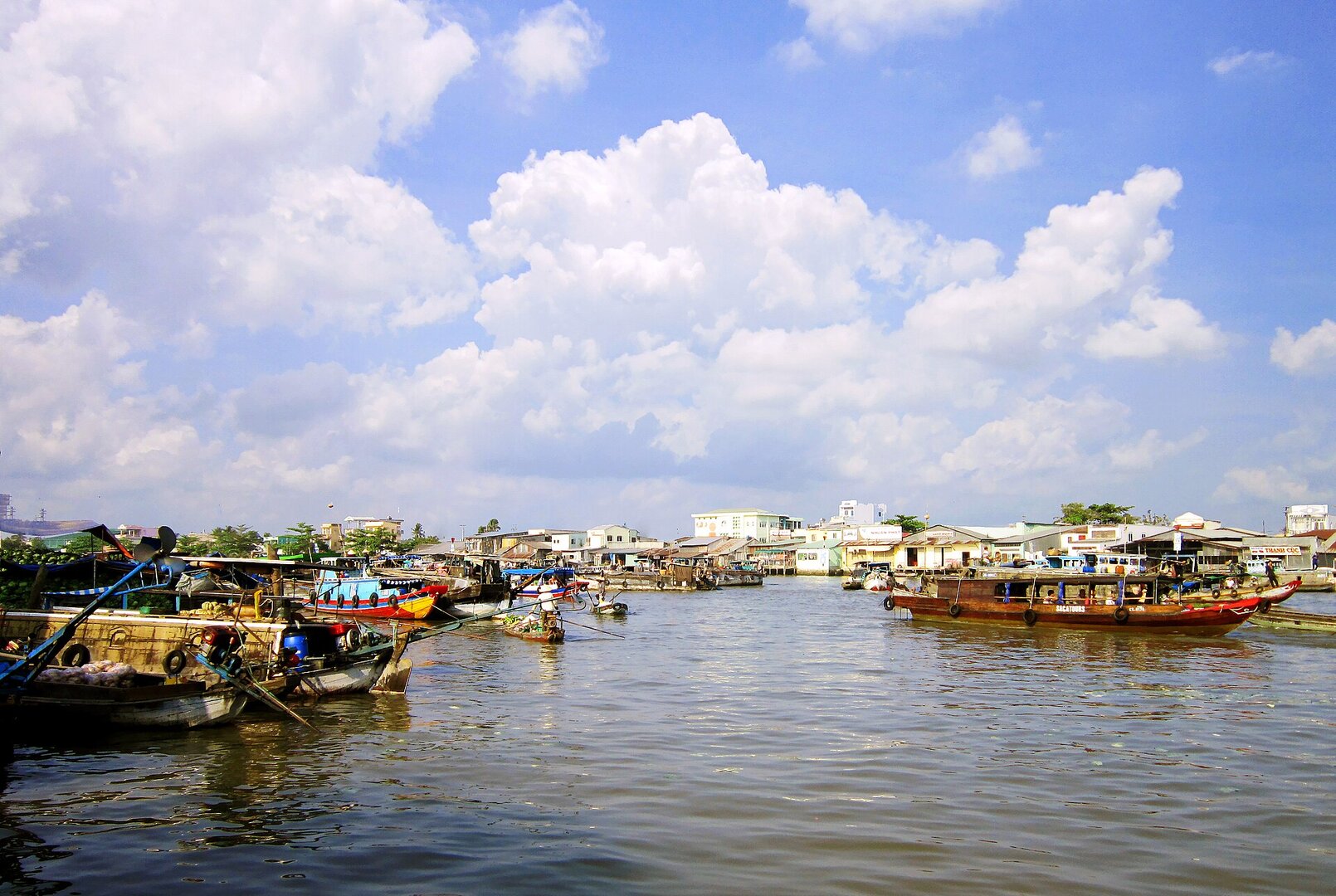
Chợ nổi Cái Răng, Cần Thơ · Market
Cái Răng Floating Market
Picture a tall pole on a boat with a watermelon dangling from the top: no signboard, no hawker's cry, yet a buyer can tell from far off exactly what that boat is selling.
Cái Răng Floating Market has no doors, no floors and no footpath in. It gathers right on the Cần Thơ River, a branch of the Hậu River (the Bassac), along a stretch of water more than a kilometre long: sellers and buyers alike sit in boats and small canoes. Every boat is both a stall and a home, anchored in place with open water left in the middle for other boats and visitors' boats to slip through. Instead of a signboard there is the cây bẹo, a pole hung with samples of whatever the boat sells, because a spoken cry would be drowned out by boat engines anyway. "Bẹo" is southern Vietnamese dialect for putting something on show.
Cái Răng Floating Market — what hangs is what's for sale
The rule of the bẹo pole fits in four words: what hangs is what's for sale. But market people have worked out three exceptions, and knowing them lets you read the whole river. Clothes on a pole are hung but not sold, because the boat is a home. Boats selling hủ tiếu (rice noodle soup), bánh canh (thick noodle soup) or coffee sell without hanging anything; that trade traditionally "shows off" with the sound of a horn instead. And a pole hung with a sheet of roofing thatch or a coconut frond means the thing for sale is the boat itself. Among a forest of poles hung with melons and cabbages, could you spot the boat whose owner wants to sell their whole roof?
People come before dawn, because the boat market gathers while it is still dark and is busiest in the early morning. At its core it is still a wholesale market for vegetables and fruit from the orchard country; goods pass between hulls by being tossed and caught, one person standing at the bow throwing fruit one by one, another paddling alongside to catch it. Visitors eat breakfast mid-river: a bowl of hủ tiếu cooked right on the boat, ladled with steaming nước lèo (broth) and handed across to someone sitting on the roof of their boat, who eats while steadying the bowl against the constant waves. It is a cheap, everyday breakfast; for anything else bought on the water, ask the price before you buy. The hủ tiếu here was never laid on for tourists: the noodle-making village on the riverbank once made it for the thương hồ, the river traders who live aboard their boats; the multicoloured noodles are a newer addition made for visitors. According to one vendor, the market thins out by mid-morning. Anyone arriving at midday or in the afternoon will find only the service rafts around the market, not the boat market itself.
The culture of Cái Răng Floating Market has been recognised as national intangible cultural heritage since 2016, but the river has not stood still. Only a few hundred boats remain, far fewer than before; as one boatman who carries visitors puts it, you used to look down from the bridge and see boats packed tight, and now only part of that is left. Many sellers are giving up the bẹo pole, steering motor canoes right up to visitors' boats to pitch directly. One long-time vendor says that these days it is harder to find a river trader in the market than a tourist, and some sum up the paradox this way: the more it floats for tourists, the more it sinks for the traders. Even the name Cái Răng, in Vương Hồng Sển's explanation, began with boats: Khmer people carried cà ràng, clay cooking stoves, downriver to moor at this stretch and sell. So if the last pole is one day taken down, will what remains on the river be a market, or just a view?
Photographs
21 of 30 on fileBùi Thụy Đào Nguyên· CC BY-SA 4.0 · source
Phương Huy· CC BY-SA 4.0 · source
Vyacheslav Argenberg· CC BY 4.0 · source
Liftold· CC BY-SA 3.0 · source
Andre Hospers· CC BY 4.0 · source
Adam Jones Adam63· CC BY-SA 3.0 · source
Bùi Thụy Đào Nguyên· CC BY-SA 3.0 · source
Andre Hospers· CC BY 4.0 · source
Christophe95· CC BY-SA 4.0 · source
Bùi Thụy Đào Nguyên· CC BY-SA 4.0 · source
Isderion· CC BY-SA 3.0 de · source
Isderion· CC BY-SA 3.0 de · source
Bùi Thụy Đào Nguyên· CC BY-SA 3.0 · source
Benjamin Vander Steen· CC BY 2.0 · source
Vyacheslav Argenberg· CC BY 4.0 · source
Jean-Marc Astesana from Voisins le Bretonneux, France· CC BY-SA 2.0 · source
Bùi Thụy Đào Nguyên· CC BY-SA 3.0 · source
Christophe95· CC BY-SA 4.0 · source
Franzfoto· CC BY-SA 3.0 · source
Phương Huy· CC BY-SA 4.0 · source
Christophe95· CC BY-SA 4.0 · source
Enough to decide whether to go
- What it is
- A market held on the river, trading from boat to canoe; at its core, wholesale vegetables and fruit
- Where
- The Cần Thơ River, about six or seven kilometres from central Cần Thơ, not far from Cái Răng Bridge
- When to go
- From before dawn; busiest in the early morning, thinning out through the morning
- How much to spend
- Breakfast on the boats is cheap and everyday; ask prices before buying
- Does it cost to get in?
- No gate, but you can only reach it by boat; buy tickets at an official counter
- Heritage
- National intangible cultural heritage since 2016
From someone who has been
Go very early, before dawn, because by midday only the rafts are left. At the landing, avoid touts selling tickets and buy at an official counter; once on the water, ask the price before you buy. To see the river at its most crowded, come in the days leading up to Tết (Lunar New Year), when the market gathers earlier than usual and boats laden with ornamental flowers pour in; in the early-summer fruit season, don't expect many big fruit-laden boats as in the past. Best for anyone who wants to read the rule of the bẹo pole with their own eyes while it is still being hung.
Vibe
Tags
Source
The description of a market held on the river and its position on the Cần Thơ River come from the heritage page of the Cần Thơ City Museum; the division into three zones, the number of boats remaining and the effect of the embankment come from the portal of the Ministry of Culture, Sports and Tourism (23 Aug 2024). The cây bẹo custom, 'bẹo lá bán ghe' (hanging leaves to sell the boat itself) and kèn cóc (bulb horns) come from VnExpress (11 Aug 2014) and the Vietnam Cultural Heritage Association (2025); 'thảy, chụp' (tossing and catching goods), 'bán mão' and life on the boats come from Báo Cần Thơ (19 Mar 2016, citing the heritage file); the story of Tết on the boats is from Dân tộc & Phát triển (12 Feb 2026) and Tiền Phong (26 Jan 2025); the words of sellers, boat rowers and thương hồ (river traders) come from VietnamNet (28 Jun 2023), Dân tộc & Phát triển, VOV Giao thông and Tuổi Trẻ Cuối Tuần (9 Dec 2017). Food and the hủ tiếu trade come from CafeF (9 Aug 2025), Nhân Dân (4 Jul 2025), Thanh Niên (8 May 2022) and Báo Cần Thơ. The temporary closure of the pier landing and reports of price hiking come from Tuổi Trẻ (21 Feb 2026, 6 Jul 2024). The 2016 heritage recognition comes from the Vietnam News Agency (15 Mar 2016). Rejected: the story of Gordon Ramsay praising the hủ tiếu (the origin cannot be traced), market hours and the closing day according to Wikipedia (no citation, differing from dated press), the pier address carrying the abolished district level, district-level boat figures, and undated travel guides. Photos are from Wikimedia Commons under CC0, CC BY and CC BY-SA licences, with the author credited photo by photo.
Place data is compiled from many sources across the internet by a team of automated AI agents that collect, enrich, check, challenge, score, edit, review and verify it.
Ratings & comments
Anyone can read. Sign in to rate, comment and like.