Thầy (Thay) Pagoda
Xã Quốc Oai, Hà Nội · Religious site
Quick facts
- Address
- Chân núi Sài Sơn, xã Quốc Oai, Hà Nội
- Coordinates
- 21.02294, 105.64545Directions
Compiled by AI · source-checked
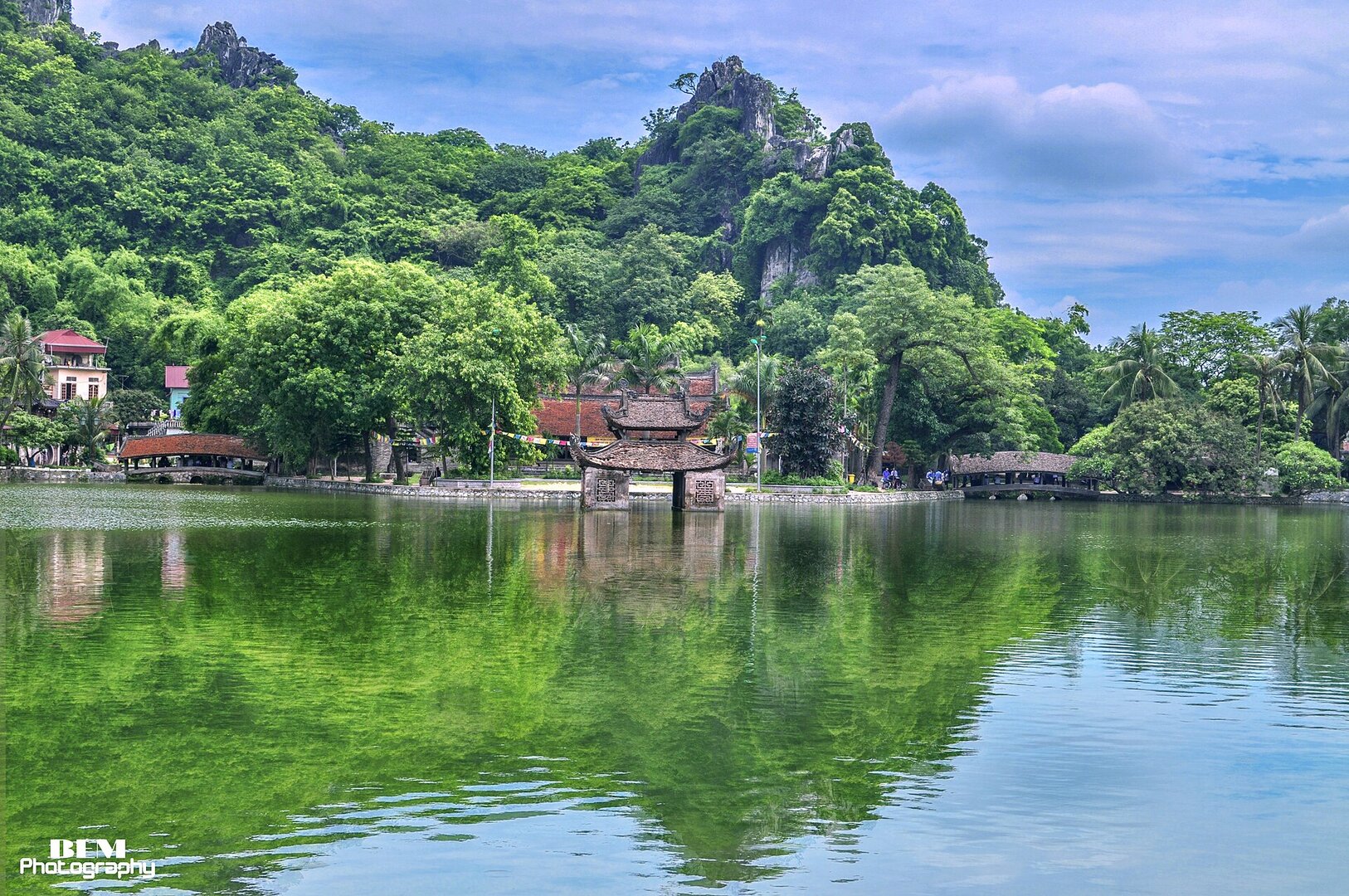
Picture a small house standing in the middle of a pond, with two tiers of roof and eight upturned eaves. If you have ever watched Vietnamese water puppetry, you already know what that house is for. And the man honoured as the patron of the puppet craft is the Zen master of the pagoda facing it.
Picture a small house standing in the middle of a pond, with two tiers of roof and eight upturned eaves, and behind it a low limestone hill full of old trees. If you have ever watched Vietnamese water puppetry — puppets performing on the surface of water — you already know what that house is for: it is a thủy đình, a water pavilion where the puppets perform. This one, in the middle of Long Trì pond, was built in the Lê dynasty, and by festival custom the puppet troupe of Ra village performs right there. The man folk tradition honours as the patron of the puppet craft is the Zen master of the pagoda facing it: Từ Đạo Hạnh.
Chùa Thầy: many eras gathered around one pond
Chùa Thầy ("chùa" means pagoda), also called chùa Cả, with the classical name Thiên Phúc tự, grew from a small hermitage into a pagoda in the Lý dynasty. The word "Thầy" — "Master" — has two explanations: Sài Sơn hill was known in the vernacular as Master's Hill; or local people called Từ Đạo Hạnh "Master", and the place where he practised took the name. His birth name was Từ Lộ, he came from Láng, and he lived in the early 12th century. Láng Pagoda is tied to his youth; Chùa Thầy saw the last part of his life. Legend says that in Thánh Hóa cave on the hill he left his body to be reborn as the son of Marquis Sùng Hiền, who later became King Lý Thần Tông. That is why folk belief sees him at once as a monk, a Buddha and a king.
Are you curious what a pagoda looks like when it honours a monk, a Buddha and a king all at once? Chùa Cả is made of three rows of halls on a raised stone-edged platform: the outer hall for offerings, the middle hall for the Buddha, and the innermost hall for Từ Đạo Hạnh, with statues depicting his three lives. His statue in the form of a saint has jointed limbs and can move. The Amitābha Triad — a set of three statues of Amitābha, Avalokiteśvara and Mahāsthāmaprāpta, carved from jackfruit wood, lacquered red and gilded, from the early 17th century — is a National Treasure. Two covered corridors run along the sides, and the last three bays of each rise into a Bell Tower and a Drum Tower.
What still lets Chùa Thầy speak to today is that it never belonged to a single era. A stone lotus pedestal carried by lions from the Lý dynasty, a pair of stone guardian creatures in the Trần style, the Lê-dynasty water pavilion, and two roofed bridges, Nhật Tiên and Nguyệt Tiên, said to have been built in the early 17th century. Đền Thượng temple on the hillside, where scholars once came to pray for exam success, was a meeting place of the Đông Kinh Nghĩa Thục movement, an early 20th-century reformist education movement. In early 1947, President Hồ Chí Minh lived and worked for about a month at chùa Một Mái, the One-Roof Pagoda within the complex. A 1968 stamp set featured the roofed bridge of Chùa Thầy. The site has been a Special National Monument, Vietnam's highest heritage ranking, since 2014, and in 2024 the Chùa Thầy festival was inscribed as national intangible cultural heritage. Each era left something around the same pond. Now it is your turn — where will you stand to look at it?
Photographs
9 of 9 on fileEnough to decide whether to go
Written by Vietlume · from the sources listed under Sources
- What it is
- A pagoda tied to Zen master Từ Đạo Hạnh; Special National Monument since 2014
- Where
- At the foot of Sài Sơn hill, Quốc Oai commune, Hà Nội
- Dates from
- A small hermitage that became a pagoda in the Lý dynasty
- Don't miss
- The water pavilion on Long Trì pond, the Nhật Tiên and Nguyệt Tiên bridges, the Amitābha Triad
- Other names
- Chùa Cả, Thiên Phúc tự
- Festival
- Early in the third lunar month
Good to know before you go
To see the water pavilion doing what it was built for, aim for the pagoda festival early in the third lunar month, when by custom the Ra village puppet troupe performs. Lovers of old architecture should give time to the two roofed bridges and the Bell and Drum Towers. If you climb the hill, Cắc Cớ cave halfway up has a narrow, dark and slippery entrance — go slowly.
Vibe
Tags
Source
Last verified 16 Sep 2026
- History
- dsvh.gov.vnhanoi.gov.vnbaotanglichsu.vn +8 · checked 16 Sep 2026
- Address & location
- hanoionline.vn · checked 16 Sep 2026
- Getting there
- scov.gov.vn · checked 16 Sep 2026
All 13 sources
- dsvh.gov.vnpublic authority
History · Name · Other details · checked 16 Sep 2026
- hanoi.gov.vnpublic authority
History · Name · Other details · checked 16 Sep 2026
- baotanglichsu.vnnewspaper
History · Other details · checked 16 Sep 2026
- scov.gov.vnpublic authority
History · Getting there · Other details · checked 16 Sep 2026
- thanhdiavietnamhoc.comwebsite
History · Other details · checked 16 Sep 2026
- Wikipediaopen encyclopedia
History · Name · Other details · checked 16 Sep 2026
- anphat.orgwebsite
History · Other details · checked 16 Sep 2026
- giacngo.vnnewspaper
History · Other details · checked 16 Sep 2026
- bvhttdl.gov.vnpublic authority
History · checked 16 Sep 2026
- daibieunhandan.vnnewspaper
History · checked 16 Sep 2026
- tapchinghiencuuphathoc.vnwebsite
History · checked 16 Sep 2026
- hanoionline.vnwebsite
Address & location · checked 16 Sep 2026
- vnpost.vnwebsite
Other details · checked 16 Sep 2026
Read the full note
Information about Chùa Thầy on this page is compiled from several layers of sources, accessed in Sep 2026. The name, monument status, the architecture of each structure (chùa Cả main pagoda, the water pavilion, Nhật Tiên and Nguyệt Tiên bridges, đền Tam Phủ shrine, the bell and drum towers, the stone crocodiles, the wooden columns of the Thánh hall) and the caves on Sài Sơn mountain come from the monument file of the Department of Cultural Heritage (dsvh.gov.vn) and the Cultural Dictionary scov.gov.vn. The ranking as a special national monument under Decision 2408/QĐ-TTg of 31 Dec 2014 is cited via Báo Giác Ngộ and the list on the xaydungchinhsach.chinhphu.vn portal. The festival was inscribed as national intangible cultural heritage by decision of the Ministry of Culture, Sports and Tourism in Feb 2024. The date 12 Apr 2024, which one magazine calls the date of recognition, is in fact the ceremony of receiving the certificate, so it is not used. The story of Từ Đạo Hạnh is cross-checked against Lê Mạnh Thát's translation of Thiền uyển tập anh. The 1109 bell inscription and the line about the Buddha's footprint at Phật Tích in An Nam chí lược follow a paper on thanhdiavietnamhoc.com. The Di Đà Tam Tôn (Amitabha Triad) statues, the 36 ancient wooden statues, the water pavilion and the puppet troupe of Ra village follow the National Museum of History. The festival rituals and the saying 'Bơi Đăm, rước Giá, hội Thầy' follow the Hà Nội Department of Culture and Sports. The address in Quốc Oai commune follows Đài Hà Nội (2 Jul 2025) and OpenStreetMap. The traces from 1947 at chùa Một Mái follow Báo Đại biểu Nhân dân. The 1968 stamp 'Cầu có mái chùa Thầy' (the covered bridge of Chùa Thầy) follows Vietnam Post. Several sources repeat each other's wording, so they count as one source: scov.gov.vn and a 2009 Giác Ngộ article; the Museum's festival article and the one by the Department of Culture and Sports. Details dropped because of insufficient sources or conflicting sources: the birth year 1072 and the rank of '24th patriarch' for Từ Đạo Hạnh (Thiền uyển tập anh gives no birth year; the death year differs between 1116 and 1117); the founding year 1057 and the story of Emperor Lý Nhân Tông rebuilding it; the year 1602 for the two bridges and the set of statues; the story of a statue that stood up by itself to greet visitors and the 'oldest wooden column' (found only on Wikipedia, with no citation); the story of the Ming army burning a corpse in 1407 (one source only); a Lý-dynasty bell still at the pagoda (a research paper records the bell being destroyed to cast coins in 1789). The date of the water pavilion differs between sources, so only 'Lê dynasty' is stated. Photos are taken from Wikimedia Commons, each with its own author and licence; three photos by Léon Busy (musée départemental Albert-Kahn) are autochrome colour photographs taken in 1914–1916, not the present-day appearance. Opening hours and tickets have no official source and are left blank.
Source-checked by Vietlume: compiled by AI from public sources, then checked against each source above before publishing.
Star ratings & comments
Anyone can read. Sign in to rate, comment and like.